Home » Jazz Articles » Live Review » Day 11 - Ottawa International Jazz Festival, July 2, 2006
Day 11 - Ottawa International Jazz Festival, July 2, 2006

The final day of the TD Canada Trust Ottawa International Jazz Festival proved a number of points: that it's possible to market almost anything to a position of prominence; that it's possible to entertain without sacrificing musicality and talent; and that sometimes the best artists are not the ones at the top of the bill.
 Canadian bassist Robert Occhipinti has long been associated with Afro-Cuban jazz, and his quintet, which opened up the festival's main stage event on its final day, clearly had the background to play with total commitment in the genre. But what makes Occhipinti stand out—in the way Paquito D'Rivera stood out early on at the festival—is that he's always been a more diverse player. One of Canada's most important musicians, Occhipinti is as comfortable on the symphony stage as he is in a (no longer smoky) jazz club. In addition to being an exceptional bassist, composer and bandleader, he's also an in-demand producer—something that was acknowledged when the National Jazz Awards chose him as Producer of the Year earlier this year.
In addition to some longtime associates and faces familiar to Canadian audiences—Toronto mainstays pianist Hilario Durán and trumpeter Kevin Turcotte, as well as Vancouver-based saxophonist Phil Dwyer—Occhipinti has also recently begun working with New York-based drummer Dafnis Prieto.
Originally from Cuba, Prieto, who still looks barely old enough to shave, is one of the hottest up-and-coming Latin drummers on the New York scene, and he's already showing a capacity for seemingly exponential growth. While there was much to recommend about his first album as a leader, About the Monks (Zoho, 2005), it seemed almost too precocious. His complex compositions were too clever for their own good, and his playing style, while clearly skilled, bordered on overkill. But in the short space between that disc and Absolute Quintet (Zoho, 2006), he's evolved considerably into not only a more balanced writer, but a more mature drummer as well. Still capable of phenomenal displays of power and polyrhythm, he's learned to breathe more in his playing, allowing more space and applying a gentler touch.
All these skills were well-applied to Occhipinti's repertoire, ranging from burning post-bop workouts to gentler ballads and pure clavé. Occhipinti's latest disc, Yemaya (Alma, 2005), is an ambitious effort that in many ways reconciles his many influences into a cogent personal statement. With a core octet augmented by additional percussion, vocals, horns and a string quartet, the recording covers a broad base of musical styles that include his own vibrant writing, a couple of compositions by bandmates Duran and Dwyer, a traditional tune, and two pieces by Brazilian composer/performer Jovino Santos-Neto—who, though he comes from the other end of the musical spectrum, shares Occhipinti's defiance of musical boundaries.
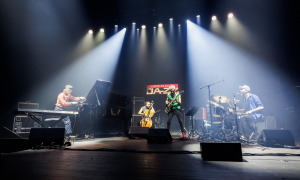
But Occhipinti's Ottawa performance on the final day of the festival proved to be a highlight. His pared down group placed more emphasis on playing, everyone got ample space to solo, and there wasn't a weak link to be found. The set list, consisting of a couple of new tunes and pieces culled from Yemaya and an earlier album, The Cusp (Modicamusic, 2003), was compositionally rich, raising the bar even higher for a festival that featured one of its strongest and most musically intrepid lineups this year.
 It's hard to pick highlights when the entire set was so strong. Every solo was clearly focused, striking the balance between abandon and control. Duran is a pianist whose reputation has been building on both sides of the border, but the sad truth is that he'd likely be a bigger name if he lived in an American jazz mecca like New York. But the same could be said for everyone in the band (with the exception of Prieto, who already lives in New York). And Canadians should be grateful that, given jazz's marginalized position in the music world, artists of this caliber choose to remain here.
At the end of a set as alive as this, the audience was looking for an encore. But singer/songwriter Sonya Kitchell and British jazz crooner Jamie Cullum were scheduled to close out the festival's main stage for the season, so Occhipinti and his group were sadly unable to comply. And that's a shame, because while Cullum and his opening act drew some of the biggest audience numbers of the festival, they were in many ways the perfect indicators of just why festivals like Ottawa's, which has resisted for so long, are being forced to incorporate artists who have a peripheral relationship with jazz at best.
Kitchell's short set would have been fine at a folk festival, but little of it linked her to jazz in any way, shape or form. The fact that her record company is touting her as "the next Norah Jones" really says it all, since Jones—as fine an artist as she absolutely is—would be the first to deny that she's a jazz singer. The most open-minded jazz fans, who are perfectly capable of acknowledging the electronica/ambient-based jazz of trumpeter Nils Petter Molvaer or Wibutee as part of the larger continuum, would find it difficult to place Kitchell anywhere in a jazz space. She has a strong voice and writes engaging and accessible tunes, but instead of expanding jazz, she ultimately dilutes it.
That goes double for Jamie Cullum, who's more a pop star than a jazz artist, and a showman who jumps around the stage (and his piano) with frenetic energy. Cullum's claim to fame is his on-stage antics—he plays the piano with most of his body parts in a standard costume that turns into a bit of a striptease as the show progresses. At the end of the day, Cullum is an average singer at best and a pianist who claims to appreciate the jazz of Herbie Hancock and Miles Davis but can't even navigate the simple changes of his own tunes, let alone the standards he attempts to contemporize.
Listeners who like what Cullum represents accuse those who don't of being purist reductionists who don't understand the need for jazz to continue growing and be contemporary enough to attract a younger audience. But there's a universe of a difference between artists like Nils Petter Molvaer, who incorporate modern technology like sampling and a turntables, and wannabes like Cullum. At one point during Cullum's show, in fact, he ran around his piano to a turntable setup and gave it a few spins, much to the delight of the crowd. Rather than lending the turntable relevance in jazz, he turned the display into a shtick that completely demeaned the strong contributions of Molvaer's turntablist, DJ Strangefruit, two evenings previous.
One might compare Cullum to a younger Harry Connick, Jr. But Connick can play, and he truly understands the tradition that he's brought into a more entertainment-oriented context. Nearly twenty years on, Connick is still selling strong and making records like last year's Occasion (Marsalis Music, 2005), which show how capable he is of performing more "serious" improvised music when he wants to. He's fashioned a career that will no doubt last a lifetime, whereas Cullum will be lucky if his half-life is five years.
What's perhaps most frustrating about the success of a pretender like Cullum is that most of his audience will walk away from last night's show thinking they've heard jazz. But as much as Cullum's publicists want to tag him as the kind of musician that jazz needs to attract younger audiences, artists like Molvaer, Wibutee and EST that are already doing that—and in a way that still fits within the larger jazz continuum. At best Cullum is an entertainer, and if he succeeds on that merit, all well and good. But a performer with any kind of improvsational prowess or working knowledge of jazz vernacular? Certainly not at this point.
The final show of the festival's eleven-day run was highly entertaining without sacrificing any musical value. Quadro Nuevo put on a thoroughly enjoyable show at the National Arts Centre's 10:30 pm Studio Series, and it might have gone on all night if the audience had had its way. It's not uncommon to see people leaving the Studio shows mid-performance, because they do run late. But between the incredible musicianship of this German quartet, its uncommon blend of musical sources (from gypsy music to tango and whiffs of Parisian coffeehouses and the streets of Morocco), and its wonderful ability to relate to an audience, tell stories and create an informal atmosphere, Quadro Nuevo gave its brand of shtick plenty of legitimacy.

The members of the quartet are all strong musicians. Andreas Hinterseher played accordion and vibrandonenon, a kind of super-sized melodica with a brass tube that he blew into. Woodwind multi-instrumentalist Mulo Francel also played the mandolenon apoletano, which looks like a strange kind of zither or dulcimer, but is played with a bow or willow rod. Quadro Nuevo is rounded out by bassist D. D. Lowka and nylon-string guitarist Robert Wolf. Each one of them is a virtuoso, but collectively they are just as impressive for their clever arrangements of songs from Italy, Brazil, Argentina, Greece, the Middle East and other places.
Francel was the main spokesperson for the quartet. Like Kiran Ahluwalia the day before, he created an instant rapport with his dry wit and self-effacing persona. At one point early in the show, a tune ended with Lowka gradually reducing a bass line to a single resonant low note. Francel asked the audience of anyone knew what note it was. After a few bad guesses, one audience member called out "F" and, guessing correctly, won a copy of the group's CD, Mocca Flor (Fine Music, 2004). When it turned out the lucky winner was a musician, Francel asked him if he had perfect pitch—and if he wanted to try another note to "double his win." The audience member declined, but a connection with the group had been made.
Quadro Nuevo's music has been described as cinematic, and there were points throughout the performance where it sounded like the score to a Woody Allen movie. Hinterseher is an exceptional accordionist—a strong accompanist and an even more energetic soloist who often doubled lines with one of Francel's many horns to create a beautiful sonority. For the most part, Lowka kept things moving underneath the rest of the quartet, although he was just as often seen using his double-bass as a percussion instrument, alternating between playing proper notes and slapping it to create his own one-man rhythm section. Wolf combines the best of classical, South American and Spanish traditions on guitar, effortlessly moving through rapid changes and building solos that lithely threaded through those changes.
 Francel was perhaps the most overt showman of the group, but he's also a strong woodwind player. On one song he began with a bass clarinet solo that combined circular breathing and other extended techniques to create a low-end drone that seemed to phase-shift, at times almost sounding like a didgeridoo. And shtick it may have been, but when he took his right shoe and sock off and proceeded to bow the mandoleno napoletano with his foot while simultaneously playing soprano saxophone, he still sounded completely musical and fit into the larger ensemble.
The capacity audience brought the group back for a lengthy encore. At nearly two hours, this was the longest performance of the series (and possibly the festival). Especially in comparison to Jamie Cullum's grandstanding, the members of Quadro Nuevo revealed they were the real entertainers, and they ended the festival on a great note.
And so, at the end of eleven days, how did the 26th Annual TD Canada Trust Ottawa International Jazz Festival stack up to previous years' events? There's no doubt that the main stage lineup was one of the weakest in recent memory—with a few exceptions, including Occhipinti, Stefon Harris, McCoy Tyner and Paquito D'Rivera. Now light on jazz, it appears that the Ottawa festival has finally been forced to succumb to the same pressures that have been diluting other jazz festivals for many years—and, in fact, the festival organizers deserve credit for managing to maintain its purity for so long.
But get away from the main stage and this was one of the strongest festivals ever. Forget about Jamie Cullum and consider the innovations of artists like Nils Petter Molvaer, Rez Abbasi, Miguel Zenon and Vijay Iyer—or the improvisational prowess of Brad Turner and Dylan van der Schyff, Yusef Lateef, Alberto Pinton, and Joost Buist Astronotes. Consider the legends, including Sonny Fortune/Rashied Ali, McCoy Tyner and Yusef Lateef. The festival may have miscalculated the draw of some artists and overestimated that of others. But the Connoissuer, Improv and Studio series sported consistently strong rosters—and even the weakest performers (few as they were) were worth seeing. From a purely artistic perspective, the 26th annual TD Canada Trust Ottawa International Jazz Festival may have actually superseded the more big name-heavy 25th Anniversary show in 2005.
Visit Roberto Occhipinti, Quadro Nuevo and the TD Canada Trust Ottawa International Jazz Festival on the web.
A special note of thanks to John R. Fowler and Brett Delmage for invaluable photographic advice. Visit their sites for more terrific photos from the 2006 TD Canada Trust Ottawa International Jazz Festival.
Photo Credit
John Kelman
Tags
PREVIOUS / NEXT
Support All About Jazz
 All About Jazz has been a pillar of jazz since 1995, championing it as an art form and, more importantly, supporting the musicians who make it. Our enduring commitment has made "AAJ" one of the most culturally important websites of its kind, read by hundreds of thousands of fans, musicians and industry figures every month.