Home » Jazz Articles » Live Review » Day 1 - Ottawa International Jazz Festival, June 22, 2006
Day 1 - Ottawa International Jazz Festival, June 22, 2006

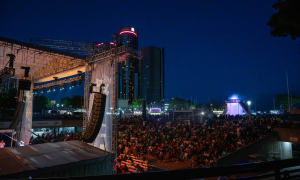
After an outstanding 25th anniversary celebration in 2005, the TD Canada Trust Ottawa International Jazz Festival's 2006 lineup raised a number of eyebrows when it was announced back in April. Last year's event sported a star-heavy and jazz-heavy lineup on the outdoor main stage at Confederation Park, including Joshua Redman, Diana Krall, David Sanchez and Terence Blanchard. This year the lack of more clearly defined jazz artists on the main stage has been criticized, including a number of undoubtedly strong but hardly jazz artists like Mavis Staples, Maceo Parker and Canada's own Bedouin Soundclash occupying the festival's largest venue.

Still, the 26th Edition has a lot to offer—one simply has to go to the other venues to find them. This year's 4 pm Connoisseur Series at the Library and Archives Canada theatre will feature artists ranging from alto saxophonist Miguel Zenón to rising star pianist Robert Glasper. The National Arts Centre Studio's 10:30 pm series includes artists as diverse as Canadian bassist Michael Bates' Outside Sources and the Swedish superstar trio EST. The 8 pm Improv Series at the Fourth Stage, after a successful first run in 2005, will host Norwegian trumpeter Nils Petter Molvaer and Canadian-based drummer Jerry Granelli's marvelous Sandhills Reunion Project, a real hit at last year's International Festival Musique Actuelle Victoriaville.
While guitarist/vocalist John Pizzarelli entertained a receptive audience at the festival's main stage, two diametrically opposed shows on the festival's first day set a high bar for the days to follow.
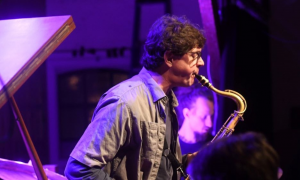
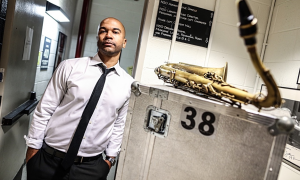
 Puerto Rican altoist Miguel Zenón opened the festival with a ninety-minute set with a heady mix of complex composition and remarkable interaction. While this was not the quartet featured on his two most recent recordings—Ceremony (Marsalis Music, 2004) and Jibaro (Marsalis Music, 2005)—it was no less impressive. The group featured rising star Edward Simon on piano, the ever-imaginative Hans Glawischnig on bass and drummer Henry Cole—a relatively recent emigrant to New York from Puerto Rico who has been in Zenón's quartet for about a year and is another young player to watch.
 With material culled from Jibaro, despite the challenge and intrinsic detail of Zenón's charts, there was still plenty of room for improvisation. Zenón opened the show with a solo saxophone spot that seemed about to burst with ideas, yet was more than a display of his inimitable prowess. While Zenón doesn't have the raw power of Kenny Garrett, he's got his own kind of energy, which is more reliant on evolving a solo from clear motifs rather than milking single notes for all they're worth. While he cued the band at various points, there were other times when the other players seemed to intuitively come together for written passages that acted as links between solos.
What's especially significant about artists emerging from Latin America in recent years is how they have managed to embrace the musical traditions of their various cultures while applying modern ideas. Rather than treating traditions as fixed and unmovable entities, artists like Zenón and Simon believe them to be living, breathing things. While Zenón's music clearly comes from his cultural background, it's hardly what one could call conventional Latin music— nor is it anywhere close to the jazz mainstream. Instead, it's a curious hybrid that bears comparison, at least conceptually, to the cerebral approach of saxophone legend Wayne Shorter. Like Shorter, Zenón makes intense demands on his players—something clear during the sound check, when Simon was seen to be working hard at getting a particularly difficult phrase down for the show.
One thing is for sure: if Simon is finding Zenón's music tough, then it's really tough. Over the course of his own growing discography and collaborations with artists including alto saxophonist David Binney and trumpeter Diego Urcola, Simon has been building a reputation as an improviser who's versed in the language of jazz, but equally informed by a certain classical impressionism. Like Zenón, he often starts his solos with the simplest of motifs but manages to take these spare ideas and build them into larger explorations that are spontaneously compositional in their scope.
Glawischnig—using a borrowed bass from Ottawa's John Geggie—combines navigating Zenón's oftentimes episodic charts with a firm yet responsive anchor that let's everyone else take greater liberties. Though he soloed rarely, he demonstrated a wonderful blend of deep tone and vivid lyricism when he did. He worked hand in glove with Cole, who is a remarkably dynamic drummer and, during his own solo spots, a melodic one as well. Almost as impressive was the fact that he didn't require charts to make it through Zenón's complex compositions.

Given the strength of the individual players in Zenón's quartet and the impressive way they make it through his intellectual compositions, what was perhaps most extraordinary was their high level of interaction. There were times when the group would be so in sync during a solo that it was impossible to know just who was leading whom—or whether everyone was truly traveling the same path in tandem.
Zenón may be almost too intelligent for his own good. In the press release for Jibaro he said, "Given my tendency to sometimes write music that is too difficult to play, I was sensitive to bringing the music to the point where it was difficult, but not impossible. He treads a fine line, but the end result is music that challenges the audience as much as the musicians. Yet the set was ultimately engaging and was clearly appreciated by a capacity turnout.
Contrasting Zenón's more detailed approach, Canadian clarinetist Phil Nimmons and pianist David Braid, touring behind their recent live album of all-improvised music, Beginnings, put on a show that relied completely on their ability to pull music out of the ether. Like the recording—which was, surprisingly, recorded live to a minidisc recorder through a single stereo microphone—Nimmons and Braid demonstrated that when there's a deep connection it's possible to make music that may not have any ground rules up front, but ends up sounding as if it was intended all along.
 What Beginnings didn't reflect is the duo's relaxed delivery in live performance. This was not a "serious evening of free improvisation, à la Keith Jarrett. Instead, Nimmons—at 83 one of Canada's true jazz institutions—told the audience that, for this cross-country tour, the festivals were instructed that they would only play small venues where they could operate entirely acoustically. Other than a microphone hooked up to Nimmons' trusty minidisc recorder (they're recording all their shows with the hopes of releasing a followup to Beginnings with the best performances from the tour), there wasn't another one to be found. Even when Nimmons and Braid spoke to the audience, it was without the aid of the PA system.
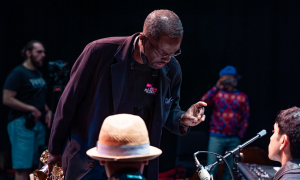
 Nimmons, in fact, told the members of the audience that he wanted the performance to be as if they were in his living room. the affable and quick-witted player encouraged the audience to participate in the performance by asking questions throughout. Some artists project so much aloofness that even if they encouraged this kind of interaction, they wouldn't get it. But Nimmons managed to get the audience so involved that there may well have been as much discussion as music, making it a truly unique experience.
And while Nimmons is an elderly gentleman, what's perhaps most remarkable about him is how he still views music as something that isn't standing still. Completely unaffected, he's like a musical sponge and clearly has incredibly broad listening tastes. While other artists his age might coast on stylistic laurels, Nimmons believes there's always something new to learn. Braid, nearly 53 years Nimmons' junior, might be expected to be the subordinate here, but it's clear that the respect is clearly mutual—as does the desire to learn from one another.
Braid has achieved considerable success in Canada, when you consider that he only came to jazz piano a little more than a decade ago. His own sextet's Vivid: The David Braid Sextet Live made it clear that not only is he a pianist rapidly rising to the top of the Canadian jazz scene, but a distinctive contemporary writer as well. This year's Mnenomsyne's March, his cooperative group with saxophonist Mike Murley, offered further evidence.

But in the intimate setting of duets with Nimmons, Braid's reach is clear. Both Nimmons and Braid have classical backgrounds. Nimmons has lived through almost every development in jazz, but Braid is hardly a stranger to its history, either. During the performance Braid demonstrated that he is as in touch with Fats Waller's stride as Keith Jarrett's more abstract impressionism.
While Nimmons would typically provide the starting point for their improvisations, Braid's ability to hear a single phrase—sometimes a single note—and immediately jump in to begin creating form was consistently revealing. And while they were as often as not exploring more abstruse ideas, they were rarely, if ever, anything but completely accessible. The blues figured deeply during a couple of improvisations, but Nimmons and Braid were equally cooperative with one audience member's request to approach a piece from a more classical aesthetic.
Perhaps the most important lesson the audience walked away with is that music is really one big continuum, and artists like Nimmons and Braid simply don't see stylistic delineations. When one audience member asked Nimmons if they'd be playing any standards, Nimmons' response was "no, we'll be making our own. The perfect response.
The Zenón and Nimmons/Braid performances set different but equally high standards for this year's festival. There will no doubt be many other fine performances during the festival's eleven-day run, but these two will be tough to beat.
Visit Miguel Zenón, David Braid and the TD Canada Trust Ottawa International Jazz Festival on the web.
Photo Credit
John Kelman
Tags
PREVIOUS / NEXT

Become a Sustaining Member

Since 1995, All About Jazz has championed jazz as an art form and supported the musicians who create it. Over three decades, it has grown into one of the world's leading jazz resources, serving hundreds of thousands of readers, musicians, presenters and industry professionals each month.
Help Build the Future of All About Jazz
Your support helps us continue building All About Jazz for the next generation—expanding our editorial coverage, preserving jazz history, developing new community features and creating better ways to discover the music and the people behind it.
Become a sustaining member for as little as $20 per year and you'll immediately enjoy an ad-free experience along with access to subscriber features and future articles for a full year.
Together, we're not simply sustaining All About Jazz—we're building its future. Thank you for being part of the journey.