Home » Jazz Articles » Book Review » Harlem of the West: The San Francisco Fillmore Jazz Era
Harlem of the West: The San Francisco Fillmore Jazz Era

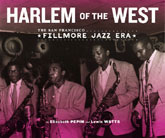 Harlem of the West: The San Francisco Fillmore Jazz Era
 Elizabeth Pepin and Lewis Watts
200 B/W photographs
ISBN 0811845486
Chronicle Books
2006
Harlem of the West is a charming, violet-hued paperback that digs deeply into one of America's most endangered jazz legacies. Long before it gained a new reputation in the hippie era, the Fillmore neighborhood west of San Francisco's City Hall was the site of the "other West Coast jazz boom. The title is apt; there were indeed a number of parallels between the Fillmore and Harlem. An expansive Jewish neighborhood at the 20th Century's turn, by the 1930s it had become a true melting pot of African-Americans, Jews, Japanese, Russians and other immigrants. With that transition came the cultural elements of the newcomers, including jazz. After World War II the Fillmore became the city's primary center of black culture, and jazz was its heartbeat.
The book includes interview clips from dozens of performers, Fillmore residents, and political figures like former mayor Willie Brown, all reflecting upon the area's heyday as the place to go for good jazz and blues. Scores of rare photographs waft away the haze of time to reveal the very soul of the Fillmore. Artists that the general jazz reader would consider familiar (Dexter, Billie, Hamp, Mingus, John Handy, Sonny Clark, Teddy Edwards, Jerome Richardson), middling (Leo Wright, Pony Poindexter, Sugar Pie DeSanto) and obscure (Frank Jackson, Johnnie Ingram, Earl Grant) are discussed and depicted in the context of Fillmore nightlife and society.
Of particular interest are the sections dedicated to memories of the individual clubs that made up the Fillmore scene: Jack's Tavern, the Club Alabam, the New Orleans Swing Club, Texas Playhouse (later Club Flamingo), the Blue Mirror, Bop City, and the legendary Fillmore Auditorium, which Bill Graham turned into a hippie haven in 1965. The book's illustrations include ticket stubs, concert flyers, fan snapshots, promo photos and historical images. Only a few flaws are noticeable, and those are chiefly misspellings of some prominent names: "Ornette Cobb, Sarah "Vaughn , Carmen "McCrae . Sometimes the reminiscences are intriguingly worded. John Handy recalls that "Addison Farmer lived there, and his twin brother, who was a trumpet player. That would be Art Farmer, whose worldwide fame eclipsed his bassist brother's long, long ago!
The last section gives a heart-rending account of the city's failure to preserve the Fillmore's heritage in the wake of redevelopment. Most of the buildings discussed have been destroyed, a small handful relocated. Jack's Tavern is the only historical jazz club still operating in the Fillmore, and even its original locale is gone. The Bop City building houses an African-American bookstore, maintaining the culture in a different fashion. Pepin and Watts make a good case for sound preservation tactics, presenting the Fillmore's demise as an example of progress gone wrong.
All in all, Harlem of the West is a fascinating read for general jazz fans, and especially West Coasters. Exceptionally well put-together, with an abundance of great photos and remembrances, this book comes highly recommended.
< Previous
Leaving New York
Next >
Mercernary
Comments
Tags
For the Love of Jazz
 All About Jazz has been a pillar of jazz since 1995, championing it as an art form and, more importantly, supporting the musicians who create it. Our enduring commitment has made "AAJ" one of the most culturally important websites of its kind, read by hundreds of thousands of fans, musicians and industry figures every month.
You Can Help
To expand our coverage even further and develop new means to foster jazz discovery and connectivity we need your help. You can become a sustaining member for a modest $20 and in return, we'll immediately hide those pesky ads plus provide access to future articles for a full year. This winning combination will vastly improve your AAJ experience and allow us to vigorously build on the pioneering work we first started in 1995. So enjoy an ad-free AAJ experience and help us remain a positive beacon for jazz by making a donation today.Near


Giveaway

Days remaining: 7