Home » Jazz Articles » Profile » Benny Green: Teaching Jazz to the Next Generation
Benny Green: Teaching Jazz to the Next Generation

Everything you play underneath should support the melody -- or don't play it.
—Benny Green
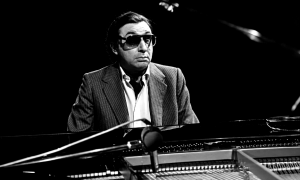
 After exhibiting great potential as a young pianist during his teens on the San Francisco jazz scene, Benny Green, long regarded as one of the most promising wunderkinds of jazz piano, spent his twenties serving apprenticeships with a virtual pantheon of musical giants. During his thirties, Green fulfilled his early promise, making the transition from sideman to a headline act in his own right. Now, in a small college auditorium in Des Moines, the student had become Zen master, and he was teaching a group of rapt young musicians about respect for the music, keeping jazz traditions alive, and playing fewer notes.
 A hard-swinging hard-bop stylist in the mold of Bud Powell, Green, 43, is a native of Berkeley, California. Although he began studying classical piano at age 7, by the time he had turned 12 he was playing jazz. His father, an amateur saxophonist, encouraged him to listen to vintage records by such figures as Powell, Art Tatum and Thelonius Monk.
After moving to New York City in '83, he spent the next decade playing with a veritable who's-who of veteran jazz artists, including Betty Carter, Art Blakey, Freddie Hubbard and Ray Brown. Through Brown, Green met piano giant Oscar Peterson, who became something of a mentor to him. In '93, when Peterson became only the third person to be awarded Canada's prestigious Glen Gould Prize, he was asked to name a young musician of great promise. Green was Peterson's choice for this prize, and in '98 the two recorded a stellar CD, Oscar and Benny, with Brown on bass and Gregory Hutchinson on drums.
It was with Hubbard that Green met bassist Christian McBride, with whom he was to start a trio culminating in the '94 Telarc Jazz recording Naturally, featuring McBride and guitarist Russell Malone. That CD was followed Green's Blues, a highly acclaimed solo offering, and a spectacular duo recording with Malone, Live at the Bistro, in '03.
On this occasion, Green had been brought to Des Moines ("for the first time," according to him) by Drake University, a private liberal arts college with a very strong music education program. Among Drake's cultural offerings is a 75-year-old "Civic Music Program." The program's directors stress that sponsoring performances by top-notch musical talent is only one element of its mission, part of a three-pronged combination that also includes community outreach and education.
Other nationally-known artists participating in the program have played at community centers and senior homes in the Des Moines area, and one musician recently performed music for newborns at a local hospital maternity ward. For his part, Green had been asked to conduct a master class for aspiring jazz musicians in which he would listen to several young performers and offer critiques. Two combos and two solo pianists were slated to participate.
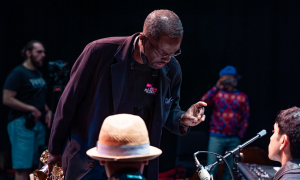
Although Green has a self-effacing, puckish manner, he was not shy about offering criticisms and suggestions. And like a yoga master citing time-honored wisdom, he did it in spiritual terms, invoking the authority of some of the most revered names in the jazz world, stressing the need to move beyond ego and serve the music.
The first combo, a sextet of college-age guys in baggy cargo pants and sneakers, played an energetic rendition of Wayne Shorter's "Black Nile" with strong solos on tenor and soprano sax and guitar. (The pianist, primarily a saxaphonist who "just sits in," did not solo). Overall, they were a serious, talented group who did a lot of things right. However, Benny, sitting in the front row of the auditorium taking notes, didn't seem quite as enamored as the rest of the audience. Of course, like any good teacher, he began by pointing to the positives. "Your basic harmonic sense is good," he said, "You've got good feel and time, and good material," mentioning his own enjoyment of Shorter.
Before beginning his critique, he teased the bassist about his high-tech instrument, a minimalist electronic upright — essentially, a fretboard on a tripod. Green, ever the traditionalist, made it clear he felt the acoustic upright bass was the only proper instrument for jazz and asked the young player about his choice of instruments. When the bassist mentioned its light weight and portability, Green would have none of it. "You're a big guy," he said, shaking his head with a smile.
"I thought the bridge was kind of nebulous; it didn't really have cohesion," he then observed. "I'd like to see you take the tempo just a little slower, like this," demonstrating by snapping his fingers, "and really bring out some dynamics going into the bridge, add some contour. Are you familiar with the original recording?" Green asked the drummer. Hearing a rather uncertain "uh-hmn" in reply, Green laughed. "I didn't like that 'uh-hmn.' You have to listen to the original recordings — it's a matter of learning the vocabulary. Art Blakey was always preaching the importance of that; he would tell young players, 'Don't cut corners — that's how the music gets watered down.'" After the class, Green underlined the point. "It just takes a couple of clicks on the Internet to download a tune," he insisted. "There's no excuse."
As might be expected at such an event, the audience that afternoon was largely comprised of supportive teachers, family members, and friends. This had not escaped Green, who constantly preached audience awareness to the aspiring musicians. "If you want people besides your friends and family to listen to you, you have to make it a pleasing experience for them. Otherwise, it won't be fun, they'll go see what's on MTV, and you guys won't be able to work as musicians."
With both combos, Green's basic jazz pedagogy hinged on three main points: getting the drummer to be less obtrusive, getting the front line players to take shorter solos, and stressing the supremacy of the melody. Green's classroom session borrowed much from the Bauhaus School: in his book, less is definitely more. He did not mince words when describing over-long solos, which he considers off-putting to a contemporary audience with a sometimes-fickle attention span. "I don't care how great a musician you are or how famous you are," he said, "after a certain point, young people are going to start looking at their watches and thinking about the end of the song, what's on TV. We have to coax young people into jazz by making it a pleasurable experience for them, so that it doesn't die out with the old people."
Green criticized what he described as a lack of contour throughout the song. "It was just this wall of sound right from start. The cymbals were washing everything out, especially during the guitar solo. If you can't hear every note everyone else in the band is playing, you're either playing too loud or playing too many notes — I guarantee it. Play what you feel like, but try to make it colorful. It makes the other people in the band want to play better when the pianist isn't pounding, and you leave each other space to do things."
Referencing Art Blakey, whom he calls a "prophet for jazz," Green challenged the drummer to be more creative and nuanced. "He [Blakey] was so good at those dynamic shifts," Green explained. "He would bring it up during a transition and then drop it down — it really catapulted the soloist forward." Green pointed out that the auditorium was big, with a high ceiling, several windows and hard wall surfaces, and he lectured the drummer about the need to scout a room's acoustics prior to any performance. Then, directing his remarks to the entire band, he invoked Betty Carter, considered by many to be today's preeminent female vocalist. "She used say that everything you play underneath should support the melody — or don't play it. That's what I'd like to hear you guys doing."
Green focused his attention on the pianist, a reserved young fellow who had contributed some tastefully understated comping, and proceeded to give him the Melody Lecture. "The most important thing in any song is the melody," Green declared. Picking up the pianist's sheet music, he asked, "Now, the way you're reading this chart, it's pretty much you're playing the chord changes and letting the horn players worry about the melody, right?" Receiving a more-or-less affirmative nod, Green continued. "What I want to hear is you serving the song: either support the melody or don't play, OK?"
He picked out the song's spare melody with one finger. "Beautiful, isn't it?" he asked rhetorically. "You take that and go any way you want with it, play it the old way, do something new, but you should always support that melody." Green then demonstrated, playing block chords voiced with the melody on top that also matched the melody rhythmically, instantly making it more vivid. Not coincidentally, it also drew a stronger, more assertive sound from the piano, the only instrument in the band (besides the drums) operating without the benefit of electronic amplification.
Green then had the group play the song again, with the length of solos cut in half. "Charlie Parker used to say that if it hasn't happened by the second chorus, it's not gonna happen," said Green. Many present, both on stage and in the audience, raised their eyebrows and nodded respectfully in acknowledgment of this often-forgotten truth.
The soprano player, evidently the de facto bandleader, had absorbed Green's suggestions. During take two of the song, he used his horn like a conductor's baton, reminding his somewhat overactive drummer to make appropriate drops in volume when playing the bridge, giving a stronger sense of contrast. The solos this time were comparatively short and sweet, with a sense of something left in reserve, rather than the exhaustive explorations of the first rendition. The melody was indeed much more vividly present, and the band seemed to be listening to each other more. Green noted a greatly enhanced sense of ensemble cohesiveness. "He sure lets you know when he doesn't like something," said the tenor player about the session afterward, shaking his head and adding with a smile, "But, hey — that's what you want in a teacher, right?"
The second ensemble Green audited was a septet with three horns that played Ellington's "Take the 'A' Train." Among other things, Green mildly criticized one of the trumpeters for his stage presence during someone else's solo. "It doesn't look to the audience like you're showing respect to the music and the other people in the band. I know you do, but the body language wasn't working for me. Give it your all or don't do it. It isn't a virtuosity thing; it's about humility."
Once again, he stressed the need for young jazz musicians to be well-acquainted with the original recordings. "Don't skip listening to them — that's how the music gets watered down," Green said. He then repeated his objections to lengthy solos taken by the front-liners. "Lots and lots of notes," he said disapprovingly. "After a while, it just becomes rude and self-indulgent. We want to make it a pleasing experience for the listener, and we don't do that by boring them. When people know you're going to be taking long solos, they start to lose interest. When they know you're just going to be playing a little bit, they pay more attention."
Working on the section in which the rhythm section players "trade fours," Green urged them to punctuate the starts and stops more cleanly. The same point was made about the classic unaccompanied two-bar introduction frequently used to begin a solo. "Right there — the break — that's the essence of jazz, right there," he said, insisting that it should be crisp and distinct.
When coaching both combos' pianists, Green used a light touch, preferring to look over their shoulders and make suggestions rather than take over the chair. However, when he did lean in and play a few chords during this ensemble's second take, it seemed as if he was trying to demonstrate to both keyboardists that "supporting the melody" did not necessarily mean being demure and retiring. Both of the combos' young pianists were using polite, close-handed chord voicings. Green showed them (among other things) how leaving more spread between the left and right hands can create livelier, brighter chords that don't get overwhelmed by the collective decibels of an ensemble with multiple horns and amplified instruments, especially in the forte passages.
Throughout the afternoon class, Green demonstrated great tact and sensitivity in the often-tricky business of constructive criticism and adolescent egos. It was the second band which perhaps presented Green with the afternoon's single biggest teaching challenge, namely, a very young drummer to whom he gave a great deal of attention both during the class and afterwards, as well.
The 12-year-old budding percussionist was being coached along by the bassist, an adult teacher filling in for the regular player. He wasn't very responsive when Green, on the second take of the song, urged him with stage whispers and pantomime to quiet down and switch to brushes. It did not seem as if the youngster was equipped to make that particular adjustment on the fly; his face reddened, and he started to look flustered. Green cut the song, and he spoke gently and earnestly to the drummer about constructive criticism, taking suggestions, and the harsh fact that not all older musicians are going to show much respect to a younger player. "Don't even bother with those people," advised Green. "Stay with your base, your family, teachers, friends; you don't need to play with guys like that."
"It's not about me or my ego, or who's famous or any of that," continued Green. "It's about serving the music, and making it a pleasing experience for the listener. Look, I'm a nice guy," he said to the drummer, "but not everyone else is," and the tactful manner in which Green spoke to the youngster confirmed what he was saying. It seemed as if Green hadn't forgotten what it was like to be an adolescent trying to keep up with older players, and a comment he made later that evening confirmed this impression. "I just wanted to say some of the things to him that nobody said to me when I was that age," he said, discussing the class in his hotel lobby before that evening's performance. Green spent some time chatting with the youngster after class as well, and he autographed his copy of "The Real Book."
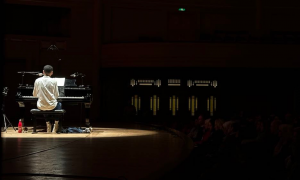
The final participant in the master class was a 14-year-old piano soloist who made a brave effort with a moderately challenging ragtime composition titled "Boogie All the Way." While giving him some one-on-one coaching, Green showed he was not hesitant to speak bluntly to the audience, as well, when he felt that they weren't displaying proper respect toward the musical process.
There had been several small glitches in the tempo, which drew Green's immediate attention to two fundamental problems involving fingering. The song's basic melodic motif was an five-note ascending figure, a roll from thumb to little finger, repeated four times down the keyboard. However, the young man was rolling his thumb under to play the fifth note, throwing up his elbow and making a smooth transition to the left difficult. Aggravating the situation, as Green noted, the young man was flattening his ring finger while he made this counterproductive roll. Although playing with flattened hands and using the pads of the fingers rather than the tips may have worked for Thelonius Monk, it was only making things awkward for this particular player.
Green pulled up another bench, sidled next to him, and demonstrated, pointing to the small numeral "5" above the treble clef on the sheet music. "Keep your hand rounded, this this," demonstrated Green, his hand poised over the keyboard, holding the classic imaginary tennis ball. Then, he played the full melody, with four smooth rolls. "See how much easier that is? That's why they wrote the fingering like that." Green played the figure slowly. "Once you've gotten that thing smooth, then it's nothing to speed it up," he said, repeating the figure over and over, playing it a little faster each time. Green had the student try it a few times, at a very deliberate pace, getting used to the new fingering.
Green looked over his shoulder at the audience. Unfortunately, those in the auditorium were paying something other than full attention. In fairness, by that point, the class had lasted nearly two hours: most in the gallery had seen their particular youngster(s) perform and were now beginning to chat among themselves. Green saw that it wasn't just young people's attention span that required coaxing. "I'm sorry, we're getting kind of technical here," he said apologetically, "but it's a pianist kind of thing we've got to work on here."
 He had begun to talk about the other difficulty the young pianist had created for himself, in Green's view, by attempting full tempo before mastering all of the notes at a slower speed. Like countless piano teachers before him, Green broke out a metronome and directed his student to play the song at half-speed. "You need to find a comfortable practice tempo. Look, you have to have patience and honesty: patience to get to where you want to be, and honesty to admit to yourself what you have to do to get there."
Under questioning by Green, the young ragtime artist revealed that he was unacquainted with metronomes. This led Green to procure a nearby electronic version, as well as a small notebook from his duffel bag, which he placed next to the sheet music. "What we want to do is keep a record of your progress, and the metronome helps do that. You keep track of your speed in your notebook, and bring it up little by little" He fiddled with the device, setting it to half that called for by the sheet music. "Now, try playing it nice and slow, like that," he instructed, moving a hand back and forth. "Think about your fingering, and just take your time, real easy."
At this point, regrettably, the murmurings in the gallery had gotten louder, as most of the young musicians had joined their family and friends and were discussing the afternoon's proceeding. This irritated Green, who is known in the music business as a gentle spirit with nothing temperamental or arrogant about him. However, he displayed some genuine pique when he stopped the pianist and spoke sharply to those creating the low-level disruption.
Green has doubtless played in many more nightclubs than auditoriums during his already-lengthy career. Loud conversations and the clinking of glasses — even during quiet ballads and soft interludes — are facts of life for working jazz musicians like him. However, as he was quick to point out, this was a master class for serious-minded young musicians, not an entertainment venue. "Hey, this young man is up here, trying to learn about jazz and become a better player, and it's not fair to him. This is all about the music here, and there should be some respect for the process." Chastened, the audience and gallery quieted down, and Green continued on with his student.
The incident, understandably, didn't do much to relax the young pianist. When he tried to put the song back together again for Green, he did indeed concentrate on the new fingering; however, he also seemed irresistibly drawn back to a faster speed — complete with glitches. "Hey, what happened to that nice slow tempo we were going to have?" said Green with a smile, putting a hand on his shoulder. "I'd really recommend that you go out and get one of these," he said, indicating the metronome and added, "if you can afford one, that is." The youngster indicated he could handle the expenditure and was willing to follow Green's game plan, and both agreed that the day's lesson had reached a logical conclusion.
With that, Green brought the class to a close, requesting a round of applause for all the participants and giving out some last words of sage advice and encouragement. "It doesn't matter what you play," he told them, "as long as you mean it."
Photo Credit
B&W by Ron Hudson
About Benny Green

Tags
PREVIOUS / NEXT
Benny Green Concerts
Become a Sustaining Member

Since 1995, All About Jazz has championed jazz as an art form and supported the musicians who create it. Over three decades, it has grown into one of the world's leading jazz resources, serving hundreds of thousands of readers, musicians, presenters and industry professionals each month.
Help Build the Future of All About Jazz
Your support helps us continue building All About Jazz for the next generation—expanding our editorial coverage, preserving jazz history, developing new community features and creating better ways to discover the music and the people behind it.
Become a sustaining member for as little as $20 per year and you'll immediately enjoy an ad-free experience along with access to subscriber features and future articles for a full year.
Together, we're not simply sustaining All About Jazz—we're building its future. Thank you for being part of the journey.