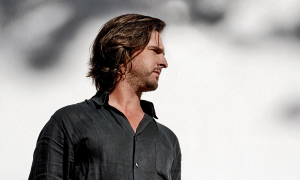
Home » Jazz Articles » Interview » Joe Locke: On the Ascension, Part 1-2
Joe Locke: On the Ascension, Part 1-2

While vibraphonist Joe Locke has been on the scene for over twenty years, it is only in the past half decade or so that his name has begun to reach a broader audience. This is in no small part due to his participation in two seminal groups: British reed player Tim Garland's Storms/Nocturnes Trio, which also features pianist Geoff Keezer and, perhaps most importantly, Locke's current group project, 4 Walls of Freedom, which has released two albums in the past three years to great critical acclaim, and has experienced its share of emotional upheaval in its short life, with the tragic death of original saxophonist Bob Berg.
With these two projects Locke has completely transcended his past reputation as a fine post bop instrumentalist, demonstrating a more complete musical picture that includes everything from melodic chamber jazz to intensely personal compositions that bridge the gap between post bop and a more lyrical contemporary style. But the road to where he is today has been a long one, paved with many great experiences and associations.
Part one of a two-part interview examines Locke's roots, and what has contributed to his becoming an emergent musical force. Part two will cover the Storms/Nocturnes Trio and 4 Walls of Freedom band.
Beginnings
While Locke didn't exactly come from a musical family, music was definitely a part of his upbringing. "That's been misinterpreted a lot," says Locke. "A lot of people say my father was a classical music professor, but he was a classics professor, he was a scholar on ancient Latin and Greek literature. My brother played some acoustic guitar, but didn't go on to a career in professional music. And my mother plays; she was the product of a Boston Catholic education, and part of that was you learned to speak Latin and French, and you learned how to read music at the piano. So although she didn't have a musical nature per se, she could sight read."At the age of seven or eight," Locke continues, "I got interested in the drums. I remember going to the Bloods and Sacraments School in Rochester, and had drum lessons with Sister Sylvia, who was about eighty years old. She'd learn the lessons of every instrument the night before, and then teach the kids the next day. I took lessons on my little red sparkle snare drum, and went from there to getting a drum set. When my mother saw I was getting more interested in the drums and more serious about it, she said, 'If you're going to play the drums you have to take piano lessons, because rhythm is only part of the equation, and you need to learn your notes and you need to learn how to read music.' So she gave me piano lessons every Sunday morning, and by and large it would end in a fight, but by osmosis some of it started sinking in, and by the time I got to be twelve or thirteen, and found the vibraphone, I already had some grounding in drums and piano, and the vibraphone is right in the middle of the two instruments.
"It's a funny thing," continues Locke, "I wanted to play a melodic instrument, but I didn't want to become a pianist. I still considered myself a percussionist, but I wanted to play melody. There was a girl in my neighbourhood, her name was Wendy Lipson, she was a friend of my sister Bea who is six years older than me, and she was very hip and had an important part in my becoming a musician. I remember going to her house and listening to Thelonious Monk's Underground, and John Coltrane and Johnny Hartman, and I think the first vibes record that I ever heard, a Mike Manieri album called Journey Through an Electronic Tube. I remember hearing this stuff at Wendy's house when I was eight or nine years old. And her dad, Joe Lipson, he used to play vibes. One day she said, 'Do you want to see something?' and she took me up to her attic and her dad's vibraphone was there, it was the first time I saw the instrument.
"So one day my mom saw an advertisement in the Want Ads," Locke concludes, "for a Jenco vibraphone for two hundred dollars, and we went and got it. I was twelve at the time, and I basically left it in my room for a year, and didn't know what to do with it. I threw dirty clothes on it, books, and then one day I cleared off the books and clothes and started playing, and literally never stopped."
While Locke had some formal music training, he is completely self-taught on the vibraphone. "I translated piano to vibes," explains Locke, "and that's what I still do. I got to take lessons with some wonderful teachers at the Preparatory Department of the Eastman School of Music. I remember taking orchestral snare drum, and as I entered high school and got more serious, I remember part of my percussion studies involved working out of the Morris Goldenberg book for xylophone, marimba and orchestral bells, working on etudes and taking some lessons in classical mallet playing, but that was the extent of it. I didn't get heavily into classical mallet playing. I was getting more and more into jazz and basically just learning. I studied improvisation with a brilliant pianist, Phil Markowitz; in the '70s he was a senior at the Eastman School and I was a thirteen year old, so he was my teacher, getting me into chord-scale relationships and playing over changes, which was a big help. Those studies taught me how to teach myself, so I got to the point where I could transcribe solos off records and figure out what they meant.
"When Phil left Eastman," continues Locke, " I studied with Bill Dobbins, who is an incredible musician and educator, and we did some more work with me transcribing solos, opening my ears up by transcribing some Hank Mobley, Coltrane, Milt Jackson and Bobby Hutcherson solos. I started to learn how to learn and I took it from there and have been self-taught ever since, but as a vibes player I've never studied with anyone."
Early Influences
While Milt Jackson and Bobby Hutcherson were to be the players Locke modeled himself after the most, his influences were broader and, to some extent, surprising. "I remember really loving Gary Burton," Locke says, "although he didn't become a major influence on my playing. And someone else who I think I've gotten a lot from is Mike Manieri, who is just a wonderful player. I've never transcribed him, but I always got a lot out of his playing, and I think I just internalized some aspects of his work, so he's someone I always like to acknowledge. There's just a way Mike plays that seems to bridge a generational thing for me; there were certain licks that were very identifiable Mike things that I heard easily and could incorporate into my playing in a very natural way. I didn't really have to study them hard, they were just so musical, and there was so much clarity that I could translate them easily to myself. Mike is one of the true giants of the instrument and of the music. I don't only admire and respect him as a vibraphonist, I admire him as a pioneer in a lot of areas. He was at the forefront of the fusion movement with the White Elephant Big Band, Steps and other groups, and as a person and a creative artist I really admire him."But as a vibes player," Locke continues, "for the language, I spent a lot of time listening to Coltrane, especially the early "60s stuff, trying to take some of the ideas he had and some of the harmonic devices he was using around that time, superimposing them over standard forms. I was influenced a lot by the album Crescent, I remember copping as much of that language as I could and translating it to the vibes. It's really interesting because a lot of this stuff is really applicable to the vibes, and it opened me up to some interesting possibilities, that the notes you play over certain chord progressions didn't have to be so locked into what was right and wrong. So I got a lot of mileage and inspiration, as countless of us did, from listening to Trane. And, of course, like a lot of people of my generation I was influenced by people like Herbie Hancock, Wayne Shorter and Joe Henderson."
Moving to New York
In the early "80s Locke made the big leap and relocated to New York City which, at the time, was a hot bed for both established players and a whole new generation of musicians. "The amazing thing about moving the New York," Locke explains, "was the young guys moving there at the same time as myself, how gifted they were and how I realized I had a whole lot of homework to do. People like Brian Lynch, Jim Snidero, Marvin 'Smitty' Smith and Jeff 'Tain' Watts. It was around that time that Branford Marsalis was starting to break into the scene. And the list goes on and on."I thought that I would be moving to New York," continues Locke, "to hear the great musicians who were my heroes, like Dexter Gordon, Michael Brecker, Sonny Rollins and Freddie Hubbard, but I got just as much inspiration from guys my age who were letting me know that the time that I was practicing " or not practicing more to the point " they were at home getting it together and that I'd better step up to the plate. So that was really inspiring."
While sitting in with more established names at the clubs was de rigueur, it was much more difficult as a vibes player to break into jazz circles. "It's pretty hard to carry your axe around," says Locke, "and say, "can I sit in, can I set up my vibes and play one tune with you?' So it was a very slow road. I think at the time that I moved to New York, in the post bop scene I was in, the real hardcore straight-ahead scene, the vibraphone had lost a lot of its credibility. There weren't people around who were really pursuing that kind of language on the instrument. There were people like Dave Friedman and David Samuels, who I hold in very high regard, but they were doing a very different thing, and I think at the time, that there was a large gap between Bobby Hutcherson being around and laying down all this incredible music, and the time that people like myself and Steve Nelson eventually came along."
Still, perseverance and making connections resulted in Locke getting more and more work. "There were people who were very helpful to me when I first moved to New York," explains Locke. "One of them was Jerome Hunter, a bassist from Philadelphia who started calling me; I did a lot of gigs with Jerome, Byard Lancaster and J.R. Mitchell, a lot of interesting people from Philly that I used to go down and work with. At the same time I remember doing some playing with Calvin Hill and, in particular, Bob Moses, who was very helpful to me, very vocal in telling people about me and very supportive.
"But, if it's not too bold of me to say," continues Locke, "people like myself and Steve Nelson gave the vibes back some of its credibility, people started to dig the instrument again, and it started to feel like it didn't die with Milt Jackson and Bobby Hutcherson, that there were guys who were really swinging on the instrument and playing the language of the art form on a high level. And what's very heartening now, is that I see that happening a lot more after this quiet period of the '70s and '80s. I'm seeing young players come up under me that are even younger than Stefon Harris; people like Tim Collins, who is a former student of mine, who is playing really well.
"I think what it really comes down to these days," concludes Locke, "is that there are so many people on other instruments who are playing profound music. There's a whole younger generation of musicians coming up who are already established, like Seamus Blake, Chris Potter, Kevin Hays and Kurt Rosenwinkel; the music is being played on such a high level that vibes players who want to be involved in the music had better be taking it seriously."
Steeplechase and Some Early Connections
While Locke began to build a reputation through the '80s, it was only in the '90s that he began to cultivate a solo career, first through an association with Steeplechase Records. "I'd have to start off by saying that my association with Steeplechase sprang from my relationship with the great trumpeter Dr. Eddie Henderson," explains Locke, "an amazingly fruitful relationship that has lasted over thirteen years. I first recorded as a sideman with Eddie, Victor Lewis, Wayne Dockery and Kenny Barron on an album called Phantoms, and after making that record Nils Winter from Steeplechase called and said he'd like me to make a record of my own. So I went into the studio and recorded an album called Present Tense with Ron McClure, Larry Schneider, Ronny Burrage and Kenny Werner, and that was the beginning of a series of six records for the label and it was really good."So at the same time," continues Locke, "I was recording as a member of Eddie Henderson's band as well as making records under my own name, and that was an important thing to happen because it gave me projects to work towards, and when you have a project that's out there on the calendar one tends to focus, practice and grow musically. I'd take each project I was preparing for very seriously and I'd learn something getting ready for each session. It gave me the chance to write music knowing it would be recorded and it also started to slowly give me confidence in the studio, to the point where I now know that while I like to be prepared for every session, I also know that over preparation isn't a good thing either, that when the light comes on I'm just expressing myself in the moment. I think that comes from hundreds of hours of being in the studio and being put in the position to create instantly. It's something I feel very fortunate to have had, a forum, if you will, as I was making a record about every eighteen months.
Locke has always made the best of every situation he's been in, but his association with Eddie Henderson may be one of the most influential of his career. "It was of primary importance to me," Locke says. "First, Eddie is a grand master on his instrument and he's a real artist, someone who transcends the music on the page every time he plays. And I had the chance to be on the bandstand with him night after night for many years, whether it was a weekend somewhere, or a tour; I was always learning from listening to someone who had really gotten it from the source. And he always had a great band, the rhythm sections that Eddie had were always stellar, whether it was Kenny Barron, Victor Lewis and Wayne Dockery or Ed Howard, Billy Drummond and Kevin Hays.
"And the repertoire that Eddie was dealing with was very challenging," continues Locke, "including some of the more involved pieces by Wayne Shorter, Joe Henderson, Herbie Hancock from the mid-to-late '60s, as well as his own music. I was also given a forum as a writer and was able to bring some of my own compositions to the band. It was great to play in a front line situation with trumpet and vibes; I think that's going to remain a very, very important relationship. No matter how much longer I'm able to stay here and keep doing music on this earth, I think the relationship with Eddie is going to remain one of the important ones."
Milestone, Billy Childs and Gene Jackson
Following his six albums for Steeplechase, Locke moved to Milestone for three albums, Sound Tracks, Moment to Moment, and Slander and Other Love Songs, all featuring pianist Billy Childs and drummer Gene Jackson. "Billy was someone I was in awe of from a distance. I remember the first time I heard his music was on a Windham Hill record of his called His April Touch, and it was one of the best records I'd heard in a long time. Billy is just astounding as a player and a composer; I really think he's an American treasure. I was familiar with his playing from his work with Freddie Hubbard and Bobby Hutcherson, but then when I heard His April Touch I saw the scope of his gift as a composer."I remember I went to a concert he gave at Columbia University," continues Locke, "and I expected, if I was fortunate enough to meet him, to meet a very erudite, intellectual and probably distant kind of man, you know, someone who would look down his nose at someone like me. And I met him backstage and he was totally down to earth, really funny, very warm and gracious. We kept in touch, and when I had the chance to record I called him and this friendship started that continues to this day. He's not only a great jazz musician, but he's someone who is as at home with the symphony orchestra as he is with a set of blues changes. His writing for orchestra is second to none, he's an amazing composer and he's turned me onto a lot of classical music which I wouldn't otherwise have been hip to.
"I also worked, on all three albums, with Gene Jackson," concludes Locke. "He's simply one of my favourite human beings. He's a great person and he's a hundred percent serious about the music. He really cares about the music, and he's a great drummer with a great feel and a great spirit that he puts into the playing."
Working with Pianists
Until recently, almost all of Locke's work has been in tandem with a pianist, which some might find odd, considering that both are chordal instruments and have the potential of getting in each others' way. How has Locke managed to work so well with so many fine pianists, including Frank Kimbrough, Kenny Barron and David Hazeltine ( Mutual Admiration Society )? "Here's the thing," says Locke. "I hold four mallets when I play, but I'm really a two-mallet vibraphonist in most situations. When I'm holding the four mallets I play with the two inside mallets, and when I'm playing with piano players ninety percent of the time I'm not using the two outside mallets. The outside mallets are there for ensemble stuff and I'm very agile with four mallets; a lot of the pianists I work with write tricky stuff where I need to use all four mallets, but when it comes to soloing I'm basically influenced by horn players, and the two-mallet vibraphonists like Bobby Hutcherson, Milt Jackson and Dave Pike, and so my concept is a linear horn-like kind of thing.John Priestley and Sirocco Records
In '00, Locke recorded his first album with John Priestley's three-year old British label, Sirocco Records. The first recording Locke made was Beauty Burning, a quartet record featuring Frank Kimbrough, bassist Ray Drummond, drummer Jeff "Tain" Watts and, on some tracks, guitarist Paul Bollenback. Indicative of the freedom that Priestley affords his artists, when it came time for the next record, rather than suggesting what might be done, he asked Locke what he'd like to do. "So I said to him," says Locke, "that I'd really like to do a project with some like-minded musicians who also want to acknowledge some of our other influences."The concept for the band Storytelling came out of meeting vocalist/multi-instrumentalist Mark Ledford in "86," continues Locke. "At the time I had written some original music; I like to write lyrics, songs coming more out of a pop/folk sensibility. But I'm not a singer, and when I heard Mark I knew I'd found my voice. He sang some of my music the way I heard it in my head only better. And Mark is a musician like me and a lot of my friends and colleagues who have a broad scope of musical interests. Mark had worked with Jon Hendricks in a real bebop thing; with Stevie Winwood and Earth, Wind and Fire; with Prince and Pat Metheny, and all of that informs his work. He's just a great musician, someone who can deal with music whether it's a piece by Joe Chambers or a song by Bill Withers, Bob Dylan, Neil Young or Joni Mitchell; he can deal with it in a really honest and well-informed way.
"So the first record we did, Storytelling, came out of that," concludes Locke, "and we made it with Jeff Watts, Eric Revis, Henry Hey, Paul Bollenback and Tim Garland. It was a thrill to go into the studio, and I'm very proud of Storytelling because it was made in a day and a half and I think it sounds like it took a week or more to make. And we went in and the result was what I was aiming for only I think we hit the mark even higher than I anticipated."
While there is a lot of current market hype about jazz bands interpreting contemporary popular music, Locke doesn't see it as a new thing at all. "The fact of the matter," Locke explains, "is I think musicians are inspired by music that resonates with them spiritually, emotionally and personally in some deep way that makes them want to adapt that music, and it can come from a variety of sources. On an earlier album of mine, Slander and Other Love Songs, I did 'Tuesday Heartbreak' by Stevie Wonder, it's just something that lends itself to being used as a blowing vehicle as much as any other jazz tune. It's relevant, it's pertinent, and it's a tune that I loved, so why not do it? I think that we want to address music that has meaning in our personal lives, and that can be a song from the Great American Songbook or anywhere else. There are songs from the Great American Songbook that maybe, at one point in my life, didn't have great meaning for me, but after certain life experiences took on great meaning. There's a song, 'A Time for Love,' that I didn't understand until I heard it sung by Abbey Lincoln, and for some reason that lyric and Abbey Lincoln's voice made the song resonate for me.
"So I think people making an issue of jazz musicians doing songs from the rock vernacular, the rock lexicon," continues Locke, "I don't think it should really be a big deal, I think it's something we're all doing. Christian McBride's doing it, Nicholas Payton's doing it, and when I talk to my friends and colleagues about it, there's nothing about it that has to do with commercial reasons. We do it because we dig a particular song and we want to do our slant on it. We have an honest motivation that goes beyond trying to attract a particular audience; we love music and we do things that have meaning for us.
"The thing is that the freedom I've had in recent years has had a lot to do with John Priestley," concludes Locke, "the fact that John has not only allowed every project I've wanted to gestate and bear fruit, but he's insisted that people associated with the label are doing individual creative work. For me, whether it's Storytelling, Storms/Nocturnes or 4 Walls of Freedom, it's been an opportunity for me to make music that's not in the same cookie-cutter fashion some producers would like. They might want me to make a quartet record that sounded like a Bobby Hutcherson or Milt Jackson record; instead I've been able to make music which is much more personal and it's been wonderful to have that freedom. I've been really fortunate because even though I've never had a major record deal with a lot of money thrown at me, and the doors to the kingdom have never really opened up for me, in some ways it has been like that because someone has always come along who has allowed me to continue growing. And in the past few years it has been John Priestley and Sirocco Music, who have been behind the scenes at the germination and growth of Storms/Nocturnes and 4 Walls of Freedom."
The Willow and Made By Walking: The Beginning of Storms/Nocturnes
In '98 Locke recorded a duet record with Frank Kimbrough, Saturn's Child, with the simple premise of making highly lyrical music. "Up until this time," says Locke, "when my relationship with Sirocco began, I think I was considered by most to be this post bop vibes player, and I never considered myself that, even though it was certainly part of the equation. But having the chance to do the duets with Frank gave me a chance to explore the larger palette and give people who were listening to the music the picture that I was more than just a post bop player."Interestingly enough, the follow-up to Saturn's Child, The Willow, found Locke and Kimbrough expanding their sonic palette by adding Tim Ries on woodwinds and Jeff Ballard on hand percussion. Around the same time Locke made a recording with British woodwind player Tim Garland, Made By Walking, and the final track on that record, "Trinity," had a certain synchronicity with The Willow in its combination of vibes, piano and woodwinds. That track was to be the germination of an ongoing musical relationship, the Storms/Nocturnes Trio, which has resulted in two critically acclaimed recordings and numerous tours.
Continue...
< Previous
Art of the Groove
Next >
Bremen to Bridgwater
Comments

Tags
For the Love of Jazz
 All About Jazz has been a pillar of jazz since 1995, championing it as an art form and, more importantly, supporting the musicians who create it. Our enduring commitment has made "AAJ" one of the most culturally important websites of its kind, read by hundreds of thousands of fans, musicians and industry figures every month.
You Can Help
To expand our coverage even further and develop new means to foster jazz discovery and connectivity we need your help. You can become a sustaining member for a modest $20 and in return, we'll immediately hide those pesky ads plus provide access to future articles for a full year. This winning combination will vastly improve your AAJ experience and allow us to vigorously build on the pioneering work we first started in 1995. So enjoy an ad-free AAJ experience and help us remain a positive beacon for jazz by making a donation today.

Giveaway

Eligible winners: 15
Days remaining: 5
Days remaining: 5