Home » Jazz Articles » Live Review » ICP Orchestra in Seattle, WA
ICP Orchestra in Seattle, WA
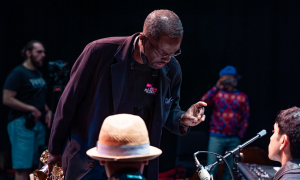
The ensemble's primary composer, pianist Mengelberg is a spoiler, a trickster, Coyote energy personified. The worm in the apple, the virus in the computer, he seems to delight in constructing elaborate forms then reveling in their destruction and partial reassembly.
Seattle, WA
March 25, 2006
New Dutch Swing is the phrase coined by critic Kevin Whitehead - who wrote a book of the same name - to describe the music of the ICP (Instant Composers Pool) Orchestra, the Willem Breuker Kollektief, Bik Bent Braam and other members of the vital improvised music scene in Holland. Misha Mengelberg, Han Bennink and Breuker were co-founders of ICP in 1967. In Seattle as part of a rare U.S. tour, long-time ICP compatriots Mengelberg and Bennink were ceaselessly creative and irreverent (as always).
The group consists of Mengelberg, piano and voice; Bennink, drums; Mary Oliver, violin and viola; Tristan Honsinger, cello; Ernst Glerum, bass; Ab Baars, tenor saxophone and clarinet; Tobias Delius, tenor saxophone and clarinet; Michael Moore, alto saxophone and clarinet; Thomas Heberer, trumpet; and Wolter Wierbos, trombone. Oliver, Honsinger and Moore are U.S. expatriates; the other members are Dutch.
The ensemble's primary composer, pianist Mengelberg is a spoiler, a trickster, Coyote energy personified. The worm in the apple, the virus in the computer, he seems to delight in constructing elaborate forms then reveling in their destruction and partial reassembly. He is an elliptical maestro of mystifying magic and metrical manipulation, juggling allusions and illusions. Mengelberg is a provocateur, an absurdist, using aural montage and collage in a provocative and waggish manner, often rife with self-mockery and self-deprecation. Thelonious Monk was one of his early musical influences and inspirations. The eccentric genius of Monk remains an important part of Mengelberg's roots. Regeneration (Soul Note 121 054-2) documented his continuing reinvestigation and reinvigoration of Monk's legacy and was also instrumental in rekindling interest in the long-neglected works of Herbie Nichols, another sui generis composer, improviser and pianist.
One of Monk's lesser-known pieces, "Locomotive," in an arrangement by Michael Moore, highballed along with no braking or whistles at the crossings in its Seattle performance. The strings of violinist Mary Oliver, cellist Tristan Honsinger and bassist Ernst Glerum were to the fore as the engine built a head of steam, stoked by Bennink's drums. Trombonist Wolter Wierbos displayed his mastery of mutes, including the plunger, in his engaging solo. When tenor saxophonist Ab Baars was well into his off-center solo I was reminded of a comment I once read (source unknown) likening Albert Ayler to a cranky but loveable grandmother who bakes apple pies and farts a lot. A slightly warped Swing-era 78? Throwing a crowbar on the tracks just to see/hear what happens? Many of the rhythms and tempos utilized by ICP are pre-Swing · sometimes even "pre-jazz" · often with little if any syncopation. It's a bit like walking into a jazz club expecting to hear bebop and marching out at the end of the night with echoes of James Reese Europe and the early jazz of Sam Wooding (African American bandleaders who left a lasting impression on European audiences during the early years of the 20th Century), European cabaret music, circus bands, chamber music, and marching bands ringing in your head. This "Locomotive" also hearkened back to the take-no-prisoners Harlem stride of Luckey Roberts and James P. Johnson; a style abstracted by Monk in what Whitney Balliett called "[his] vinegary, dissonant, Gothic music." It was a cheery if odd train ride, more akin to polkas and schottisches than bebop and the avant-garde.
Mengelberg was associated with the Fluxus movement from 1961 through 1964, and presented a composition at the Fluxus Festival of 1964, the same year he and Bennink recorded the famous Last Date session with the late Eric Dolphy. His affinity with Stan Vanderbeek, Peter Brötzmann, Yoko Ono, Charlotte Moorman, Nam June Paik and other participants in the Fluxus movement is still evident forty-something years later. The ICP's music is always in a state of fluxion: change is the only constant. Paik's cryptic observation: "I...must renew the ontological form of music..." comes to mind.
He could be considered something of a latter-day Dadaist as well. The rumbling, dark, dissonant low-register chords and oblique left-hand melodies, the off-key whistling, the "vocals" based on nonsense syllables and invented languages, the presumably purposefully tentative-sounding entrances - such as the one in this concert's first full-ensemble piece where he tweaked and probed at the composition's innards - are all slightly askew. It's a funhouse mirror view of comprovisation: like carefully molding a fondant then dropping a sauté pan on it and delighting in the splatter.
A member of one of Holland's most distinguished musical families, Mengelberg was born June 5, 1935. His father, Karel (William Joseph) Mengelberg, was a widely respected pianist, composer and conductor. He is the grand nephew of renowned - and controversial - conductor (Josef) Willem Mengelberg. He studied architecture briefly before taking up music - studying at the Royal Conservatory in The Hague - and the three-dimensional aspect of that art/science might be seen as analogous to his comprovisational configurations. A Misha Mengelberg composition is a Bauhaus building with a permanent staff of demolition engineers scurrying about setting off little charges in odd corners; it's designed to retain its structural integrity despite gaping holes and sundered parapets.
A number of 20th (now 21st) Century composers in The Netherlands are important innovators in microtonal music, most significantly Henk Badings, whose compositions using a 31-note scale are well-known. Mengelberg approaches polytonalities from a different perspective, but his innovations are perhaps comparable to those of Badings. Adding pan-idiomatic improvisation to the picture results in a singular oeuvre. He has also studied Arabic and Moroccan music.
Like his contemporaries - fellow composers Reinbert de Leeuw, Louis Andriessen, et al. - Mengelberg is an ardent advocate of greater democratization of Dutch musical life and has been vocal as a promoter of social renewal throughout his career. He was the founder and first chairman of the Bond van Improviserende Musici (BIM), formed in Amsterdam in 1974, an organization that might be considered a counterpart of the AACM and BAG in the U.S.: musicians taking control of their own destinies and livelihoods. He also founded the Studio voor Elektro Instrumentale Muziek. His collaboration with writer/performance artist Wim Schippers from 1974 through 1982 resulted in some noted improvised theatrical productions.
Han Bennink was born April 17, 1942 in Zaandam, The Netherlands. His father was a classical percussionist and he took up the drums in his teens. He first attracted the attention of Dutch jazz fans for his work with visiting U.S. greats such as Dexter Gordon and Sonny Rollins. The quartet he formed with Mengelberg in 1963 played at the Newport Jazz Festival in 1966. Long associated with the avant-garde (for lack of a better, more descriptive term), Bennink has played and recorded with a long list of vanguard improvisers, including Peter Brötzmann (he's on the scary, rapid-fire and pivotal Machine Gun album), the recently departed guitar maverick Derek Bailey, Don Cherry and Dave Douglas. In addition to ICP he has had a long association with the Globe Unity Orchestra. His collaboration with Michael Moore and cellist Ernst Reijseger as the Clusone Trio produced a remarkable body of work, full of whimsical theatricality and profound musicality.
Bennink is among the most technically accomplished percussionists active in any style of music. He doesn't get in the way and never loses the pulse, the beat, and the groove: no matter how abstract things get there's always a center. He tends to tune his drums down low and has a truly uncanny ear for colors, textures and timbral contrasts. It's a painterly approach to the drum set. Not so coincidentally he is a talented visual artist, and has provided the cover art for a number of albums and CDs, including the recent ICP release Aan & Uit (ICP 042) and his delightful duet with Dave Douglas, Serpentine (Songlines SGL 1510-2).
Much has been made of his zany extra-musical stage antics. Like Mengelberg, he is something of a latter-day Dadaist in this respect. A couple of years back when I saw him in Vancouver he played the snare with one foot, bounced a stick off the floor and caught it (in rhythm!) and tossed shards of mangled sticks into the crowd. Sitting in the front row at a Bennink performance demands mindfulness; you never know when a wooden projectile might be headed in your direction. With ICP on this occasion in Seattle there was no slapstick; their humor relies less on schtick à la the Breuker Kollektief and more on the playful twists and turns of the music itself.
Bennink is well acquainted with the entire history of jazz percussion and can summon up the ghosts of Baby Dodds piloting the Armstrong Hot Sevens, Jimmy Crawford driving the Lunceford big band and Big Sid Catlett's buoyant metronomic beat and mastery of dynamics at will. His only unaccompanied solo came in the second set, after "(What Did I Do To Be So) Black and Blue." The melancholy irony of this song - forever closely associated with Louis Armstrong - was exquisitely limned in the ensembles and in expressive solos from tenor saxophonist Tobias Delius and clarinetist Michael Moore, Bennink's adroitness with brushes providing a richly detailed carpet of subtle propulsion. The blending of clarinet with Honsinger's cello here was opalescent, iridescent and almost heartbreakingly lovely. The contrast was stunning when Bennink followed this deeply spiritual performance with a tour de force drum solo that crackled with intensity. The forward momentum, astonishing variety of colors, unflagging tempo and swirling rhythms were - in the true sense of the word - awesome. Bennink is always charged like an ion, and sometimes he charges like a lion. Many drummers use a solo as an excuse to show off their technique at the expense of musicality. Though usually crowd-pleasers, unaccompanied solos - even by famous and widely respected drummers - often sound like a bunch of golf clubs falling down a flight of wooden stairs and landing on a concrete floor. This was most assuredly not the case here. Bennink belongs in the rarefied company of Max Roach when it comes to this naked form of expression.
The third piece played this evening had an almost nursery-rhyme feeling to its melody and rhythmic scheme with pizzicato violin and cello col arco taking the lead before Oliver took up her bow and then the pair was joined by Glerum's bass. Something of a Teutonic chamber ambiance often surfaces in ICP's music, and the string trio can make the leap from Baroque to post-Webern in the blink of an eye. When the three clarinets of Michael Moore, Ab Baars and Tobias Delius teamed up with Wolter Wierbos on trombone the feeling was more New Orleans speakeasy than "chamber." Jelly Roll Morton in his classic Red Hot Peppers recordings utilized this combination of instruments on numerous occasions and it is a marvelous texture missing from most modern jazz. There was some testifying plunger-mute work from Wierbos before Mengelberg finally joined in, his piano needling away and pushing towards a wilder and more "free" segment, Bennink letting loose with a barrage of batterie booting Mengelberg and Honsinger along. Clarinet and two saxophones (alto and tenor) led to Bennink bringing the dynamic level way up and then back down to a mezzo forte as the ensemble shifted to a relatively straightforward swing feel, setting up trumpeter Thomas Heberer's solo, accompanied by the "standard" rhythm trio of piano-bass-drums. Heberer has a magnificent, rich, full-bodied tone and took a gem of a solo here. At other times he was often a fulcrum for the group's flights of fancy. The ensemble entrance with two tenors and alto was spot-on. Mengelberg took a wiry, dark solo before turning things over to Honsinger for a manic slash-and-burn cello solo with Bennink kicking the dynamics up a notch or three once more. An involuted theme statement by the full band capped it all. Whew! This was a whole lot of music in a relatively brief period of time, tweaking both the intellect and the viscera.
There were way too many additional highlights in this evening of exceptional music to detail them all in a "play-by-play" fashion, but a few vignettes deserve mention.
The piece played just before intermission had a loping Sun Ra-esque swing and Ellingtonian overtones in the slower portion, gritty trumpet and more trombone with the plumber's helper providing a Jungle Band ambiance. Mary Oliver's crystalline high note on violin that closed the composition was gorgeous.
Mengelberg opened the second set in duet with trombonist Wolter Wierbos. Dutch Dada, didjerido, didjeridid, didjerislid... Wierbos once more demonstrated why he is considered one of the living masters of avant trombone with a pixilated potpourri of muting techniques, including a portion that sounded uncannily like the Australian aborigine instrument the didjerido. Mengelberg indulged in a cartoonish flurry of nonsense syllables/words and Wierbos had his own turn in the aural scribbles department playing the slide sans the rest of the instrument, sounding like Donald Duck on helium. Sly, wry, dry, fly... At the end a hymn-like melody appeared, and Wierbos also played open horn with an impressive range and opulent tone.
The composition titled "Habanera" featured Mary Oliver on viola, trading the lead with trumpet in the opening ensemble. Bowed bass with piano led to a graceful bass solo before Oliver returned with a viola solo that was abstract indeed. There aren't many improvisers who utilize the viola, and Oliver can definitely be mentioned in the same breath with Mat Maneri as a world-class player. This was a superb solo. The habanera is a Cuban dance of Spanish origin and is an ancestor of the Argentine tango.
"Great Black Music - Ancient to the Future" is the phrase used by the Art Ensemble of Chicago to describe what they play. "Great Multicolored Omnidirectional Music - Ancient to the Future" might describe ICP. The hilarious sound effects intro of the piece that closed the Seattle concert was more than a tad reminiscent of some of the AEC's "little instruments" forays. A snippet of "Take the 'A' Train" flew by thanks to Moore's clarinet and then things took a bebop-ish turn (was that "Hot House" I heard in an oblique quote?) Honsinger's cello solo was a wild and woolly detour into Cecil Taylor land (with whom the cellist has played) and the almost telepathic interaction between Moore on clarinet and Mengelberg on piano in the next segment was transcendent. Moore's warm, polished ebony tone really glowed here. Then things went "out" with a vengeance, Bennink feeding a monstrous pulse and dropping a depth charge drum break. A suspended rhythm ensemble... The end. Brilliant.
Special note should be made of the minimal sound reinforcement. There were microphones on Mengelberg's piano and voice and on the three string players, none on the drums or horns. It's refreshing to have an engineer who knows how balance in this type of music should be dealt with. The acoustics in the Asian Art Museum's performance space are excellent: kudos to those who chose not to monkey with them, and kudos to Earshot Jazz for bringing ICP to Seattle as part of their Spring Series.
Personnel
Misha Mengelberg: piano and voice; Han Bennink: drums; Mary Oliver: violin and viola; Tristan Honsinger: cello; Ernst Glerum: double bass; Ab Baars: tenor saxophone and clarinet; Tobias Delius: tenor saxophone and clarinet; Michael Moore: alto saxophone and clarinet; Thomas Heberer: trumpet; Wolter Wierbos: trombone.
About ICP Orchestra

Tags
PREVIOUS / NEXT

Become a Sustaining Member

Since 1995, All About Jazz has championed jazz as an art form and supported the musicians who create it. Over three decades, it has grown into one of the world's leading jazz resources, serving hundreds of thousands of readers, musicians, presenters and industry professionals each month.
Help Build the Future of All About Jazz
Your support helps us continue building All About Jazz for the next generation—expanding our editorial coverage, preserving jazz history, developing new community features and creating better ways to discover the music and the people behind it.
Become a sustaining member for as little as $20 per year and you'll immediately enjoy an ad-free experience along with access to subscriber features and future articles for a full year.
Together, we're not simply sustaining All About Jazz—we're building its future. Thank you for being part of the journey.
Near

Seattle Concerts