Home » Jazz Articles » Bailey's Bundles » Isaac Hayes & John Fogerty: The Progeny of Concord-Fantasy
Isaac Hayes & John Fogerty: The Progeny of Concord-Fantasy

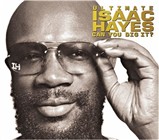 Isaac Hayes
Ultimate Isaac Hayes: Can You Dig It?
Stax
2005
Isaac Hayes has faded in and out of the limelight over his thirty-plus year career but is recently on the upswing, thanks to the Comedy Central cartoon South Park, his Memphis restaurant, and a renewed interest in his music. Hayes may be best known for his incendiary soundtrack to the 1971 Gordon Parks film Shaft, which contained the most identifiable use of the guitar wah pedal since its popularization with Jimi Hendrix and Eric Clapton. By that time, Hayes had already released the critically acclaimed Hot Buttered Soul, The Isaac Hayes Movement and Black Moses, three recordings that helped buoy Stax Records in its final years.
The Tennessee-native emerged into the rich Memphis music scene in the early 1960s, recording a single for Chips Moman in 1962. Noticed by Stax Records owner Jim Stewart, Hayes was tapped as the label's house keyboardist in the absence of Booker T. Jones. Within two years Hayes had joined with David Porter, penning a string of soul hits that were to define the Stax sound: "Soul Man, Hold On, I'm Comin', "When Something is Wrong with My Baby, and "I Thank You.
Hayes stepped out as a leader in 1968, coaxed by Little Rock, Arkansas-native Al Bell. This resulted in Introducing Isaac Hayes. This album and its single, "Precious, Precious, were poorly received. In early 1969, Bell decided to flood the market with Stax material, having all contracted acts record new material, including the house musicians. With the stipulation that he have creative control, Isaac Hayes recorded Hot Buttered Soul—and, as they say, that was that.
The "Isaac Hayes Greatest Hits picture is a mess. A definitive, single volume set has yet to be released, though the Ultimate Isaac Hayes goes far in remedying that. It contains all of the evidence that Hayes is the logical heir to Charles in both his performances of other composers' materials, like "Never Can Say Good Bye, "By the Time I get to Phoenix and "Walk on By, as well as his own material, like "Shaft, "Precious, Precious and "Soulsville."
Hayes recreates classic chestnuts with no effort; they are lengthy, layered readings that have aged remarkably well. His own compositions are worked out in detail. Both bear the mark of the grandiose 1970s because of this, but somehow, Hayes never descends into banal self indulgence. His music remains interesting, vital and honest. While Hayes is a master of orchestration, a black Berlioz or Wagner, he is perfectly capable of miniatures. Hayes produced "His Eye on the Sparrow, where he reveals the Church in His Music for the Reverend Dr. Jesse Jackson at a Push Concert late 1972 in Chicago. This is riveting and compelling music.
The silly exists with the sublime. Hayes' South Park tenure is represented by "Chocolate Salty Balls, a confection satisfying the popular show's fan base. But this is really the only truly silly inclusion, and is included precisely because this is an "ultimate collection. The remainder of the collection is top-drawer Isaac Hayes—Black Moses.
Can I hear an amen?
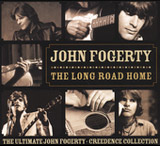 John Fogerty
The Long Road Home
Fantasy
2005
No compilation of a single artist's work has so schizophrenically confounded me as The Long Road Home. I was a 'tween listening to "Green River in the bedroom of my five-year-older cousin, thinking, "Goddamn, this is what music is all about! Creedence Clearwater Revival was the greatest singles band between 1968 and 1970. The music released during this brief two-year period was staggering and dense.
Creedence Clearwater Revival, Bayou Country, Green River, Willie and the Poor Boys and Cosmo's Factory exceeded the contemporaneous music of the Rolling Stones (Begger's Banquet, Let it Bleed, Get Yer Ya Yas Out) and the Beatles (The White Album, Yellow Submarine, Abbey Road and Let it Be). American music was best represented by an American band.
The Long Road Home is at once the perfect, most complete and least satisfying, most anemic career compilation. All of the usual suspects are here. From the Creedence period are "Born on the Bayou, "Bad Moon Rising, "Green River and "Proud Mary. From the solo period are "Centerfield, "Almost Saturday Night, "Rockin' all Over the World and "The Old Man down the Road. The Long Road Home contains four previously unissued live versions ("Bootleg, "Keep on Chooglin', "Hey Tonight and "Fortunate Son ).
These are fine contemporary recordings, but I do not feel they are enough to sell this compilation to all of the old hippies who have replaced their vinyl Creedence collection with CDs and MP3s. This collection is perfect for the Creedence completist and the Creedence novice. If you haven't heard Creedence or John Fogerty, The Long Road Home fits the bill. But was it really necessary?
Visit Isaac Hayes and John Fogerty on the web.
Tracks and Personnel
Ultimate Isaac Hayes: Can You Dig It?
Tracks
CD1: Theme From Shaft; Precious, Precious; Hyperbolicsyllablicse-quedalymistic; Ain't That Loving You; Never Can Say Goodbye; By The Time I Get To Phoenix; Soulsville; Wonderful; Help Me Love; Need To Belong To Someone; Good Love; The Look Of Love; Do Your Thing; For The Good Times; I Stand Accused.
CD2: Walk On By; Joy; His Eye Is On The Sparrow; Brand New Me; If Loving You Is Wrong (I Don't Want To Be Right); Someone Made You For Me; Baby I'm-a Want You; Let's Stay Together; Theme From The Men; I Can't Help It (if I'm Still In Love With You); Title Theme; Run Faye Run; Chocolate Chip; Come Live With Me; Disco Connection; Rock Me Easy Baby (pt. 1); By The Time I Get To Phoenix/I Say A Little Prayer.
Personnel: Isaac Hayes and a cast of thousands.
The Long Road Home
Tracks: Born On The Bayou; Bad Moon Rising; Centerfield; Who'll Stop The Rain; Rambunctious Boy; Fortunate Son; Lookin' Out My Back Door; Up Around The Bend; Almost Saturday Night (live); Down On The Corner; Bootleg (live;) Have You Ever Seen The Rain?; Sweet Hitch-hiker; Hey Tonight (live); The Old Man Down The Road; Rockin' All Over The World (live); Lodi; Keep On Chooglin' (live); Green River; Déjà Vu (all Over Again;) Run Through The Jungle; Hot Rod Heart; Travelin' Band; Proud Mary; Fortunate Son (live).
Personnel: John Fogerty: Vocals, Guitar, Dobro, Mandolin, Electric Sitar, Harmonica, Piano, Bass Guitar, Drums, Percussion; Matt Nolen: Guitar, Keyboard; Tom Fogerty, Billy Burnette, Mike Canipe, Bob Britt, Johnnie Lee Schnell: Guitar; Howie Epstein, Paul Bushnell, Stu Cook, George Hawkins, Bob Glaub: Bass Guitar; Doug Clifford, John Molo, Kenny Aronoff: Drums; Luis Conte: Tambourine; Julia Waters, Maxine Waters, Oren Waters: Background Vocals.
< Previous
Jazz Super Hits & Soul Party
Next >
It's All In The Game
Comments
Tags
For the Love of Jazz
 All About Jazz has been a pillar of jazz since 1995, championing it as an art form and, more importantly, supporting the musicians who create it. Our enduring commitment has made "AAJ" one of the most culturally important websites of its kind, read by hundreds of thousands of fans, musicians and industry figures every month.
You Can Help
To expand our coverage even further and develop new means to foster jazz discovery and connectivity we need your help. You can become a sustaining member for a modest $20 and in return, we'll immediately hide those pesky ads plus provide access to future articles for a full year. This winning combination will vastly improve your AAJ experience and allow us to vigorously build on the pioneering work we first started in 1995. So enjoy an ad-free AAJ experience and help us remain a positive beacon for jazz by making a donation today.

Giveaway

Days remaining: 6



