Home » Jazz Articles » Bailey's Bundles » Two Roads Diverged
Two Roads Diverged
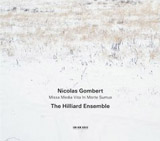 The Hilliard Ensemble
Nicolas Gombert: Missa Media Vita in Morte Sumus
ECM
2006
Nicolas Gombert (c.1495-c.1560) was born in South Flanders (now Northern France). He was considered one of finest choral composer of the Renaissance. Composers from this early period do not typically have household names as do composers of the Classical and later periods. Gombert represents the link between Josquin Desprez (c. 1450-1521) and Giovanni Pierluigi da Palestrina (c. 1526-1594) most acutely in the area of choral music. A Catholic cleric, Gombert served as singer and composer in the employ of Spanish emperor Charles V. While in this capacity, Gombert was convicted of an indiscretion with a choirboy and sentenced to rowing in a ship's galley. By legend, the composer won his pardon from Charles by dedicating his Magnificat cycle to the emperor. This cycle, a motet in each of the eight tonal modes, stands as Gombert's masterpiece and is considered medieval choral polyphony at its zenith.
Gombert's style of choral composition is characterized by an almost palpable texture, given his avoidance of rests and his craggy contrapuntal style. The result is maximum density choral singing where no aural space is left unfilled. In the present recording, the Hilliard ensemble presents Gombert's six-voice motet, Missa Media Vita in Morte Sumus (1539). This motet served as the source for the five-voice Missa Media Vita (1542). While Gombert derives from his mentor Josquin, he carries the compositional complexity to the next level. This complexity contains a degree of dissonance previous not heard in a choral setting. This dissonance marks Gombert, making him sound completely unique when compared with Palestrina, Tallis, or Josquin.
The Hilliard Ensemble presents six voices sounding like a thousand. Their singing is clear, sharp, and crystalline without being dry. This motet is the music of anxious mourning and the Hilliards capture it perfectly. This mourning betrays a deep remorse borne under the mantle of great loss. I will stop short of describing this choral singing as beautiful. It is majestic, almost overwhelming in its powerful attack on the senses. Gombert doubtlessly composed this with the biblical Lamentations in mind as no other literary text could spawn such lovely grief.
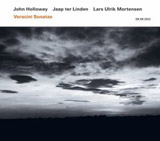 John Holloway, Jaap ter Linden, Lars Ulrik Mortensen
Veracini Sonatas
ECM
2006
Francesco Maria Veracini (1690-1768) was an Italian composer best known for his compositions for the violin. Veracini was a contemporary of Giuseppe Tartini, Johann David Heinichen, and the brilliant castrato Senesino, as well as Handel, Bach, Corelli, and Vivaldi. Not a household name. Indeed. But Veracini represents that class of composer that one turns two once fatigued with the more notable composers. Violinist John Holloway has already addressed Heinrich Ignaz Franz von Biber (1644-1704) and Johann Heinrich von Schmelzer (1623-1688), ground previously covered by Andrew Manze and Romanesca. Holloway's performances have been uniformly fine, with a sweetness and gentle disposition as opposed to Manze's enigmatic readings.
Rather than concentrate on the complete sonata from a given opus number, Holloway chooses one sonata from each of Veracini's four sets of sonatas. These four sets consist of the opus 1 (1721) and opus 2 (1744), both published in the composer's lifetime, and the unpublished Sonate a violino, o flauto solo, e basso and Dissertazioni... sopra l'opera quinta del Corelli, dating from 1716 and 1760 respectively. Vericini composed in a Vivaldian four-movement form and one should not be surprised when this music sounds very Vivaldian as opposed to Biber (1644-1704), Schmelzer (1623-1688), Holloway's previous focus. The Veracini is bright mainstream Baroque with few if any Renaissance trappings. Holloway's tone is creamy and light and his philosophy is conservative. These performances are truly superb. For the completist wishing Holloway had concentrated on a single opus, this recording is so good as to allay any such concerns. This is music to immerse oneself in.
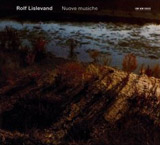 Rolf Lislevand
Nuove Musiche
ECM
2006
Rolf Lislevand is a lutenist and guitarist. On Nuove Musiche he arranges early baroque compositions in such a way as to illustrate exactly the elements that all western music has in common. So fair warning is given: those potential listeners expecting a period performance of a sixteenth century Italian minstrel show will be sorely disappointed. Instead, Lislevand practices a bit of Norse alchemy with this old music, teasing from it flamenco, Celtic, and Scandinavian elements. On this point, Lislevand opines, "[Seventeenth century passacaglias] thrive on chromaticism, harsh dissonances, and offbeat rhythms. If the composers tried to get these effects, then we have every right to go even further. My idea is simply to develop and elaborate things already there in the material. That philosophy could just as easily describe jazz's use of tin pan Alley as a song source.
Lislevand's ensemble is made up of himself and six like-hearted compatriots from his larger Kapsberger Ensemble. The principles were recorded using multi-tracking methods, providing a very full string sound. The music elaborated on is all from the sixteenth and seventeenth centuries and include pieces by Giovanni Kapsberger (c. 1575-1661), Domenico Pellegrini (c. 1610-1662), Alessandro Piccinini (1566-1638), and Girolamo Frescobaldi (1583-1643). Lislevand's arrangements effectively separate (nee, liberate) these harmonies, melodies, and rhythms from the confines of 400-year-old manuscripts, giving them an almost movie soundtrack quality. The addition of soprano voice by Adranna Savall further accentuates this illusion.
While this music sounds suspiciously like a good bit of Celtic New Age music, it is entirely too studied and intelligent to be thus pigeonholed. Lislevand researched the pieces selected with a scholar's eye and never strayed into gauche territory. The result is music, eminently listenable, that can serve a variety of purposes from passive listening to formal study when compared with period performances. In any event, the recording is quite enjoyable and highly recommended.
Tracks and Personnel
Nicolas Gombert: Missa Media Vita in Morte Sumus
Tracks: Media vita in morte sumus; Kyrie (from Missa Media Vita); Gloria (from Missa Media Vita); Salve Regina; Anima Mea; Credo (from Missa Media Vita); O crux, splenidor cunctis; Sanctus (from Missa Media Vita); Quam pulchra es; Agnus Dei (from Missa Media Vita); Musae lovis.
Personnel: David James countertenor; Rogers Covey: Crump tenor; Steven Harrold: tenor; Andreas Hirtreiter; tenor; Gordon Jones; baritone; Robert Macdonald; bass.
Veracini Sonatas
Tracks: Sonata No. 1 in g Minor from Sonate a violino solo e basso op. 1 (1721); Sonata No. 5 in C Major from Sonate a violino, o flauto solo, e basso; Sonata No. 1 in D Major from Dissertazioni ... sopra l'opera quinta del Corelli; Sonata No. 6 in A Major from Sonate accademiche op. 2 (1744)
Personnel: John Holloway: violin; Jaap ter Linden: cello; Lars Ulrik Mortensen: cembalo.
Nuove Musiche
Tracks: Arpeggiata addio; Passacaglia antica I; Passacaglia andaluz I; Passacaglia antica II; Passacaglia cromatica; Passacaglia antica III; Passacaglia cantus firmus; Passacaglia celtica; Passacaglia spontanea; Passacaglia andaluz II; Toccata; Passacaglia cantata; Corrente; Corrente; Toccata; Ciaccona; Toccata cromatica;
Personnel: Rolf Lislevand: archlute, baroque guitar, theorboe; Arianna Savall: triple harp, voice; Pedro Estevan: percussion; Bjørn Kjellemyr: colascione, double-bass; Guido Morini: organ, clavichord; Marco Ambrosin:i nyckelharpa (viola d'amore a chiavi); Thor- Harald Johnsen: chitarra battente.
Tags
PREVIOUS / NEXT
Become a Sustaining Member

Since 1995, All About Jazz has championed jazz as an art form and supported the musicians who create it. Over three decades, it has grown into one of the world's leading jazz resources, serving hundreds of thousands of readers, musicians, presenters and industry professionals each month.
Help Build the Future of All About Jazz
Your support helps us continue building All About Jazz for the next generation—expanding our editorial coverage, preserving jazz history, developing new community features and creating better ways to discover the music and the people behind it.
Become a sustaining member for as little as $20 per year and you'll immediately enjoy an ad-free experience along with access to subscriber features and future articles for a full year.
Together, we're not simply sustaining All About Jazz—we're building its future. Thank you for being part of the journey.