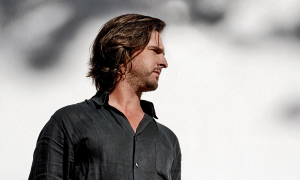
Home » Jazz Articles » Interview » Tom Lawton: Co-Creating the Music
Tom Lawton: Co-Creating the Music

On May 1, 2004, a major Philadelphia recording event occurred: Tom released a long-awaited CD of his original compositions, entitled Retrospective/Debut , on Dreambox Media, with musicians John Swana, Ben Schachter, Norman David, Lee Smith, and Jim Miller. The recording has received praiseworthy reviews by Karl Stark of the Philadelphia Inquirer and John Van Deusen of the Philadelphia Metro, as well here on All About Jazz. It is an innovative album, which, as Karl Stark noted, "skirts the edge of mainstream." At the same time, it is highly listenable. On April 24th, I interviewed Tom by phone at his home in Montgomery County, where he resides with his wife, Fran, and several cats. On some days, his living room acts as a rehearsal studio, composition space, and/or the site of a host of other projects which he or Fran may be doing at any point in time. With the same alert and turned-on energy he seems to possess for virtually any situation, Tom was ready bright and early to take on my questions.
At Tom's request, the interview is also meant to serve as additional "liner notes" for the CD, and is so noted on the CD itself. This is only one of many ways that All About Jazz is proud to support jazz musicians, many of whom are an integral part of its on-line community.
Tom is also an excellent jazz educator. I deliberately queried him on aspects of modern jazz which I have found puzzling. His thoughts cleared up some of the confusion. Now let's hear from Tom himself.
TRACKING TOM
AAJ: Your previous interview with All About Jazz was just about six years ago. What have you been doing since then? Could you give a quick rundown?
TL: I did a few years of a steady gig at Sullivan's in King of Prussia, PA. I've also worked with Norman David's Quartet, Group Four, an avant-garde group. We worked for three years at Saint Jack's club in Old City. I've also been very busy with vocalists such as Miss Justine, Mary Ellen Desmond, and Joanna Pascal. Joanna's a newcomer, only 24 years old, recently graduated from Temple University, and is a real pro already.
Of course, I've been teaching at Temple and at Bucks County Community College. For the past few months, the writing and preparation for the CD has taken up a good deal of time as well.
AAJ: Sounds like a tight schedule. Yet somehow you found time during the last couple of decades to put together a variety of new jazz compositions, some of which, I recall, you performed with a group at Montgomery County Community College to a packed house a few years ago, as well as other concert and festival venues, and some of which are the basis of your new CD, Retrospective/Debut. Also included in that CD are a Charlie Parker composition, "Donna Lee," and a Wayne Shorter number, "JuJu."
By the way, in my opinion Retrospective/Debut is one of the most interesting and enjoyable jazz CD's I've heard in quite a while, so congratulations on your achievement. Let's talk about the album. What's the meaning of the title? Retrospective suggests past work; Debut indicates something new. Why the paradox?
THE CD: RETROSPECTIVE/DEBUT
TL: Usually, the slash (/) is used to denote opposites like happy/sad, rainy/sunny. So the "Retrospective" is from the standpoint that I've been composing for a long time...
AAJ: Some of the compositions go back as far as 1975.
TL: There's one from that time, and then we skip to 1984. The larger quantity is more recent. So, the "Retrospective" refers to my playing and writing for a long time. But, it's a "Debut," in that it's my first CD as a leader.
AAJ: So, why did you decide to come out with your "leader" debut with your own compositions—why not just do standards? Why debut in two ways at the same time? You've worked numerous live gigs with these guys- Ben Schachter (sax), John Swana (trumpet), Lee Smith (bass), Jim Miller (drums) as your quartet- and also with guest artist Norman David (clarinet). This is your first CD with them, I take it. Why bring in your own compositions at this point?
TL: Well, for this CD, I didn't want to be concerned with the commercial end of things- playing for the sake of playing. I do that all the time anyway. Not that I don't love and enjoy it, but when the time and effort of making a CD is so all-consuming, and it's time to put your own expression out there, I wanted to do what's most personal to me and make it distinct. I mean I love standards. The "great American songbook" has some of the most amazing things ever written, but again, so does Schoenberg, or for that matter, Dave Douglas.
AAJ: It's interesting you would put Schoenberg, Dave Douglas, and pop tunes all in the same class!
THE MUSICIANS ON THE CD
Tell us a bit about the musicians on the album. About their background. And why did you choose each to be on this particular CD?
TL: Well, let's see, I chose these guys because, first of all, each of them has a particular "vibe" that I wanted. I wanted their sound, combined with the fact that I knew they would have the ability to interpret my compositions and personalize them for themselves, while still being true to the spirit of each piece. `
AAJ: Yes, I do think you all succeeded admirably in combining personal styles and ideas with the whole.
TL: The one I've been with the longest is Jim Miller. At this point, I think that we have a thirty-year history of playing together. By the way, he's one of the few drummers that the late, great Al Stauffer liked to work with. We did trio work for a while. Jim has a good way of maintaining the groove, but still being adventurous polyrhythmically. He pushes and pulls time in interesting ways that I like, and I hook up with him really well. I have a shorter history with Lee Smith, maybe the last ten years. He'd been on the circuit much longer than that. We've really enjoyed playing together and want to as often as we can.
AAJ: What is it about Lee's playing that to you is different and special?
TL: Well, he has a really deep, big sound that personifies the bass, a deep, resonant sound that's rare. And he's also adventurous while at the same time he's cognizant as to how to underline the music. He really knows how to propel a group. The rhythmic responsibility of the bass can be as important as, if not more important than the drums, because the bass is harmonic and rhythmic at the same time. Lee has a way of delineating things that just brings the group together.
AAJ: Gerry Mulligan said that he listened to the bass for cues more than the drums.
TL: I think the best thing for me, however, is to listen to the whole sound and not tune into one person. I listen to the totality of the sound.
AAJ: How about John Swana ?
TL: John is an amazing player. He has an incredible linear concept. He comes out of be-bop, but has many personal ways of dealing with that language and expanding upon it. Of course he has a great sound and great timing.
AAJ: Ben Schachter (left).
TL: I'm trying to think of when I met him- it was somewhere around 1990. I was introduced to him by Al Stauffer. He's an incredible musician, one of the few who prefers to do things in an uncompromising manner. Most often, you won't see him on the regular gig circuit. He chooses to do as little of that as possible, so that he has time for his own writing and woodshedding. I'm honored that he wanted to appear on my recording, because he's definitely the type who leads a group, but when he likes the concept, he's very good at interpreting others' music. I'm honored, because he won't do that for everyone.
AAJ: What about Norman David? He's only on one track, "The Norman D. Invasion," which I take it is named after him.
TL: Norman is the leader of Group Four. I played with him for twelve years or so, with him leading a quartet, but we've done some projects with an "eleven-tet." He's a full-time composer. Very prolific: he can crank out ten compositions to my one! He's also a multi-reed teacher and player. He has two books published, one textbook on big band arranging, and he just published a new book on Ella Fitzgerald.
AAJ: Do you know what it's about? Is it a biography?
TL: It has some biographical information, but it concentrates more on her musicality. He transcribed a lot of her phrasing...
AAJ: Her "scat" singing.
TL: Some of that, and even just her phrasing on melodies- how she re-interpreted melodies, changed the rhythms, etc. It's not overly scholarly but it's very thorough. Again, Norman has a unique vision. I like all the musicians on my CD because they're very eclectic in their taste and their abilities.
AAJ: Now, I take it that Jim Miller is also the CEO of Dreambox Media?
TL: He owns it. But that's not why he's on the recording. In fact, when we recorded, I hadn't even decided yet who the label would be. I didn't decide that until a few months after the recording was done.
AAJ: Has Schachter recorded before?
TL: He has four CD's of his own, and he's working on a fifth.
AAJ: And we know that John Swana...
TL: Has a million records on Criss Cross.
AAJ: What about Norman David's recording history?
TL: We have a CD out with his group, Group Four. It's called Norman David's Group Four: There's Room for All.
JAZZ COMPOSITION
AAJ: I think we should tell our readers that the stereotype of jazz composition is writing melodies for tunes. You don't just write tunes, from what I can gather. You tend to structure, or create a lack of structure, throughout the performance, so it's not just the melody. Is that correct?
TL: Well, not really. I mean it evolves that way through playing, and you try to create a framework... On the CD, there are only three tunes that are "free," and even they are partially composed. The rest of the tunes are in fact regular tunes, only longer. The forms are longer, and a little "quirkier."
AAJ: So that what you call a composition is a tune on which you elaborate a structure?
TL: In jazz, what you call a composition is that you write the structure upon which to improvise.
AAJ: OK, that would be very interesting to our readers.
TL: I think they may already know that. I mean, composition doesn't necessarily mean everything is written out- in jazz.
AAJ: I think everyone recognizes that most of it is improvised on the spot. But I think most people think that what is composed is the melody.
TL: Oh, there is a melody composed for every tune, and most have a harmonic scheme, as well.
AAJ: But you're also saying that a jazz composition could conceivably be a structure, not just a melody.
TL: In the CD, they all have melodies and harmonic progressions, both of which constitute the structures
AAJ: But, in principle, they don't have to.
TL: Right. I mean there are three "free" pieces on the CD, in the sense that there still are melodies to start with, but what makes them "free" is that the improvisation is not over a recurring form of chords.
AAJ: Can you tell us a little bit about how you go about creating a piece? Take it from the initial inspiration to what you put down on staff paper, to what you bring into the recording studio with the guys.
TL: In a general way, my method is what I call organic. I don't set out to write a certain number of bars. I often start out either with a mood, or a fragment of a melodic or rhythmic motif, occasionally a rhythmic groove, and then that generates some kind of germinal material that I then just play repetitively and try different ways to elaborate on it. For me, it takes a long time, because I keep playing it until the next bar, or- occasionally- the next ten bars at a time, becomes organic and feels right. I'm very unscientific. I do use my intuition and harmonic knowledge to generate degrees of tension and release.
AAJ: And what'll go on the staff paper? Melody and chords?
TL: Yeah. And rhythms.
AAJ: So then you'll take that into the studio with the guys. And what do you tell them? You don't just tell them, "Let's wail?"
TL: For this recording, we had a few rehearsals. They see the music. I tell them generally the tempo, the mood. We try a couple of things. They ask questions about it. Do we want this section to be a "chill out" from the preceding section? We play it a few times. At first it's a bit mechanical as we get it together. Then, gradually, as we do it more, the group's chemistry asserts itself because they absorb the material, and it generates a life of its own.
AAJ: When they're actually playing, do you give them any cues to try to generate a particular effect or emotion? In other words, are you, in a sense, composing as you're all performing?
TL: Only occasionally, on the "free" pieces, I may wave a particular instrument out or in, to get a particular orchestral mix.
MUSIC WITHOUT CATEGORY
AAJ: On the CD liner notes, you say something very intriguing, that you "embrace the idea of music without category." What could you mean by that statement?
TL: Well, at this point in my musical life, I'm not concerned with jazz per se, although if you had to name it, that's what I do. But most of what's really interesting in jazz of the last twenty years has happened because of people checking out wildly diverse music and bringing their own improvisational skills to it. For instance, there have been so many wonderful things happening in New York, like John Zorn, and his whole movement of radical Jewish jazz. There are dozens of CD's bringing in, say, klezmer music, mixing it with Ornette Coleman-like sensibilities, and classical music. And guitarist Bill Frisell mixes a country feel. Dave Douglas incorporates everything, and it still sounds unified.
AAJ: But your CD isn't like that. Isn't it more along the lines of mainstream jazz?
TL: Well, if it's mainstream, then I've done something wrong. Except for perhaps the first tune, I don't really think of it as mainstream at all.
AAJ: Well, let's get right to it, then. How is it NOT mainstream?
TL: For instance, most of the harmonic things that happen are not what you would hear in mainstream jazz at all. There's influence from twentieth century classical music...
AAJ: Quite frankly, isn't that happening in mainstream jazz on a regular basis?
TL: Oh, it's happening everywhere. It's happened since the fifties. But that type of thing has never become mainstream. Yes, there are some things in the record that are definitely more "inside" than others. These days, one can no longer really innovate. What happens is that each individual consolidates his or her diverse influences and then a unique sound hopefully emerges.
AAJ: A propos of that, you talk about "free" composition....
TL: Well, the composition isn't free. The improvisation is.
AAJ: I thought ALL improvisation is free.
TL: It's a term that goes back to the sixties. "Free jazz" is used to describe improvisation that is not over regular chord changes, like the later Coltrane, Ornette Coleman, Albert Ayler, Cecil Taylor. It's not a totally correct term because every one of those people has his own structure governing the so-called "free" improvisation.
AAJ: The pieces on your CD strikingly come across as very coherent from beginning to end.
TL: Right- that is the goal, but that's partially because I try to present a structural basis for the freedom. But the most free ones are "The Norman D. Invasion," "Celestial Prism," and "Archetypal Archives," because those do not have any recurring harmonic structure that the soloists are playing over.
AAJ: So how do you guys all get together?
TL: Well, after the head, you just use other elements. You use melodic ideas, textural ideas, rhythmic motifs, group interactions.
AAJ: So, as before, there are other structuring elements than the chord progression.
TL: For instance, in "The Norman D. Invasion," we used motifs from the melody very loosely as the basis for the entire improvisation. It begins with pulse-making, where the pulse behind the improvisation is still referencing what happened during the melody. After a while, we leave pulse entirely, and it's more rubato. So, the piece is based on motifs from the melody.
VARIOUS INFLUENCES
AAJ: That reminds me of John Coltrane's "Meditations."
TL: Right, right. That kind of thing, yeah. Even though each player and composer will do it differently, it is that idea.
AAJ: Now, is there a relationship between "free jazz" and "Third Stream Jazz."
TL: I'm not sure what "Third Stream" is other than Gunther Schuller coined the term for combining jazz with various classical elements. They may have used some freedom in a certain way, for example, when collaborating with Ornette Coleman on some projects.
AAJ: Yes, a cohort of musicians seemed to call themselves "Third Stream..."
TL: You rarely hear that term any more, but I think it had to do with some people at the New England Conservatory. In truth, jazz from its inception has always been a hybrid of everything, from the African rhythms and melodies mixed with European harmonies that musicians took from hymns. It's always been a hybrid, but today it's more exciting than ever, especially in the hands of someone like Dave Douglas.
AAJ: We'll get to him a little later. I want to get to some of the classical influences. First, of all, while it's not directly relevant to your CD, perhaps you can speak to it. Two composers in particular are given a great deal of credit for impacting upon modern jazz, beginning say with bebop. Those are Debussy and Stravinsky. Musicians such as Charlie Parker, Gil Evans, Miles Davis, Dexter Gordon, and J.J. Johnson often have commented about the impact of one or both of these two composers. What's your sense of what Debussy and Stravinsky contributed to jazz?
TL: OK. In terms of mainstream jazz, Debussy is easier to peg. Debussy and Ravel used extended harmonies, but in "straight ahead" contexts. Herbie Hancock, Bill Evans, McCoy Tyner—indeed many things that are now considered "stock" in jazz- originated in the impressionist composers. The harmonic elements, not the rhythmic elements.
AAJ: And Stravinsky?
TL: The "Rite of Spring" probably affected everyone. It's interesting that when you think of that, a lot of the "free jazz" that we play, comes out of improvising with that type of idea in mind, where we're not necessarily sticking to the same pulse or recurring structure. We're just sort of improvising in a "through-composed" way.
AAJ: Which is characteristic of the "Rite of Spring."
TL: Well, I don't purport to know what is the structure of "Rite of Spring," but we just hear that kind of idea, mutated through a jazz lens.
AAJ: In your CD, what classical composers could we catch glimpses of?
TL: Well, I didn't set out to officially imitate anyone, but- for instance- "Celestial Prism" is probably impressionistic- that and "Island." They have shades of Debussy, Ravel, and Messiaen. Actually Oliver Messiaen is one of my favorite modern composers. "Norman D. Invasion" and parts of "Archetypal Archives" may have more of... This is all very loose talk... but I would say Lutoslawski and Penderecki are there. They are MY references, but the other guys on the CD- they may be thinking of something else entirely.
AAJ: But someone might hear echoes of Lutoslawski and Penderecki there.
TL: In the big picture, I think of it more organically. We have these various influences, but when we're playing organically, it's just certain types of sounds, textures, or whatever may have been stimulated in us. It comes out differently than it went in.
AAJ: Now, are there particular jazz influences which impact on your composing and playing?
TL: To me, the pinnacle of jazz composition is Dave Douglas. He's one of the few musicians that I must listen to frequently. He's extremely prolific- I don't know how he ever sleeps! He has numerous ensembles that he writes for and plays with. They're all different, yet they all sound like his concept. Someone like Dave comes along very seldom.
AAJ: So Dave Douglas. Others?
TL: Uri Caine, Ben Schachter are great composers. Also, Norman David, Chris Speed, Ornette Coleman. Going back, Monk, Wayne Shorter, Mingus.
MORE ABOUT RETROSPECTIVE/DEBUT
AAJ: In your CD, I am struck that, while the pieces are very coherent- organic is perhaps the term you use- each of the musicians is able to express their uniqueness very powerfully. You can really pick up the distinct style of each- Swana, Schachter, etc., each in his own element. It's not a blending of styles so much as a creative combination of each person's unique idiom. How do you facilitate this individuality?
TL: Basically, that's why I chose these guys. For this kind of gig, you have to get people whose sound you want, yet their bending to what you want them to do can happen while they can still be themselves. Sometimes if you get someone on a project, you might like their playing, but some projects may not be the right match, because it may be too much of a departure from what they normally do to work.
AAJ: How do you want the folks who get this CD to listen to it? Do you want them to put it on for dinner by candlelight, or sit down quietly as if in a concert hall and really focus in? How do you want them to listen to your music to get the most out of it?
TL: I'm not picky about that. It's different for each person.
AAJ: So you can listen in a relaxed way, as well as in a very serious way. It's not necessarily "jazz chamber music," so to speak. It has a very nice sound to it that you can really enjoy as a background to whatever you might be doing.
TL: There are definitely some cuts that would lend themselves to that. There are others that you wouldn't want to put on when you're getting up in the morning or whatever.
AAJ: (Laughter): OK I can see that! JuJu in particular. That's a Wayne Shorter tune?
TL: It's a Wayne Shorter classic.
AAJ: I personally hear your rendition as if it consisted of interesting sound effects- I don't quite hear the motifs. Am I missing something?
TL: You probably have to know the tune. I've got the melody happening throughout. I do a couple of minutes of rubato treatment of the melody, appearing through a murky "soundscape." But when I set the bass vamp, I state the melody twice on top fairly clearly. Probably the best thing to do is listen to the original so you know the melody. It's on Shorter's JuJu album on Blue Note.
THE MUSE
AAJ: Got it! To change the subject, you mention that your lovely wife, Fran, serves as a muse for you. How does she do that for you?
TL: Not "officially."
AAJ: More subtly? She doesn't actually intervene in your work?
TL: Oh, no. Not at all. For me, "muse" means inspiration. It's much easier to be inspired when someone you're close to is very supportive. Fran is also very inspiring as a person, because she's her own person. She's my wife, but she's her own person, and she has her own musical inspiration. Since the last interview when I may have mentioned she was doing vocals, she has since earned a degree in composition, and also plays alto saxophone now.
AAJ: She versatile and gifted, like Jim Ridl's wife, Kathy.
TL: Fran, like Kathy, has an art degree. She's one of those people who is creative in every move she makes. So I find her very inspiring, and we have a positive relationship. No, we don't collaborate officially on writing music. If she's writing a tune, it's completely apart from me and vice-versa.
THE ESSENCE OF JAZZ
AAJ: Something I'm intrigued about in jazz is that each musician has his own sense of what jazz does for him and does for an audience. What is it for you? What does jazz convey for you? What does it mean to you on a personal and musical level.
TL: That's a double edged thing. I like to think of jazz in the most general sense of the word, which probably doesn't have anything to do with what musicologists would call jazz. I like what Abbey Lincoln says. She says "Jazz is a spirit." And I think of it as a spirit of creativity and improvisation. I think there is something about checking out all kinds of music. When someone experienced in jazz does that, I think jazz becomes an interesting lens through which to filter everything else. For instance, I grew up playing classical and rock for years before I ever got to jazz. Ever since I've been involved with jazz, the whole way I hear classical music is very different.
AAJ: That's a fascinating idea: jazz as a filter for other influences.
TL: As I was saying, John Zorn, Dave Douglas- one of his first groups was called the "Tiny Bell Trio" and that started a whole movement in jazz that was checking out Eastern European and Balkan dance forms. And there are still people doing it today, like Chris Speed. To me, most of the interesting things in jazz in recent years have come from the fringes, not from Lincoln Center. The Kinitting Factory, Tonic, hip-hop, klezmer, and so on have all fed the fire.
AAJ: Meaning that it comes from the whole world.
TL: No- what I mean is that Wynton Marsalis' Lincoln Center vibe- for a while there was a traditionalist movement in jazz where the history was a big thing. I never really wanted to go there. I've always respected the history, but I never wanted to stay there. I'm much more interested in what's happening right now and at noon tomorrow. As great as the masters are, I'm not into constantly revisiting them, especially as regards conscious imitation.
AAJ: There's a difference between jazz as a specific development and jazz as incorporating whatever happens to be there.
TL: Jazz musicians have always done that, and for lack of a better term, we call certain things "jazz." And I'm all for a very broad interpretation of that. In fact, I'd just as soon not use the term "jazz," rather "universal music." Critics, and even jazz musicians can be the worst offenders in criticizing certain jazz groups because they're supposedly not using the essentials of jazz. At this point, things can go anywhere. There's so much of that that's already been done. Basically, take what you like from that tradition and then mix it with your own vision. I love Keith Jarrett's quote: "Seek what the masters sought, not what they found."
DREAMBOX MEDIA
AAJ: As I mentioned before, the recording is on the Dreambox label, which I believe is based in Philadelphia and uses many recording artists for the region. Kathy Ridl does many of their album cover designs.
TL: They have quite a catalog now.
AAJ: Tell us what you know about the company and how you ultimately chose to put your CD out under their auspices.
TL: It's run by Jim Miller and vocalist Suzanne Cloud. It's run by musicians for musicians. Basically, they allow the musicians to do their thing, put out their own projects. The musicians finance the project, and Dreambox opens avenues of distribution.
AAJ: Is that label open to musicians nationally and internationally.
TL: They'll consider it from anywhere. If someone, say, from Denmark has something, he or she can send it to them. If they like it, they might accept it. However, the priority is giving coice to the rich, yet underexposed Philadelphia scene.
AAJ: And they can access the information by going to the website www.dreamboxmedia.com .
TL: Also, your readers can purchase the CD's, including mine, on that website as well as at amazon.com
THE RECORDING STUDIO: MAGGIE'S FARM
AAJ: Tell us about the recording studio: Maggie's Farm is the name- it has echoes of Richie Havens or whatever.
TL: That's a studio in Pipersville, Bucks County, that's gaining quite a reputation lately.
AAJ: Near New Hope.
TL: Right. It's run by Matt Balitsaris, who is also a wonderful engineer. He happens to be a co-owner of Palmetto Records, so lots of great people record there like Andrew Hill, Fred Hersch, Matt Wilson. It's becoming more and more respected, as is his engineering.
HOW TO CONTACT TOM LAWTON
AAJ: If any of the listeners and/or musicians would like to contact you about jazz composition, and so on, how can they get ahold of you?
TL: Believe it or not, I've just been given an email address .
AAJ: OK. We've covered quite a bit of territory. To sum up, Tom, you've come up with a creative, original, exploratory, and at the same time very listenable CD that will both be an inspiration to other musicians and expand the musical horizons of the fans. Kudos! And, as always, thanks for your thoughts and your music.
Comments

Tags
For the Love of Jazz
 All About Jazz has been a pillar of jazz since 1995, championing it as an art form and, more importantly, supporting the musicians who create it. Our enduring commitment has made "AAJ" one of the most culturally important websites of its kind, read by hundreds of thousands of fans, musicians and industry figures every month.
You Can Help
To expand our coverage even further and develop new means to foster jazz discovery and connectivity we need your help. You can become a sustaining member for a modest $20 and in return, we'll immediately hide those pesky ads plus provide access to future articles for a full year. This winning combination will vastly improve your AAJ experience and allow us to vigorously build on the pioneering work we first started in 1995. So enjoy an ad-free AAJ experience and help us remain a positive beacon for jazz by making a donation today.

Giveaway

Eligible winners: 15
Days remaining: 5
Days remaining: 5