Home » Jazz Articles » Bailey's Bundles » WAM at 250
WAM at 250

 Dateline: February 27, 2006, Little Rock, Arkansas.
 No, not WHAM!, the 1980s boy duo of George Michael and what's-his-name. WAM! - Wolfgang Amadeus Mozart, and today is his 250th birthday. Mozart was born in Salzburg, Austria on January 27, 1756; his full name Johannes Chrysostomus Wolfgangus Gottlieb Mozart. The composer was baptized as Johannes Chrysostomus Wolfgangus Theophilus Mozart: named after his grandfather on his mother's side and after the Saint honored on the date his of birth, Johannes Chrysostomus.
Classical musician anniversaries, births and deaths, are events when a musician's life and life's work can be re-examined and appreciated anew with good reason. And what a whopper of a birthday we have to celebrate today. In honor of the anniversary of Mozart's auspicious debut, I have several recordings to recommend, intended to introduce (or re- introduce) this composer of composers to novice and expert alike. These suggestions are by no means what the majority of erudite classical music critics would consider the finest recordings of these compositions. These suggestions represent an odd lot, all having something just a bit askew that serves to endorse these interpretations. I will include at the end of each personal suggestion the recordings recommended by Gramophone magazine for contrast.
 Benny Goodman
Mozart at Tanglewood
Concerto In A For Clarinet And Orchestra, K. 622 (1791)
Quintet In A For Clarinet And Strings, K. 581 (1789)
Boston Symphony Orchestra, Charles Munch
RCA 68804, 1997
No serious classical music critic is going to claim that these 1956 Tanglewood performances by Benny Goodman are the alpha and omega of Mozart clarinet performance. In fact, more often than not critics deride these performances and by doing so completely miss the point. It is not whether Goodman is note-perfect to the composer's intentions. It is that Benny Goodman, the King of Swing, was playing outside the box and I suspect nothing would have delighted the impishly playful Mozart more.
These performances attest to the expansive talent of Goodman and do make superb, even exciting listening when contrasted with an Anthony Pay, Dame Thea King, or Sabine Meyer performance. Goodman was no stranger to classical music. Contemporary classical composers such as Aaron Copland, Darius Milaud, and Bele Bartok, created concertos and other works for the great swing clarinetist. He also recorded some notable Weber clarinet music. But these Tanglewood performances are special. Goodman is obviously enjoying himself, even within the relatively close confines of the Classical composition strata. Goodman's articulation and modulation are perfectly fluid, betraying is impeccable Swing experience. Maestro Munch and the orchestra provide Goodman the necessary latitude to flex without being gauche. In a word, Goodman makes Mozart Dance.
Gramophone recommendations:
Beethoven Concerto for Violin and Orchestra, Op. 61 [performed on clarinet]
Mozart Concerto for Clarinet and Orchestra, K622, Michael Collins, clarinet, Russian National Orchestra/Mikhail Pletnev, Deutsche Grammophon 457 652-2GH.
Brahms Quintet for Clarinet and Strings, Op. 115, Mozart Quintet for Clarinet and Strings, K581, David Shifrin. Clarinet, Emerson String Quartet, Deutsche Grammophon CD 459 641-2GH.
 Vladimir Horowitz
Horowitz Plays Mozart
Concerto for Piano and Orchestra no. 23 in A major, K. 488 (1786)
Piano Sonata In B Flat Major, K. 333 (1784)
La Scala Symphony Orchestra, Carlo Maria Giulini
Deutsche Grammophon 23287, 1990
The Last Romantic, Vladimir Horowitz and... Mozart? Horowitz, considered the greatest high-wire act in 20th Century pianism was one of the greatest interpreters of Chopin, Liszt, Rachmananov, and Scriabin, all Romantics, early and late, to be sure. So, what is enigmatic Horowitz doing with Mozart and with another bona fide romantic, Maestro Giulini. Throughout his long successful career, Horowitz always had a major soft spot for selected Baroque and Classical composers Scarlatti, Clementi, Haydn and, yes, Mozart. And as one would expect, Horowitz plays these composers romantically. Horowitz's coda on the Mozart Piano Sonata In B Flat Major, K. 333 on his fabulous Horowitz in Moscow (Deutsche Grammophon 19499, 1990) sounds like a Liszt transcription of Schubert Leider, odd and beautiful. That same cross-period tempering is found on Horowitz Plays Mozart.
The piano concerto and sonata is performed through a historical prism backwards. This is not Mozart played from the vantage point of Haydn but of Chopin. Horwitz is liberal with his pedal use and romantic arpeggios, practices the composer whould not have employed, but that is no matter. The listener should be forewarned that this is a Horowitz Recording first and a Mozart Recording second. Vladimir Horowitz is perhaps the last artist to embrace the romantic Lisztian ideal of the artist as hero, the concept invent by Italian violinist and violist Nicolo Paganini. On Horowitz Plays Mozart, we hear Mozart in the mind's ear of the 20th Century's greatest pianist.
Gramophone recommendations:
Concerto for Piano and Orchestra no. 23 in A major - Clifford Curzon, London Symphony Orchestra, István Kertész, Decca Classic Sound M 452 888-2DCS
Piano Sonata In B Flat Major - Mitsuko Uchida, Philips CD 422 517-2PME5.
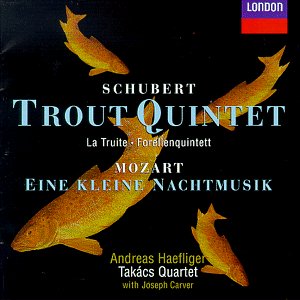 Schubert: Trout Quintet
WA Mozart: Serenade No. 13 for strings in G major (Eine kleine Nachtmusik), K. 525 (1786)
Franz Schubert: Quintet D 667 (Trout)
Hugo Wolf: Italian Serenade Takács Quartet(with Joseph Carver, Double Bass) Decca Records 460034, 1999
Mozart's most famous serenade, Serenade No. 13 for strings in G major, is most commonly known as Eine kleine Nachtmusik. It is the tune the elderly Salieri tested the priest with in the movie Amadeus. It is a piece used in countless soundtracks, commercials, and muzak loops. I have chosen the Takács Quartet recording because it is performed by a string quintet rather than the traditional chamber orchestra most listeners are familiar with. The smaller the ensemble the fewer places to hide: hide mistakes, fluffed notes, slurred passages and the like. The canny Mozart prepared both chamber orchestra and string quartet scores for Eine kleine Nachtmusik. The Takács exercise a sprite and sharp performance of the serenade with a Spring bright allegro opening movement and equally bright but more powerfully sharp closing Rondo: allegro. The middle movements are tender and crystalline, illustrating the power of the smaller ensemble over the larger.
Mozart's serenade is juxtaposed with Franz Schubert's Trout Quintet and Hugo Wolf's Italian Serenade, offering the listener an interesting and informative view from Mozart into his musical future as the Classical Period gave way to the Romantic Period.
Gramophone recommendation:
Serenade No 6, Serenata notturna, K239 -Serenade No 12, K388 /K384a - Serenade No 13, Eine kleine Nachtmusik, K525, Orpheus Chamber Orchestra, Deutsche Grammophon 439 524-2GGA.
 Le Nozze di Figaro
The Marriage of Figaro , K. 492. (1786)
Vienna Philharmonic, Claudio Abbado, Anna Caterina Antonacci, Carlo Allemano, Cecilia Bartoli, Franz Bartolomey, Lucio Gallo, Istvan Gati, Sylvia McNair Decca Records 460034, 1999
Mozart's Don Giovianni is considered by many the greatest opera ever written. It is a grandly majestic stroke on the part of Mozart. Le Nozze di Figaro (The Marriage of Figaro) is by far the most accessible of a very accessible corpus of operatic composition. Its overture is as ubiquitous in our culture as is the previously mentioned Eine kleine Nachtmusik. It is a story of comedy and intrigue involving a barber, his fiancé, nobility, and the greatest mezzo soprano trouser roll in all of opera, that of Cherubino, the horny court page and the reason I selected this particular performance. The roll of Cherubino is filled by Italian mezzo Cecilia Bartoli, a diva who has forged bold roads in the mezzo soprano well beyond Figaro. This is not her only performance of the roll on record either. She also recorded Figaro with Daniel Barenboim on Erato 45501, 1991. With Abbado, Miss Bartoli is coupled with the impelling Sylvia McNair as sparkling Suzanna. The thing here is Claudio Abbado is no Mozartean and his approach tends to the Romantic, with slower tempos in some arias and choruses. The performance in no way lacks gusto, however, and all soloists are robust and durable. It is Bartoli who shines and brings luminescence to the recording making this Cherubino worth the hearing.
Gramophone recommendation:
Le Nozze di Figaro, Glyndebourne Festival Chorus; Glyndebourne Festival Orchestra, Vittorio Gui, Classics for Pleasure CD-CFPD4724.
 Mozart - The Last 5 Symphonies
Symphony No. 41 Jupiter, K. 551 (1788)
Academy of St. Martin-in-the-Fields, Sir Neville Marriner
Decca Records 460034, 1999
Mozart composed 41 Symphonies if one follows the conventional classical wisdom. His final Symphony, dubbed The Jupiter Symphony was composed in a six week period during the Summer of 1788, a summer that also produced Symphonies No. 39 in in E flat, K. 543 and No. 40 in G minor, K. 550, just prior to the publication of The Jupiter. The composer was in his cups: bankrupt and in debt a situation exacerbated by the recent death of his newborn daughter. From this maelstrom of stress arose a revolutionary work destined to foreshadow that revolutionary from Bonn, Beethoven. Critics have long lauded The Jupiter as the summation of symphonic music up to that point. Central to the symphony is the work's final movement where Mozart takes on the titan Bach and produces a five-part counterpoint rivaling the High Baroque Master.
Amid the dust and debris of period instrument performances remains the sublime readings of Sir Neville Marriner and his Academy of St. Martin-in-the-Fields. This suggested recording is a small box containing the Master's final five symphonic works. Sure one could buy the 40th and 41st by Marriner with no problem, but this is a budget set that is too good to pass up. And the performances? The performances are warm and well paced with brisk tempi. Marriner's Mozart possesses a timeless quality about it. As Thomas Cahill says of Luke's Jesus, it is this face that billions expect to see when dying, so Marriner's Mozart is what we hear when recalling a Mozart composition from our subconscious.
Gramophone recommendation:
Symphony No 40, K550 - Symphony No 41, Jupiter, K551, The English Concert, Trevor Pinnock, Archiv Produktion 447 048-2AH
 Mozart Opera Arias
Soprano Opera Arias
Sandrine Piau, Freiburger Barockorchestrer, Gottfried von der Goltz
Naive 8877, 2004
I selected this recent collection of opera arias for soprano voice by French singer Sandrine Piau based completely on her previous release on Handel bel canto arias, GF Haendel: Opera Seria, (Naive 8894, 2004). Of a spate of Handel opera aria releases since 2000, Opera Seria is perfect in all elements: repertoire, accompaniment, and voice - above all, voice. That is why I eagerly awaited the release of Miss Piau's collection of Mozart soprano opera arias. That wait supports the value of delayed gratification as the soprano easily equaled her Handel collection in all respects. Miss Piau's singing is characterized by a ravishing, intelligent, virtuosity. Her voice is petite, sharply focused, and perfectly centered with impressive balance over her entire vocal range. Miss Piau's control and articulation is solid and centered. Her orchestral accompaniment is thoughtfully historically informed, with perfect sonics.
Gramophone recommendation: Not only is there is no Gramophone recommendation for collections of Mozart's Soprano Opera Arias, there is not even a Gramophone category. This is where the writer's prerogative comes in. So, I put forth Barbara Bonney's collection, Mozart Leider, Barbara Bonney, soprano Goeffrey Parsons, piano, Teldec 46334, 1992. This is not a collection of soprano opera arias but of Mozart's art songs. I ask the fussy readers to forgive my license.
The cliche claims from your lips to God's ear. In the case of this composer, it is from God's lips to Amade's ear. Happy Birthday, Wolfgang.
Related Article
"Mozart: Reloaded": A Jazz and Classical Multimedia "Salon"
< Previous
Red Dust
Next >
Lost Children
Comments
About Wolfgang Amadeus Mozart
Instrument: Composer / conductor
Related Articles | Albums | Photos | Similar ToTags
For the Love of Jazz
 All About Jazz has been a pillar of jazz since 1995, championing it as an art form and, more importantly, supporting the musicians who create it. Our enduring commitment has made "AAJ" one of the most culturally important websites of its kind, read by hundreds of thousands of fans, musicians and industry figures every month.
You Can Help
To expand our coverage even further and develop new means to foster jazz discovery and connectivity we need your help. You can become a sustaining member for a modest $20 and in return, we'll immediately hide those pesky ads plus provide access to future articles for a full year. This winning combination will vastly improve your AAJ experience and allow us to vigorously build on the pioneering work we first started in 1995. So enjoy an ad-free AAJ experience and help us remain a positive beacon for jazz by making a donation today.

Giveaway

Days remaining: 4



