Home » Jazz Articles » Bailey's Bundles » George Frideric Handel and His Messiah: The Perfect Holi...
George Frideric Handel and His Messiah: The Perfect Holiday Collection
 Comfort ye
 Comfort ye, my people.
Sayeth your God,
Sayeth your God...
Isaiah 40, KJV
And so begins one of the most readily identifiable Christmas collections on record. It is not a collection in the tradition of collections of familiar carols, hymns, and plainchant. It is a cogently assembled collection of prayers and scriptures, set to music and combined for a specific reason for a specific audience. Since its first performance in Dublin on April 13, 1742, there has scarcly been a year when the famous oratorio has not been performed.
This monumental composition is, of course, George Frideric Handel's Messiah.
Both the composer and oratorio have a colorful history worthy of some descripion, as all larger-than-life things do. Handel's professional life begins with an old joke:
George Frideric Handel was a Saxon who moved to England to produce hot-blooded Italian Opera, went broke and rebounded with pious religious oratorio.
That is the definition of a cosmopolitian, entrepreneurial man. In his salad days, no other composer was more celebrated. Where his contemoprary, JS Bach, would have been considered provential, having never left his native Germany, Handel was international, living large in Germany, Italy, Ireland, England—his remains are interred with honor in the vernerable Westminster Abbey.
Putting Handel into perspective is a writer's challenge. A great deal has been written about Handel, but little is known of his closely-guarded personal life. Quoting New York Times classical music critic Harold C. Schonberg who, in his book The Lives of the Great Composers, said of the Composer and Impresario:
"George Frideric Handel: a big man and a lusty one; a naturalized British subject who spoke English with a heavy accent; a man with an explosive temperment and with all a sweet-tempered and even generous philanthropist; a man who made and lost fortunes in this musical enterprise; the owner of a good art collection, including some Rembrandt paintings; one of the greatest organists and harpsichord players of his day; a man with a simple uncomplicated faith and an equally simple uncomplicated view toward life."
That is a guy I would have like to have known.
Larger Than Life
Handel, the big burly Saxon, tactless and domineering, detonated like an atom bomb, fully formed, into an English Age of the Enlightenment society that encompassed the likes of Alexander Pope, John Gay, Jonathan Swift, Joseph Addison, Richard Steele, and Isaac Newton. It was the age of the first tabloids, the Tatler and the Spectator, of scientific advancement mathematically redefining nature, and of a beautiful assembly of wits, literary figures, eccentrics, nobility, perverts, pederasts, poets, essayists, and politicians. Magically drop St. Paul into the mix and the Apostle would have mistaken eighteenth century London for first century Corinth. No artist today can boast the same notoriety and creative environment as Handel.
The composer's "explosive temperament" is best illustrated in his famous sword duel with Johann Mattheson over Mattheson's demand to take over the harpsichord from Handel during a performance of Mattheson's opera, Cleopatra. The two composers had words, decided to take it outside, and drew swords. During the spar, Handel's coat button deflected what would have been a fatal blow from Mattheson's blade, knocking both men to the ground. The two composers arose, smiled and embraced and went their merry way.
That was George Frideric Handel.
It was this same George Frideric Handel, impetuous and impulsive by nature who, while listening to the great Italian violinist Archangelo Corelli slay one of Handel's compositions, grabbed the violin from the greatest virtuoso in Europe and demonstrated the proper way to play the piece. A sweet natured and generous man, Corelli replied "Mi Il caro Sassone, this music is in the French style, of which I have no knowledge."
Mi Il caro Sassone, My Dear Saxon—this is how the bigger than life Handel was thought of by those he did not manage to insult or offend (and many that he did). Il caro Sassone also had the reputation of possessing sweet temperment and generosity. These traits are no better displayed than through his bequeathing the complete score and vocal parts from his greatest oratorio, Messiah, to an organization dedicated to helping poor children, helping sustain this organization to this day.
Messiah
Few classical, or more appropriately Baroque, musical pieces receive as much attention year in and year out as Handel's monumental Messiah(HMV 56). A perennial holiday favorite worldwide, Messiah was originally composed for performance during Lent, between Ash Wednesday and Easter Sunday. Noted English librettist Charles Jennens originally conceived the oratorio in 1739, following several librettos he successfully produced with Handel (Saul, 1738 and L'Allegro, il Peneroso ed il moderato, 1740). He drew his libretto from the King James Version of the Old and New Testaments as well as the Anglican Book of Common Prayer. Handel composed Messiah between August 22 and September 14, 1741, in a 24-day burst of inspiration. Composing at an impressive clip, even for Handel.
In keeping with the compositional standards of the late Baroque period, Messiah, as well as Handel's other oratorios, was comprised of three sections or acts, a convention adopted from Baroque Italian Opera, a style already well practiced by Handel. Handel was an efficient and facile composer. As the religious oratorio rose in popularity and the popularity of Italian opera was waning in England, Handel adapted to the trend both musically and financially. The Bel Canto nature of his Italian Operas made easy Handel's transition to the oratorio.
Regarding the subject matter for Messiah, Jennens and Handel conceived the breakdown as follows:
- Part I- Prophecy of Salvation,
- Part II- Crucifixion and Death, and
- Part III- Resurrection.
A unique characteristic of Messiah as an oratorio is the absence of character parts. Most oratorios have distinct characters, including a protagonist or hero. In the case of Messiah, the protagonist ostensibly would be Jesus. It is thought that Handel and Jennens had decided to have scripture sung by unidentified entities in anticipation of accusations of blasphemy for having singers depict Jesus and the other major characters in Scripture. As it turns out, this was wise considering the poor reception the oratorio had when finally presented in London.
The first performance of Messiah was presented on April 13, 1742 at the New Music Hall in Fishamble Street in Dublin, Ireland as a charity fundraiser, where it was well-received. Handel had been reluctant to present a sacred oratorio to London theaters for fear of repeating angering the Bishop of London as he had 10 years previously when he employed Cathedral choristers in a performance of Esther. The first London performance was made to a mostly under-whelmed crown during Lent on March 23, 1743. The major criticism was whether the Theater was the appropriate place for a sacred oratorio.
Over the next several years, Handel attempted several failed comebacks for Messiah. Finally in 1750, Handel directed the oratorio on the 1st and 15th of May in support of the Foundling Hospital of London, established by Captain Thomas Coram in 1740. At his death, Handel left the score and all vocal parts to the Foundling Hospital, now the Thomas Coram Foundation, which continues today to benefit from performances of the sacred oratorio. This firmly established Handel as philanthropist and Messiah as a (or perhaps "the") canonical composition in the Western Musical Tradition.
There is no definitive musical text for Messiah. Handel, who personally conducted the oratorio some 36 times, retooled the oratorio throughout the later part of his life, tailoring the piece to the season of its performance and for the singers performing at a given recital. While he typically employed an orchestra of about 40 and a chorus of about 16, Handel did make enough vocal changes to constitute different versions of the work. For simplicity, three main versions from Handel's lifetime can be said to exist (but, understand, there were as many versions as performances directed by Handel):
- The Original 1742 Dublin Version- Handel originally scored Messiah for 2 oboes, 2 bassoons (which were not used), 2 trumpets, tympani, string orchestra, basso continuo, soloist: S(oprano)A(lto)T(enor)B(ass). This score exists in an approximate reconstruction.
- The 1752 Version- This version is the only authentic conventional SATB version.
- The 1754 Version—This is commonly termed as "The Foundling Hospital Version." It was one of the last versions directed by Handel. It contained many later versions of arias, tailored to certain singers, for example pieces changed or newly composed as a virtuoso setting for the Italian alto castrato Gaetano Guadagni, but later recast for a second soprano. Five soloists (SSATB) sing the arias.
In addition to Handel's revisions to his oratorio, Mozart was charged with re-orchestrating Messiah and several other Handel Oratorios. In 1788, at the behest of Baron van Sweiten, Mozart re-orchestrated the oratorios for a series of private performances at the homes of the Vienna elite. Mozart made the changes he did for two major reasons. First, Mozart tweaked the orchestral style, including the phrase length, to make it more contemporary. Second, Mozart added new wind parts, complementing or replacing the original parts as composed by Handel. This was done to support the continuo organ, which was not available everywhere Mozart's arrangement was to be played. Mozart favored a larger chorus, most likely comprised of 30 men and boys, for performances of his arrangement, a larger group than that used by Handel. All of Mozart's changes were made to inject the "Classical" into this Baroque piece.
Most modern conductors have assembled the oratorio as inspired, freely incorporating elements of all three versions in inauthentic concert programs, fairly in keeping with Handel's own practice of tweaking his composition. After Handel's death, there have been many composers and conductors who felt they knew truly Handelian vision. This resulted in continual revision to the score and instrumentation and vocals, the majority with bad results. There dose exist several editions of the oratorio worth mentioning:
- Clifford Bartlett: Messiah. Oxford University Press
- Donald Burrows: Messiah. Edition Peters
- John Tobin: Messiah. Bärenreiter (Hallische Händel Ausgabe)
- Watkins Shaw: Messiah. Novello (New Novello Handel Series)
To further complicate this picture, the erstwhile listener will have to contend with performance practices: modern instruments versus period instruments will have to be considered. Historically informed performance versus contemporary performances will also have to be addressed. This infusion of period practice is the result of a great deal of scholarship. The results are variable, but none of the results are truly bad. In addition to my above breakdown of Messiah versions, the venerable Handel website, GFHandel.org makes the following distinctions and recommendations:
1742 Dublin version (approximate reconstruction):
Worcester Cathedral Choir, Grande Ecurie et La Chambre du Roy, Jean-Claude Malgoire / Sony (Essential Classics) SBK63004
1752 version (only authentic conventional SATB version): Choir of King's College, Cambridge; The Brandeburg Consort; Stephen Cleobury / Argo - 440 672-2
1754 Foundling Hospital version (SSATB): Choir of Christ Church Cathedral, Oxford; The Academy of Ancient Music; Christopher Hogwood / Decca (L'Oiseau Lyre) 430 488-2 Taverner Choir, Taverner Players, Andrew Parrott / Virgin Veritas 5613302 Gabrieli Consort & Players; Paul McCreesh / DG Archiv - 453 464-2
Composite versions:
The Monteverdi Choir; The English Baroque Soloists; John Eliot Gardiner / Philips Digital Classics 4342972
The Choir of the English Concert; The English Concert; Trevor Pinnock / DG Archiv-423 630-2
Bach Collegium Japan; Masaaki Suzuki / BIS-CD-891/892
Comprehensive variants all included on:
UC Berekely Chamber Chorus; Philharmonia Baroque Orchestra; Nicholas McGegan / Harmonia Mundi - HMU 907050.52 (3 CDs)
Mozart's arrangement (in German):
Rheinische Kantorei; Das Kleine Konzert; Hermann Max / EMI Baroque Special-CDS 7 54353 2
Namur Chamber Choir; Grande Ecurie et La Chambre du Roy; Jean-Claude Malgoire / Astrée-Audivis E8509
From my humble perspective, one performance is no better than the next, only different.
Here is a smattering of some recent and not so recent treatments of Messiah for the listener's consideration (in no particular order):
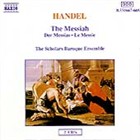 The Scholars Baroque Ensemble
Messiah
Naxos 8.550667
1995
A stripped-down orchestra and chorus give an amazingly full-bodied performance of the original 1742 composition. The soloists are also part of the chorus, in keeping with the standard practice in Handel's time. For the price, this well-received performance should not be ignored. One of a few recordings using the "original" version. 1742 Version on period instruments and historically-informed performance. 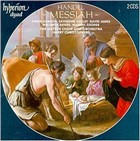 The Sixteen Choir and Orchestra / Harry Christophers
Messiah
Hyperion Dyad 22019
1987
Released in the mid-priced Dyad Hyperion Series, Harry Christophers and The Sixteen provide a crisp period instrument performance. The tempi tend to be slightly fast and all of the soloists are excellent, if not fully up to the level of other recordings. This is a fine middle-of-the-road performance that has much to endorse it. 1754 Version on period instruments and historically informed performance.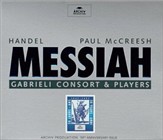 Gabrieli Consort and Players / Paul McCreesh
Messiah
Archiv / Deutsche Gramophone 453464
1997
Confident and swift, McCreesh and the gang turn in a Messiah for the 21st Century. Superbly executed, this thoughtful performance uses the SSATB soloist ensemble favored by Handel toward the end of his life. The sound and sonics are full and bright, even with the period instruments. 1754 Version on period instruments and historically informed performance.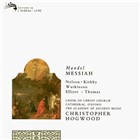 Academy of Ancient Music / Sir Christopher Hogwood
Messiah
L'Oiseau-Lyre 30488
1997
The first Messiah recorded on period instruments with a choir of men and boys. This may be as close to the perfect Messiah in spirit, but the recording is distant, making the strings a bit weak. Still, a fine performance, Emma Kirkby and the rest of the Period Performance Mafia are present. This is essential because it is the Messiah that started it all. 1754 Version on period instruments and historically informed performance.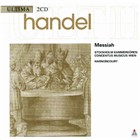 Concentus Musicus Wein and Stockholm Kammerkoren / Nickolas Harnoncort
Messiah
Teldec 18952
1983/1997
This 1982 live recording continues to be well received. Harnoncort, an enfant terrible of period practice makes no attempt to finish Messiah under two hours. Harnoncort chooses the original SATB soloist ensemble as vehicle for a thoughtful, evenly-paced performance. Transparent and beautiful even if the soloists are a bit accented. 1742 Version on period instruments and historically informed performance.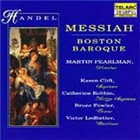 Boston Baroque / Martin Pearlman
Messiah
Telarc 80322
1992
America's premiere period instrument ensemble, the Boston Baroque has made several notable recordings of Renaissance and Baroque favorites. None has been better than their Messiah. Opting for the 1942 Dublin version, Pearlman and his group (SATB) provide a rich and precise reading. 1742 Version on period instruments and historically informed performance.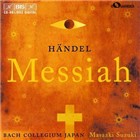 Bach Collegium Japan / Masaaki Suzuki
Messiah
BIS 891/892
1997
This shimmering, near-perfect performance is provided by none other than a Japanese ensemble. Maestro Suzuki learned his craft from Ton Koopman and learned it well. Perfect tempi and sonics. The Brilliant countertenor Yoshikazu Mera is on hand also. Check out BCJ/Suzuki's J.S. Bach Christmas Oratorio (BIS 941/942). 1753 Covent House Version on period instruments and historically informed performance.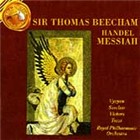 Royal Philharmonic Orchestra / Sir Thomas Beecham
Messiah
BMG/RCA 61266
1997
It is safe to say that the savvy period performance Messiah scholar will have never heard anything like this. Re-elaborated by Sir Thomas Beecham and Sir Eugene Goossens, this Messiah has all of the pre-1960s excesses one would expect from a predominantly Post-Romantic conductor. Beecham's version is performed by a cast of thousands and is loud and proud, just like the Saxon who composed the piece. Modern instruments and a splendidly historically uninformed performance.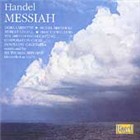 BBC Symphony Orchestra, BBC Symphony Orchestra & Chorus / Sir Thomas Beecham
Messiah
Pearl 9456
1993
The first sound recording of Messiah. Severely edited, replete with pops and scratches from the acetate transfers, this performance is a revelation when one compares this performance to all that came after. This will scare most to death, but to hear the alpha of a musical piece recorded for posterity, this should be in everyone's collection. Modern instruments and again a splendidly historically uninformed performance. Chicago Symphony Orchestra and Chorus / Sir Georg Solti
Messiah
London 14396
1997
Always tasteful, Solti and the CSO coax a warmth from Messiah that only modern instruments can provide. Not overtly Romantic, Solti's performance is powerful without being overpowering. It is an excellent foil to Beecham's vision with more body than a period instrument performance. Dame Kiri Te Kanawa is wonderful. John Tobin Edition on modern instruments and a sensible middle of the road treatment.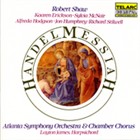 Atlanta Symphony Orchestra and Chorus / Robert Shaw
Messiah
Telarc 80093
1987
Robert Shaw was America's premiere choral conductor. It should come as no surprise that his Messiah would be both tasteful and beautiful. Opting for smaller rather than larger, Shaw puts together a well-balanced Messiah where all parts are permitted to breath, providing a warm modern instrument sound coming from a historically-informed orchestra. Modern instruments, modern performance, on a smaller than modern scale.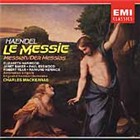 English Chamber Orchestra / Sir Charles Mackerras
Messiah
EMI 69449
1967
Mackerras is one of the few conductors to take on both Handel's original and Mozart's refurbished Messiah. His Handel original is thoroughly modern, like Shaw's, but with a larger orchestra. An interesting reading that is way above average. Fans of Mackerras will want to have this fine performance. Modern instruments, modern performance, on a modern scale.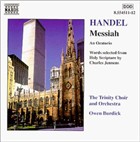 Trinity Choir and Orchestra / Owen Burdick
Messiah
Naxos 554511
1999
Burdick's Messiah is brand spanking new. Owen Burdick is the organist/director of music at New York City's Trinity Church, where Messiah received its New World debut in 1770. This is a sumptuous sensual version of the oratorio. The solos and choruses are full and warm. The orchestration is handsomely and intelligently rendered on a reduced scale. Modern instruments, modern performance, on a historically informed scale. Superior sonics. Bach Collegium Stuttgart / Helmuth Rilling
Messiah
Hänssler 98975
1999
Rilling and his Bach Collegium Stuttgart may be best known for their recording of the complete Bach Cantatas. He is a certainly an avowed Baroque conductor in modern instruments. Fittingly, he chooses the Mozart arrangement in Mozart's original German. The sound is broad and expansive and the vocals are exceptional. Mozart orchestral arrangement on modern instruments with modern performance. Handel and Haydn Society / Andrew Parrott
Messiah
Arabesque 6743
1999
Sung in English as opposed to Mozart's original German, this Messiah distinguishes itself by its pristine period instrument sound. Authentic right down to the use of a forte-piano continuo, this Mozart Messiah is very fine. Andrew Parrott makes a version as fine as his previous Handel version with his Taverner Orchestra and Chorus (Virgin Veritas Imports, 61330, 2000). Mozart orchestral arrangement on period instruments and historically informed performance. London Symphony Orchestra / Sir Colin Davis
Messiah
Philips Duo 438 356-2
1993
Hands down the best modern instrument performance of Messiah. Distinguishes itself by its perfect time. Sir Colin, twenty years on, still hangs on to the best of modern performances. As very fine as Sir Christopher Hogwood's original period instrument offering is, it still cannot surpass Davis' stunning performance. Composite Performance. Taverner Choir and Orchestra / Sir Andrew Parrott
Messiah
Virgin Vertas 3420354 2005
Pristine period instrument sound. Authentic right down to the use of a forte-piano continuo, this Messiah is exquisite. Andrew Parrott makes a version as fine as his previous Handel version with his Taverner Orchestra and Chorus re-released from the original (Virgin Veritas Imports, 61330, 2000). Period instruments and historically informed performance.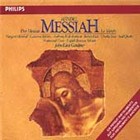 English Baroque Soloists and Monteverdi Choir / Sir John Gardiner
Messiah
Philips 3420354
2003
Originally recorded in 1982 by a young John Elioti Gardiner, this Messiah is a daring iconoclast that barrels ass into everyone's unconscious, making the listener re-think all that has come before. The most superb period instrument performance on record.
Messiah is one of the most visible of classical music compositions. Literally thousands of performances are given around the world, mostly at Christmas and Easter. It is a religious tradition firmly embraced by the secular tradition. Beautifully, some things transcend even the realpolitik and religious. It has been interpreted, re-interpreted, considered, re-considered, studied and re-studied. It comes in as many different flavors as performances and because of this provides something for everyone.
The theologian Stanley Hauerwas, when speaking of the biblical tale, wrote:
God has entrusted us, His Church, with the best story in the world. With great ingenuity we have managed, with the aid of much theory, to make that story boring as hell. Theories about meaning are what you get when you forget that the Church and Christians are embattled by subtle enemies who win easily by denying that any war exists.
And it is so with Handel's Messiah. No less the divinely inspired word, Messiah and its scholarship and theory have a place in providing alternate ways of considering the oratorio, but these alternatives in themselves are not an end, the music is.
This list will certainly not contain everyone's favorite Messiah. I own some thirty performances and have listened to a good many more. These are what are currently floating at the top.
Tags
PREVIOUS / NEXT
Support All About Jazz
 All About Jazz has been a pillar of jazz since 1995, championing it as an art form and, more importantly, supporting the musicians who make it. Our enduring commitment has made "AAJ" one of the most culturally important websites of its kind, read by hundreds of thousands of fans, musicians and industry figures every month.