Home » Jazz Articles » Bailey's Bundles » Artifacts: Three Major Jazz Discoveries
Artifacts: Three Major Jazz Discoveries
But, then again, why ask why?
The year 2005 has seen the release of three sets of previously unknown music by musicians included in critic Scott Yanow's list of Jazz Innovators. That alone should pique any jazz enthusiast's interest.
Regardless of how they got here, or what intrigue took place between the recordings and their release, we are honored to have these recordings. Tired of the same old thing...take these for a ride.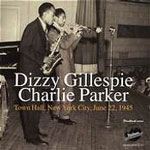 Dizzy Gillespie & Charlie Parker
Town Hall, New York City, June 22, 1945
Uptown
2005
In the day, the music contained on Town Hall, New York City, June 22, 1945 was not only fresh, it was revolutionary and definitive of change. In spite of this, it is difficult, nay impossible, for contemporary ears to listen to these sides and not say, "one more poorly archived performance of "Night in Tunisia. That is why a shot of context is in order.
The previous May 8th was VE day, the end of World War II in Europe. The war in the Pacific was to rage until its apocalypse on August 8th and rapture on September 2nd. Glenn Miller had been missing since December 15th the year before. In New York City, on 52nd Street, between 5th and 6th Avenues, jazz was downsizing back to the trios, quartets, and quintets of pre-Swing. The dance era was coming to an end with the war and jazz was returning to its innovative roots by changing everything. The result, "Modern Jazz or "Be Bop, would color jazz for the rest of the 20th Century and beyond.
In February and May 1945 Dizzy Gillespie and Charlie Parker took small groups into the studio and waxed six masterpieces: "Groovin' High, "All the Things You Are, "Dizzy Atmosphere, "Shaw 'Nuff, "Hot House, and "Salt Peanuts. These compositions the great Louis Armstrong would eventually call "Chinese Music." This musical movement is as harmonically different from Swing as Le Sacre Du Printemps is from Le Nozze De Figaro.
Mildly controversial among some critics was the unedited inclusion of Symphony Sid's inciped patter between songs, peppered with the period use of the perjorative "boy" at every turn. In the first place, we cannot critically hold the period hostage to modern political correctness. The conversation is an accurate account of the vernacular of the time, no matter how distasteful. The fact that it today sounds like fingernails on a chalkboard is a tribute to how far we have come from those pre-civil rights days of condesention and oppression. The music, of course, speaks for itself.
In May and June 1945, the New Jazz Foundation sponsored jazz concerts at New York City's Town Hall. This recording is the latter of these performances. While the sonics are not optimum, the electricity generated by Gillespie and Parker at the top of their games is. What John Birks Gillespie and Charles Parker expelled from their horns was genius illuminated by lightening flash. Scintillating might be the best, yet profoundly anemic description of this music. Coleridge encouraged a willing suspension of disbelief in the preface to Lyrical Ballads. I appeal to listeners, to hear this music as if for the first time. This is a musical Burning Bush.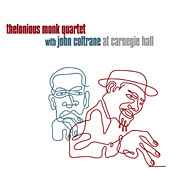 Thelonious Monk
Thelonious Monk Quartet with John Coltrane: At Carnegie Hall
Blue Note
2005
There are no less than six reviews of Thelonious Monk Quartet with John Coltrane at Carnegie Hall at this website. These reviews are penned by the right honorable Samuel Chell, Chris May, John Kelman, Jim Santella, David Rickert, and Norman Weinstein. These writers all are the cream of the crop at the website. I have little to add to what these fine writers have expressed except that the music on this disc is so well performed, so well recorded, and so essential that its discovery and release of tantamount to the 2005 discovery a draft score for Beethoven's Grosse Fugue for Piano-Four Hands, at the Palmer Theological Seminary in Philadelphia. The Monk/ Coltrane musical collaboration has a historically too finite sessionography that is well worth reprising:
- Thelonious Monk/John Coltrane: Reeves Sound Studios, NYC, Apr. 16, 1957 (Thelonious Monk Himself Riverside)
- Thelonious Monk/John Coltrane: Reeves Sound Studios, NYC, June 25, 1957 (Blues for Tomorrow Riverside)
- Thelonious Monk/John Coltrane: Reeves Sound Studios, NYC, June 26, 1957 (Thelonious Monk/John Coltrane Riverside)
- Thelonious Monk/John Coltrane: Reeves Sound Studios, NYC, July, 1957 (Thelonious Monk with John Coltrane Jazzland)
- Thelonious Monk/John Coltrane: Five Spot Cafe, NYC, Sep. 11, 1958 (Thelonious Monk Quartet Live at the Five Spot Discovery! Blue Note)
Context is everything: 1957. Miles Davis and his first great quintet had just finished recording their marathon document concluding their commitment to Prestige Records the previous October and were in the process of moving to Columbia, when in April 1957 the bandleader tired of Coltrane's heroin-induced unreliability and fired the saxophonist. The previous year, Monk, who witnessed the mercurial Davis striking Coltrane back stage, immediately offered Coltrane a job that became available in early 1957. Between April 1957 and September 1958, John Coltrane performed and recorded and part of the Thelonious Monk Quartet. This period included an almost mythic stint at the Five Spot Cafe and a period of personal and spiritual growth, under the tutaledge of Monk that would result in the end of his heroin addiction and the beginning of ten years of creativity seldom matched in jazz.
In November 1957 Coltane appeared with Monk in a fundraising concert held at Carnegie Hall. Two sets were recorded and then safely stored at the Library of Congress until their discovery this past year. These performances are vastly superior to the only other live recording testament of the Monk-Coltrane axis, Thelonious Monk Quartet Live at the Five Spot Discovery! They also find Coltrane weeks away from rejoining Miles Davis in the trumpeter's sextet that would go on to complete 'Round About Midnight, and record Milestones and Kind of Blue.
Recorded at Carnegie Hall is a confident Coltrane who assimilated all Monk had to offer him in the previous nine months. The pair emerge on Thelonious Monk Quartet with John Coltrane At Carnegie Hall as what can only be termed jazz perfection. From the opening ballad "Monk's Mood" to the incomplete closing theme, these two titans reveal what could have been...perhaps small jazz group greater than the subsequent Miles Davis Sextet. This is a musical grail.
 John Coltrane Quartet
One Down, One Up: Live at the Half Note
Impulse!
2005
From Thelonious Monk Quartet with John Coltrane At Carnegie Hall break ahead 8 years to 1965 on One Down, One Up: Live at the Half Note and the listener will be treated to a much different, but not totally surprising John Coltrane. March 26th and May 7th, 1965 lies toward the end of the watershed period for John Coltrane and his "classic" quartet. Coltrane closed 1964 recording his seminal A Love Supreme and began 1965 starting The John Coltrane Quartet Plays, which the quartet completed just after the Half Note performances. This is late in Coltrane's lengthy transition from his Be Bop and Hard Bop roots to the practice and perfection of Free Jazz that would occupy the saxophonist until his death in 1967.
Disc one presents the March 26th performance and, as expected for the period, the performances are lengthy. The music opens with a near half-hour of "One Down, One Up," originally released by Impulse on Dear Old Stockholm. The performance is incendiary, opening with a Jimmy Garrison solo and containing a long trademark duet between Coltrane and drummer Elvin Jones. Advertising hyperbole describes this performance as "perhaps Coltranes greatest improvisation." It is groundbreaking, the type of performance that occurs through conflict and ultimate dissolution of the current status quo in search of a new one. These performances were among the last of the classic Coltrane quartet. After this John Coltrane sought spiritual assumption with a new cast of characters.
The signature "Afro-Blue" follows "One Down..." and offers a relief from the exhausting opener. It is a waltz time piece favored by Coltrane in the same vein as "My Favorite Things" and "Greensleeves."
Disc 2, recorded on May 7th, contains "Song of Praise," at the time slated for release on The John Coltrane Quartet Plays. The disc ends with the ubiquitous "My Favorite Things."
This music was contained on two tape reels stored at the Coltrane family home. Impulse! had never intended to release the Half Note performances in spite of the fact that some sonically inferior performances made it into the bootleg stream. The sonics of this performance are excellent and this release is the most significant of the late Coltrane period. Touted as the most boring genius in jazz, these performances show the quartet in full bloom, taut and creative with none of bloated improvisations to come. For early and middle period Coltrane fans, this is the missing link to his final creative period.
Town Hall, New York City, June 22, 1945
Tracks: Intro; Bebop; Night In Tunisia; Groovin' High; Salt Peanuts; Hot House; Fifty Second Street Theme.
Personnel: Dizzy Gillespie: trumpet; Charlie Parker: alto saxophone; Don Byas: tenor saxophone; Al Haig: piano; Curley Russell: double bass; Max Roach, Sid Catlett: drums.
At Carnegie Hall
Tracks: Monk's Mood; Evidence; Crepuscle With Nellie; Nutty; Epistrophy; Bye-Ya; Sweet & Lovely; Blue Monk; Epistrophy.
Personnel: Thelonious Monk: piano; John Coltrane: tenor saxophone; Ahmed Abdul-Malik: bass instrument; Shadow Wilson: drums.
One Down, One Up: Live at the Half Note
Tracks: CD1: Introductions And Announcements; One Down, One Up; Announcements; Afro Blue. CD2: Introductions and Announcements; Song Of Praise; Announcements; My Favorite Things.
Personnel: John Coltrane: soprano saxophone, tenor saxophone; Alan Grant: spoken vocals; McCoy Tyner: piano; Jimmy Garrison: double bass; Elvin Jones: drums.
Tags
PREVIOUS / NEXT
Become a Sustaining Member

Since 1995, All About Jazz has championed jazz as an art form and supported the musicians who create it. Over three decades, it has grown into one of the world's leading jazz resources, serving hundreds of thousands of readers, musicians, presenters and industry professionals each month.
Help Build the Future of All About Jazz
Your support helps us continue building All About Jazz for the next generation—expanding our editorial coverage, preserving jazz history, developing new community features and creating better ways to discover the music and the people behind it.
Become a sustaining member for as little as $20 per year and you'll immediately enjoy an ad-free experience along with access to subscriber features and future articles for a full year.
Together, we're not simply sustaining All About Jazz—we're building its future. Thank you for being part of the journey.