Home » Jazz Articles » Rhythm In Every Guise » Shelly Manne & His Men At The Black Hawk
Shelly Manne & His Men At The Black Hawk

Manne's steadfast drumming, however, is not synonymous with monotony. Utilizing intelligence and imagination instead of dazzling technique, he produces a variety of sounds from a conventional four-piece drum set and a few cymbals. Manne has a knack for repositioning himself within the music without breaking the flow or continuity. When backing a soloist he'll often foreground one or two components of the drum kit, then promptly switch to others. Despite the frequent use of recognizable patterns, there's nothing schematic about Manne's playing. Furthermore, he's resourceful and creative even at slow tempos and very low dynamic levels.
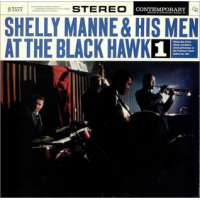 Throughout Shelly Manne & His Men At The Black Hawk (Contemporary), the near-classic sides (reissued on five compact discs) he recorded live with a working band in September of 1959, Manne displays a brilliant improvisational sensibility. At the helm of a conventional hard bop unit, consisting of two horns (trumpeter Joe Gordon, and tenor saxophonist Richie Kamuca) and rhythm (pianist Victor Feldman and bassist Monty Budwig), the drummer places himself deep inside the music, picking up on virtually everything that goes on around him. Contrary to his revered contemporaries Art Blakey and Max Roach, Manne never gets insistent, preferring to influence rather than dictate the proceedings. Manne's relatively light touch is nonetheless firm and decisive. Even at the wickedly fast tempos of tracks such as "Poinciana" and "Theme: A Gem From Tiffany" you can sense Manne's mind at work; weighing the possibilities while he responds in the moment to the exigencies of the music.
 Moving at a dirge-like pace for nearly 12 minutes, the band's rendition of Gershwin and Heyward's "Summertime" (Volume 1, Track 1) never becomes tedious, partly because of Manne's melding of rhythms and textures. Despite his supportive role in maintaining the solemn disposition of the music, there's a restless quality to the drummer's work. A pulse can usually be heard, via the hi-hat pedal on beats 2 and 4, some nimble ride cymbal patterns, or standard issue brush strokes; yet none of these things become too familiar due to Manne's penchant for unceremoniously moving from one to another, while spontaneously integrating other elements. Never playing above mezzo forte and usually much softer, he often highlights pairs of sounds from different parts of the drum kit. During the beginning of Gordon's solo, for example, the wispy hiss of a brush on cymbal lies under the steady clap of the hi-hat. Behind Kamuca's turn, slapping single strokes with sticks to the snare are mixed in with precise eighth-note triplets to the bass drum.
Two separate takes of Benny Golson's jaunty "Step Lightly" constitute some of Manne's finest medium tempo efforts on the five discs. Consistently staying under Budwig's sturdy bass line, his playing on the head of the first version (Volume 2, Track 1) is a lesson in how to help a band swing without making a fuss. As always, the small, seemingly inconsequential details of Manne's drumming add up to something special. During the ten-measure "A" section of the 38-bar tune, as the hi-hat pedal on beats 2 and 4 clearly delineates the pulse, his ride cymbal work is barely audible. When the section repeats the cymbal is louder and more clearly defined, giving the music just a little more of a bounce. On the eight-bar bridge he briefly answers the horns with an odd, twisting fill between the snare and toms that momentarily jars the band's march-like momentum. Although he stays in the pocket when the band returns to the "A" section, Manne is a bit more active, throwing in one prominent shot to the bass drum, a quarter note triplet on the snare that ends with a light cymbal crash, and a vigorous buzz stroke to the snare.
The challenges for Manne on both versions of "Step Lightly" are to keep things moving and sustain an easygoing groove for long periods of time (the tracks are 12:38 and 14:13, respectively). He does this very effectively in part by adhering to the basics of steady time, clearly defined sticking and footwork and, most of all, a willingness to listen and lock into Budwig's line. Manne possesses a very large bag of tricks—he doles them out patiently and selectively. During Kamuca's first chorus (Volume 2, Track 1) he lays back and allows us to appreciate the warmth of Budwig's walking, judiciously adding snare drum accents (a good fit with one of the tenor saxophonist's repeated phrases), some eighth-note triplets to the ride cymbal, as well as single strokes to a partially opened hi-hat. A few nicely placed hits to the mounted tom-tom indicate a building of intensity for Kamuca's second chorus, and Manne follows with a rim knock on the fourth beat of each measure that, in terms of timbre, meshes with the slap of the hi-hat pedal on 2 and 4. As if to throw off the chains of this intentionally rigid pattern, he changes the hi-hat rhythm for several measures, playing the second and third beats of a quarter note triplet, briefly creating the illusion of accelerating the tempo when in reality everything stays in place.
By Manne's somewhat conservative standards, the head of an up-tempo version of Tadd Dameron's "Our Delight" (Volume 1, Track 2) is exceptionally busy and assertive. Moving around the drums with abandon, Manne sounds like he's riding herd over a big band, reminding us of the years spent in Stan Kenton's behemoth ensemble. Aggressively nailing the contours of Dameron's composition, it's one of those rare instances on the Black Hawk sides when he challenges the front line instruments. During the "A" section he fills all of the space left by Gordon and Kamuca with variations of fast single stroke rolls to the snare and toms. He briefly lets up on the bridge and plays straight time, but then adds exaggerated shots to the bass drum in unison with the horns. After busting loose again on a repeat of the "A" section Manne does an about face for Kamuca's solo, reverting to a more conventional—but no less effective—timekeeping role. Manne lowers his volume and sparingly integrates terse snare and bass drum combinations into the steady ride cymbal and hi-hat rhythms. In the middle of the tenor saxophonist's second chorus, he introduces a hopping, riff-like figure to the bass drum, and repeats it later on during Gordon's turn. Another simple but propulsive device is Manne's riding one cymbal for a period of time then switching to another. The light ringing tone followed by a hard metallic ping instantly adds another dimension to the band's momentum.
Unlike his disciplined up-tempo timekeeping on the rest of the track, Manne ends "Theme: A Gem From Tiffany" (Volume 4, Track 4) with a stunning rubato drum solo. Singing and grunting beneath the sounds of his brushes, Manne jams together two very different strains of rhythms at an interval of a few seconds and then repeats variations of them. Sounding like an untutored child's frustrated attempts at playing a melody on the piano, the first strain consists of hard slapping strokes that lurch between the snare and tom-toms, with irregular bass drum punctuation. It's as if he takes a perverse pleasure in exposing the differences between the drums' tone and timbre. The second, a burlesque of the standard ride cymbal rhythm played on the closed hi-hat, brings to mind Manne's abandonment of the track's original rapid tempo. Very different from anything else on the five discs, it's a sly, willfully unhinged performance.
< Previous
Jeff Gauthier & Cryptogramophone Records
Comments

Tags
For the Love of Jazz
 All About Jazz has been a pillar of jazz since 1995, championing it as an art form and, more importantly, supporting the musicians who create it. Our enduring commitment has made "AAJ" one of the most culturally important websites of its kind, read by hundreds of thousands of fans, musicians and industry figures every month.
You Can Help
To expand our coverage even further and develop new means to foster jazz discovery and connectivity we need your help. You can become a sustaining member for a modest $20 and in return, we'll immediately hide those pesky ads plus provide access to future articles for a full year. This winning combination will vastly improve your AAJ experience and allow us to vigorously build on the pioneering work we first started in 1995. So enjoy an ad-free AAJ experience and help us remain a positive beacon for jazz by making a donation today.

Giveaway

Eligible winners: 15
Days remaining: 5
Days remaining: 5