Home » Jazz Articles » Bailey's Bundles » Two Volume 2s: Mulgrew Miller and Jessica Williams-Live at Yoshi
Two Volume 2s: Mulgrew Miller and Jessica Williams-Live at Yoshi
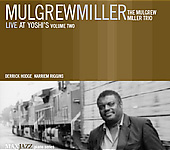 Mulgrew Miller
Live at Yoshi's Volume 2
MaxJazz
2005
Mulgrew Miller's followup to his well-received Live at Yoshi's Volume 1 continues boldly were that release let off with two-fisted pianism full of block chords and arpeggio flourishes. It is a fair evolutionary comparison to say that Miller and his current trio with bassist Derrick Hodge and drummer Karriem Riggins are the logical outgrowth of the Red Garland/Paul Chambers/Art Taylor trio of the '50s and '60s, forty years later. While the songs are updated and the original compositions more complex, the sympatico remains the same for both groups. Miller opens the disc with Victor Feldman's "Joshua, making me wonder if this is not how Garland would have sounded with Tony Williams playing drums rather than Philly Joe Jones or Art Taylor. "Joshua is populated with aural hand grenades tossed left and right by Riggins. Hodge keeps the time while Miller and Riggins dual in a John Coltrane/Elvin Jones fever.
The ballad "Comes Love further deepens the Mulgrew Miller/Red Garland connection, Miller playing with less muscle and more finesse. Hodge and Riggins perform similarly. This is also true on the beautifully displayed "Little Girl Blue. The swing is gentle and light, but more advanced than Garland would have sounded. Miller's timing is much more elastic, but never so much that it robs the listener of the melody. Miller honors the late James Williams by playing the composer's upbeat "Road Life, a rollicking, straight-ahead blues that picks up momentum with every chorus. He works out those tired twelve-bars as if they were newly minted. Bassist Hodge is allowed a solo that walks over the boardwalk laid down by Miller. They take turns keeping time in the piece during the solo.
The most compelling of the pieces is Miller's own "One's Own Room, which has an extended introduction by Hodge. This is a composition characterized by rhythm as opposed to harmony and melody. Hodge offers a variety of variations on a simple theme before Miller enters and nails down the motif. The lengthiest piece on the recording, "One's Own Room, provides the trio individual and collective space with which to explore the theme. Miller closes the set, appropriately enough, with a Tony Williams tune, "Citadel. He approaches the piece calmly, exploring its off-tone character and inner complexity. When the band enters, the steady 4/4 takes hold, making one's foot tap, until a certified Williams interlude interrupts the proceedings and a rhythmic fire fight occurs, never growing out of control. Control may be that element common to both Miller and Garland, though they're forty years apart. The pianists exercise it wisely and with restraint.
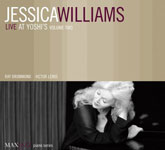 Jessica Williams
Live at Yoshi's Volume 2
MaxJazz
2005
The first volume of Jessica Williams' trio recordings live at Yoshi's extended the reputation she had already established on MaxJazz with This Side Up and All Alone. Williams plays the piano with a complete reverence and total disregard for those piano forces that came before and after. Her piano style, more than any other pianist currently playing, has assimilated all styles and she can fluidly move from one style to the next, often within the same piece.
Where her compatriot Miller storms out of the shoot with an aggressive "Joshua. Miss Williams begins quietly with Miles' "Flamenco Sketches surreally introduced with Williams strumming the piano strings and bassist Ray Drummond setting up the signposts for Victor Lewis to brush in. This is apoplectically sumptuous ballad playing. Sharply juxtaposed to the easy flow of "Sketches is Williams' schizophrenic canon introducing the Hammerstein/Kern piece "Why Do I Love You. The construction is sheer genius, never even approaching consonance until the whole band joins her in a swinging take on the tune. Williams out-Monks Monk with this introduction in the category of hard corners in music. Following the head, things drop low with Drummond picking up the stroll and Lewis lays down the groove for Williams to solo over. She returns the favor when it is time for Drummond to step up for several choruses. She closes the piece with style, quietly descending back into the schizoid intro with a trill.
The next pieces are three of her four original compositions on the disc. "Spoken Softly is a ballad with a deceptively turbulent minor center. "Elbow Room is exactly what Williams creates with a complex Monkian blues waltz that allows the pianist to play in the piano's lower register, where she solos, quoting "Blue Monk and "A Rhapsody in Blue. As the swing straightens out, the pianist's soloing becomes more facile and her left hand more propulsive. Drummond solos over Williams chording seamlessly. Lewis, ever the perfect time keeper, quietly plies his trade, keeping the other two on course. "Soldaji is a descending chordal pattern over Drummond's arco bass, almost a nocturne in the beginning with a ripple of anxiousness in the high keys. Lewis provides a soft Caribbean beat, echoing Williams' left hand. A full 2:30 into the piece, all three principles come together and over the remaining choruses slowly build the unrequited tension anticipation, a set of variations on a theme, with each member improvising.
Williams approaches Sonny Rollins' "Paul's Pal from the point of view of the saxophone, approximated on the piano. Her solos pay homage to the tenorist, honoring his lyricism and grace. "Lulu's Back in Town finds the pianist in a strident mood, playing the dozens with Willie "The Lion Smith. This is perfect throwback to throw into the mix this musical chemist is cooking up—pure fun.
A lengthy introspective "Summertime closes the recital. Williams navigates the standard carefully, with a languid and tender caress. On this always humid piece, slow and narcotic, the pianist draws from the creation of Gershwin an entire season of ideas, concepts, motives, and notes. With ebb and flow the piece builds velocity slowly and with purpose, never getting raucous or loud. Just keeping the tension on and continuing to prove an observation that I made three years ago: "...Williams has the facility to play in any damn style she likes, thank you! In the end Jessica Williams plays like Jessica Williams."
Tracks and Personnel
Mulgrew Miller - Live at Yoshi's Volume 2
Tracks: Joshua; Comes Love; Road Life; It's Easy To Remember; One's Own Room; Little Girl Blue; Citadel.
Personnel: Mulgrew Miller: piano; Derrick Hodge: bass; Karriem Riggins: drums.
Jessica Williams - Live at Yoshi's Volume 2
Tracks: Flamenco Sketches; Why Do I Love You; Spoken Softly; Elbow Room; Soldaji; Paul's Pal; Dear Gaylord; Lulu's Back In Town; Summertime.
Personnel: Jessica Williams: piano; Ray Drummond: bass; Victor Lewis: drums.
Tags
PREVIOUS / NEXT


Become a Sustaining Member

Since 1995, All About Jazz has championed jazz as an art form and supported the musicians who create it. Over three decades, it has grown into one of the world's leading jazz resources, serving hundreds of thousands of readers, musicians, presenters and industry professionals each month.
Help Build the Future of All About Jazz
Your support helps us continue building All About Jazz for the next generation—expanding our editorial coverage, preserving jazz history, developing new community features and creating better ways to discover the music and the people behind it.
Become a sustaining member for as little as $20 per year and you'll immediately enjoy an ad-free experience along with access to subscriber features and future articles for a full year.
Together, we're not simply sustaining All About Jazz—we're building its future. Thank you for being part of the journey.