Home » Jazz Articles » AAJ PRO » Musings of a Jazz Camp Junkie
Musings of a Jazz Camp Junkie
Hey kid - It's not a bicycle race!—Response to a student question regarding who was the better sax player
When one thinks of a jazz camp, it might be tempting to visualize a place where high school kids hang out. Actually, jazz camps, or workshops as they are sometimes called, encompass a very broad range of age groups, even including players up to their eighties. They do have mostly college and high school age kids, but a significant percentage of the attendees are non-music professionals (lawyers, doctors, engineers, nurses, etc.) who wish to hone their skills in an area they are really passionate about, the performance of jazz music. Many are music semi-professionals, but pursue it as an avocation rather than a full time career.
These workshops typically last a week, starting on a Sunday and commencing sometime during the following weekend. Sometimes because of their popularity they have to split their sessions into two or more one-week segments. Each July, Jamey Aebersold has two sessions, each one having close to 400 students.

One of Jerry Coker's student combos at the Aebersold Jazz Workshop.
One of the organizers' main areas of concern is some kind of placement process, i.e. how does one place students with others of like ability? From the standpoint of student satisfaction, it is imperative to place beginner, intermediate or advanced students with others that play at the same skill level. This is done by either a pre-workshop tape submittal, or by an in-person audition at the very start of the camp.
The workshops' choice and number of faculty members is largely dependent upon their budgetary constraints. The larger workshops, such as those conducted by Centrum in Port Townsend, WA, or Jamey Aebersold's workshop in Louisville, KY, can afford to bring in the best musicians and educators. For example, last summer Aebersold brought in David Hazeltine (piano), Scott Wendholdt (trumpet), Rich Perry, Jim Snidero (saxophones), Conrad Herwig (trombone) from the "big apple and Jerry Coker (saxophones, theory) from Tennessee. These are famous names, but it not sufficient just to be well known. To illustrate: Once, Gerry Mulligan was asked to help with a student big band, so they played one of his charts. One of the instructors asked him to comment about their performance. He thought for a minute, then remarked "Play it better.
A workshop day typically starts off at 9 AM with music theory classes of several different levels, the placement decided by a written test at the beginning of the week. Then there are the master classes where everyone of a particular instrument congregates with a faculty member specializing on that instrument. Optionally, there may be listening sessions, where a faculty member plays recordings and elicits student discussion about them.
These are followed by the combo rehearsals, where each group consists of those at approximately the same skill level, supervised by a faculty member. If several hours are devoted to rehearsals, the day may be split into two sessions. Finally, at the end of the day are the faculty concerts. Depending upon the size of the faculty, there may be a faculty concert every day, or just one concert near the end of the week. As a highlight of the Aebersold clinic we also had a daily lunchtime concert at Masterson's, a restaurant located adjacent to the U of Louisville. They had moved in a Hammond B-3 organ from Aebersold's basement, masterfully played by Bobby Floyd from Cincinatti. He really kicked butt, accompanied by drummers such as Steve Davis or John Riley, with Dave Stryker on guitar.
After the faculty sessions are the improptu student "jams, where the students congregate on their own. I don't feel that those accomplish much, because they are totally unsupervised. However, for some students, it's their only chance to practice what they are learning.
Of all the activities mentioned above, the only one that requires student attendance is the combo rehearsals. They usually consist of a rhythm section with two to five horns. Depending upon student participation level and interest, there also might be a formation of a big band. Last summer at Centrum, there were two, supervised by Jay Thomas and Clarence Acox. They typically play quality charts by Mantooth, Florence, Holman, Barduhn, Sebesky, and Niehaus, to name a few.
Often, these workshops have a significant vocalist component. For example, the Vermont Jazz Center last summer sponsored a workshop with about sixty participants, but one-third of them were vocalists. In that case, the vocal coaches were Sheila Jordan and Jay Clayton, who focused more on traditional stylings. They provided "helpers, or students who provided the vocal accompaniment to practice with. The helpers get some reduction in their tuition for that service as part of a work-trade arrangement.
Finally, the week is capped by the student combos, big bands and vocalists performing what they have been rehearsing, usually for the general public. The audience typically consists of the students' friends and family members. In Aebersold's workshop, Rufus Reid was my combo instructor. We didn't have a bassist, so he not only rehearsed with us, but played with us at the final concert. I thought I'd died and gone to heaven.
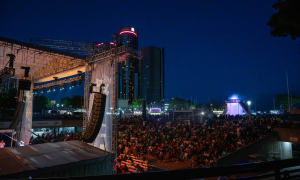
Often, the jazz workshop coincides with a jazz weekend for the general public. Their strategy is to minimize the travel expenses for the faculty by combining the two activities, since the workshop faculty members are also the weekend performers. For example, during the last weekend of July, the Centrum workshop had "Jazz Port Townsend in their McCurdy auditorium for the lunchtime and evening concerts, starting Thursday evening and commencing Sunday morning. The evening concerts ended at 11 PM, then those that want more went downtown to "jazz in the clubs, held at several restaurants. To alleviate parking problems, the concert organizers provided free shuttle bus service for ticket holders.
I was one of those who brought their spouse along. She did not want to participate in the jazz camp activities, but there were plenty of local tourist activities, such as museums, hiking trails, art galleries and libraries to occupy her day. Non-musicians who want to be more active can "audit the workshop, meaning that they can attend the concerts, but don't perform or take any instruction.
What about cost? Typically the tuition is from $350 to $500, but may be much higher if meals or lodging is included. Adding other incidentals, such as air fare and car rentals, the total cost for one week can easily reach about $1500.
Finally, what does one gain from attending one of these workshops? There is a great comradery from sharing a week with fellow jazz players. And one also gets to rub shoulders with great musicians with ideas that are freely imparted. One advantage of getting instruction from this source is they have nothing to lose by being honest. The workshop instructors are paid to be straightforward, whether it is praise or criticism. Once a famous saxophonist at Centrum was pestered by one of the students regarding who was better, Ben Webster or Lester Young. Finally the instructor threw up his hands and said, "Hey kid -It's not a bicycle race!
As a gigging pianist I received some valuable ideas regarding accompaniment: How to better stay out of the way of the soloist, especially when sharing the stage with a guitarist, where we have to avoid clashing with each other. Beyond that, I got a stronger sense of self-worth as a musician and a more open-minded attitude of seriously trying to get with the music.
Tags
PREVIOUS / NEXT


Become a Sustaining Member

Since 1995, All About Jazz has championed jazz as an art form and supported the musicians who create it. Over three decades, it has grown into one of the world's leading jazz resources, serving hundreds of thousands of readers, musicians, presenters and industry professionals each month.
Help Build the Future of All About Jazz
Your support helps us continue building All About Jazz for the next generation—expanding our editorial coverage, preserving jazz history, developing new community features and creating better ways to discover the music and the people behind it.
Become a sustaining member for as little as $20 per year and you'll immediately enjoy an ad-free experience along with access to subscriber features and future articles for a full year.
Together, we're not simply sustaining All About Jazz—we're building its future. Thank you for being part of the journey.