Home » Jazz Articles » Profile » Jacques Coursil
Jacques Coursil

For years, I slept three hours a day. I would go to the theater at 1 am because someone was having a rehearsal there, someplace in a warehouse. I would meet all sorts of people. People were friendly, open, not keeping their stuff for themselves.
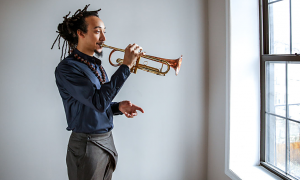
 Since Henry Grimes' resurfacing, the bar has been raised for dramatic stories of life away from music. During the summer, trumpeter Jacques Coursil released a new record, his first since 1969. Was there a commensurate exciting story for his long sojourn away from music? Not really. Since an early age, music has just been one of many careers and interests Coursil has had. He only spent the last few decades receiving two Ph.D.'s and most recently completing a Visiting Professorship at Cornell University. "Those things come by scientific reputation, Coursil recounted. "I met someone several times in colloquiums and we had affinities in various subjects and they were looking a visiting professor because they were in need of filling some empty slot. I was at that time teaching at the University of the West Indies [in Martinique]... In Cornell, I teach Francophone Literature... colonialism, post-colonialism, things like that with regard to issues. My position is kind of a philosopher but I had my training in linguistics and philosophy of language and all that goes with linguistics.
 Prior to recording Minimal Brass (Tzadik) this year, Coursil's last sessions were his first two as a leader close to 40 years prior: Black Suite with Anthony Braxton and Burton Greene and The Way Ahead. These two entries into the BYG-Actuel catalogue were some of the label's strongest, particularly because of Coursil's compelling compositions. Though he was recording with ex-pats like Braxton and Greene (Coursil also participated on Greene's own BYG disc Aquariana), he was actually an ex-pat returning home for these recordings.
Coursil was born in Paris but moved to New York in 1965. "In 1965, just around the assassination of Malcolm X, this is a natural propensity of a person of me like, having been in Africa, Senegal, West Africa, now I got to see the United States. I sold my library, I was not old at the time, I was 28 but I had a lot of books so I sold my books, paintings and I started playing almost immediately. Coursil is nostalgic for those early days in New York, a much different time for the city. "New York has changed considerably. It was extremely appealing. For years, I slept three hours a day. I would go to the theater at 1 am because someone was having a rehearsal there, someplace in a warehouse. I would meet all sorts of people. People were friendly, open, not keeping their stuff for themselves. This environment was a particularly expansive one. The October Revolution in Jazz was still fresh and the movement of free players in New York was substantial. The young trumpeter, whose experience was more traditional, found the city invigorating and in line with his philosophical thinking, concepts that would serve him in his then future career. "I had a lot of things intellectually also to unlearn all the time. This is how knowledge goes, it doesn't pile up, it takes out what was only beliefs and it gets clearer and clearer or maybe it becomes the opposite, it becomes more chaotic because you discover a fact you believed was true was not... What I am interested in is how people listen, not what they want to listen to... The human is a musical animal basically. So I am not trying to play things for him that he wants but things that he can hear in his range, his capability of listening.
Coursil played around a lot during the '60s and appeared on two recordings for the ESP label - the home for the New York avant-garde. Sunny Murray's eponymous debut and Frank Wright's second disc for the label, Your Prayer, are monumental documents of the genre. Coursil even recorded his own disc for ESP in 1967 with Marion Brown but it remains unissued because, as Coursil says, "I was afraid he would publish the record under Marion Brown's name. I think he was about to do that. I would have been extremely mad, not that I have anything against Marion, but this is my record with compositions that I wrote, very funny bebop Ornette Coleman type of stuff. For those who lump Coursil squarely in with the free movement, hearing him talk about his influences belies that notion: "When I was a kid I was studying the cornet. You cannot match the French masters on the cornet. Those guys are too much, especially the tradition of the 19th century. And then came Armstrong, no rubato, no virtuoso at all but such a timbre, such a clarity of timbre. You hardly know those people before him existed... vanished into the garbage can of history.
 Just around 1975, when Coursil would leave New York to begin his career in linguistics, he had a musical moment that would only come to fruition 30 years later with the recording of Minimal Brass. "I was walking on Park Avenue late in '75. I met my good friend Jimmy Owens who is the finest trumpet player ever with a lot of soul. And I said to him 'Would you tell me how to do circular breathing?' And as he was walking towards his home, he picked up straws from the cafeteria and he showed me the trick. And then I think I willed myself into that and started stopping all the clichés that I heard and learned, dropping them off, and in jazz, rhythm and blues, free jazz, there's a lot of that. Then dropping all the clichés I have invented myself, as far I could know. And keep on circular breathing, just one note. And from then until now, it's just been one note. It's an interesting itinerary. Then what's left? Sounds. Those sounds and that one note gave birth to Minimal Brass. The album is just Coursil playing fanfares he wrote for the trumpet. He wrote 12 parts and played them all, creating an acoustic music that reflects the sensibilities of all the sounds that have come subsequently. It is solo by design but also out of necessity. "It would have been too long to explain and I don't know many people who circular breathe and who know how to double tongue, triple tongue and certainly not 8 or 10 or 12 of them.
 To say that Coursil is back is inaccurate. He so far doesn't wish to be an active musician with a touring schedule but in other ways, the layoff is just time with no significance. "...Artistic or literary or scientific, this is the same person... for a long long time, I've not really been interested in playing in public. But I never considered myself an amateur musician... I've been a musician from this first day.
Recommended Listening:
· Sunny Murray - Sunny Murray Quintet (ESP, 1966)
· Frank Wright - Your Prayer (ESP, 1967)
· Burton Greene - Aquariana (BYG-Actuel, 1969)
· Jacques Coursil - Black Suite (BYG-Actuel, 1969)
· Jacques Coursil - Way Ahead (BYG-Actuel, 1969)
· Jacques Coursil - Minimal Brass (Tzadik, 2005)
About Jacques Coursil

Tags
PREVIOUS / NEXT

Become a Sustaining Member

Since 1995, All About Jazz has championed jazz as an art form and supported the musicians who create it. Over three decades, it has grown into one of the world's leading jazz resources, serving hundreds of thousands of readers, musicians, presenters and industry professionals each month.
Help Build the Future of All About Jazz
Your support helps us continue building All About Jazz for the next generation—expanding our editorial coverage, preserving jazz history, developing new community features and creating better ways to discover the music and the people behind it.
Become a sustaining member for as little as $20 per year and you'll immediately enjoy an ad-free experience along with access to subscriber features and future articles for a full year.
Together, we're not simply sustaining All About Jazz—we're building its future. Thank you for being part of the journey.