Home » Jazz Articles » Album Review » Andrew Hill: Judgement!
Andrew Hill: Judgement!

Whether using larger ensembles on Point of Departure and Passing Ships, or smaller groups on Black Fire and Dance with Death, Hill's ability to skirt the edges of the avant-garde while remaining within a more mainstream context made his inability to reach audiences, who were soaking up records by Wayne Shorter and Bobby Hutcherson, all the more curious. Both were enjoying greater success while mining similar territory, at least some of the time.
Perhaps part of the problem was Hill's more idiosyncratic, serpentine, and at times jagged writing. As cerebral as Shorter was, with the possible exception of outré recordings like The All Seeing Eye and Super Nova, he was more concerned with harmonic density, always keeping a steady pulse underneath. While Hill also kept an eye on forward motion, he was also exploring irregular and shifting meters—characteristics likely disconcerting to a mainstream crowd—while his allegiance to form alienated devotees of the free jazz movement taking hold at the time.
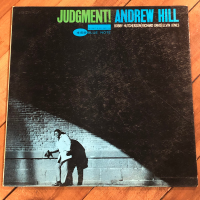
In some ways this 1964 recording is Hill's most unconsidered session of the time. On this quartet date he placed Hutcherson's vibes, rather than a horn player, in the front line and used Richard Davis—his clear bassist of choice, appearing on seven sessions between '63 and '65. Drummer Elvin Jones had ended his six-year run with John Coltrane, rejecting Coltrane's total transition away from defined structure. Hill's distinguishing marks are all over the album's six compositions, but they're somehow more relaxed than usual. Perhaps it's simply a matter of texture—Hutcherson's vibes are a more ethereal foil to Hill's abstruse style—but even pieces like the irregular-metered "Siete Ocho" have an understated intensity.
There's something more open about the loose swing of "Flea Flop." Hill's accompaniment beneath Hutcherson's characteristically well-developed solo is less angular and more to the point. While his own solo finds his left hand in more oddly-placed counterpoint to the skewed rhythms of his right—all the while with Davis carefully filling in the blanks—it's only when Jones steps up for a solo that things really heat up. "Alfred" is a surprisingly tender ballad, although Davis' more interactive role keeps things from becoming too settled.
What makes every new Hill reissue from the '60s significant is how he managed to blend complex compositional ideas and oblique thematic constructs; left-of-centre, to be sure, but still in that centre's general vicinity. Perhaps he was ahead of his time, and his increased popularity these days indicates that his audience has finally caught up with him; in any case, Judgement! is a classic entry that's sure to please.
Track Listing
Siete Ocho; Flea Flop; Yokada Yokada; Alfred; Judgment; Reconciliation;
Personnel

Andrew Hill
bassAndrew Hill: piano; Bobby Hutcherson: vibes; Richard Davis: bass; Elvin Jones: drums.
Album information
Title: Judgment! | Year Released: 1964 | Record Label: Blue Note
About Andrew Hill
Tags
PREVIOUS / NEXT

Become a Sustaining Member

Since 1995, All About Jazz has championed jazz as an art form and supported the musicians who create it. Over three decades, it has grown into one of the world's leading jazz resources, serving hundreds of thousands of readers, musicians, presenters and industry professionals each month.
Help Build the Future of All About Jazz
Your support helps us continue building All About Jazz for the next generation—expanding our editorial coverage, preserving jazz history, developing new community features and creating better ways to discover the music and the people behind it.
Become a sustaining member for as little as $20 per year and you'll immediately enjoy an ad-free experience along with access to subscriber features and future articles for a full year.
Together, we're not simply sustaining All About Jazz—we're building its future. Thank you for being part of the journey.