Home » Jazz Articles » Live Review » Jazz In Marciac Festival: Day 6
Jazz In Marciac Festival: Day 6

 Godfather. Adopted son. Honorary Muskateer.
Whatever the title, Wynton Marsalis is a figure of affection in Marciac.
The trumpet player has performed at the Jazz In Marciac Festival every year since 1991 and taught at the village's esteemed college music program. His 2000 septet album The Marciac Suite is the finale in his eight-CD Swinging Into the 21st series and, according to his web site, is "arguably the most personal disc of the batch."
"Marciac is an inspiring place," said Marsalis in comments posted at the site. "It's down- home. Each song in the piece has to do with a person there or the landscape or food. I love it there. It's the feeling you get when you like something because it's always changing but always the same."
He is billed as the godfather of the festival and embraced as an adopted son for his involvement in the community. Officials in the Gascony region - home to the Three Musketeers - also bestowed that honorary title upon the modern jazz icon. A life-size bronze statue of him is in the Place du Marciac town square, along with engravings featuring the first page of each movement of the 13-part suite he premiered during the 1997 festival.
There was something mind-boggling about not being able to find a copy of the album for sale among the numerous festival vendors with sizable inventories, but perhaps appropriate. Marsalis, who said "I didn't want this CD to be sold. I wanted it to be given away to people," did so with 2,000 pre-release copies during the 1999 festival to friends associated with the event. Columbia initially offered it as a free mail-in bonus for those purchasing the other albums in the set before releasing it as a retail item.
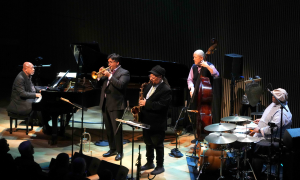
Marsalis played two concerts during the first weekend of the 28th annual festival, making him the only main stage performer appearing more than once. A "My Brazilian Heart" concert with a 12-member supporting cast Friday was followed by a quintet concert backed by a string ensemble Saturday.
More than the usual number of people holding or wearing handwritten "need ticket" messages seemed to be in the main village square during the day, and one got the feeling they weren't the same types one sees nightly at some urban festivals handing their purchases off to accomplices for resale at inflated prices. A weekend mentality may have had something to do with it, along with the fact a second series of featured concerts (a twin billing of Ghetto Blaster and Femi Kuti) was taking place on a different stage for the first time all week, but denser crowds and more buzz was certainly in the air.
That said, a shameful personal confession: I dogged it Friday night. I'd been feeling awful from sleep deprivation since arriving in France nearly a week before and was getting worse every day pushing things. Since The Man was playing two shows, I decided enjoying one beat suffering through two and the quintet performance was of far greater interest. Regrettable, but after 14 hours of coma-depth slumber my appreciation of all things French has improved 1,000 percent (even if I can't understand the gourmet fascination with cassoulet - maybe the world's most expensive version of franks and beans).
 There was the usual local and regional action throughout day six, including an appropriate pickup from where day five's student performances left off. Saxophonist Benjamin Dousteyssier, a graduate of the college who plans to continue his music studies in Paris this fall, led the Namaste quartet through some energetic shows on the town square stage. Possessing a fairly contemporary tone and speed recalling memories of Christopher Holiday's play-twice-as-fast-as-the-masters work a decade or so ago (Dousteyssier suggests Steve Coleman - who he cites as an influence along with John Coltrane, Kenny Garrett and Keith Jarrett - as a personal comparison), his alto and soprano work on compositions including post-bop, African and Indian shadings offered a good balance of academia and emotion. There are a couple of regional saxophonists I've heard so far I'd rate higher, but Dousteyssier's somewhere secure among the next tier in the upper echlon.
Also performing a couple of stage shows was the African percussion group Batuque Usina, whose early afternoon wanderings around the town square were a daily occurrence during the festival's opening days. A secure spot on the stage offered a change to hear a more complex and polished series of jams, but somehow it felt less entertaining and spontaneous than watching them take their acts through the wine booths on the streets with a crowd in tow. But in terms of energy, quality and authenticity, they came across first-rate in both settings.
 An early evening show by the Francois Chassagnite Quintet fell into the mediocre category, with their show of largely low-key fusion lacking depth. There were some interesting twists such as a slightly atonal "Take The A Train" with a waltz bridge thrown in, but others - one sounded like a derivative of the theme from "Taxi" - slipped out of consciousness as they were played.
The night's featured concerts under the big tent got off to a great start, as two young girls I encountered selling programs a few days earlier and tipped for their enthusiasm did a spontaneous a cappella "Lullaby of Birdland" after spotting me in my usual isolated seat in the back bleachers (a good place to be, thanks to massive video screens, until one needs to enter the melee to take pictures and such).
What followed was a disappointment.
The Sarah Lazarus Quartet performed a competent set of standards from the Billie Holliday to Sarah Vaughn eras, but nothing close to something deserving premier billing on a Saturday night at a festival with the magnitude of featured artists. Audience reaction, it should be noted, was considerably more enthusiastic than mine.
Lazarus is a pro and her mid-range vocals from the get-right-to-it opening of "Devil May Care" showcased dead-on lyrical precision mixed with frequent modest pitch jumps. There wasn't a wrong note, but the whole presentation was short in quality and soul compared to other popular singers of such material such as Madeleine Peyroux or even Diana Krall. The sterile quality carried over to her instrumental trio, with many solos predictably close to home and too short for real development. As a midday show it'd be competitive, but not as a prelude to perhaps the festival's biggest attraction.
Like I said, the crowd got into it.
Which brings things to Marsalis Twilight Time.
Seeing as how he's got a longtime spot somewhere on my top 20 "we're not worthy" list, it's possible he could have turned in a performance worthy of Chuck Magione and I'd have found something nice to say. But even turning the "ante-groupie" radar up a bit to compensate for possible bias, it proved worthy of the warm intimacy Marsalis said he appreciates about Marciac and the festival.
"It's always about swinging and quality, no matter what goes on in the world, because everything is just getting louder and louder anyway," he told the audience.
 Just being backstage beforehand (gotta love those press passes) was intriguing, listening to individuals and subsections from the string ensemble going through warm-ups in the lawn area. It created a garden party atmosphere with a quaint dignity the rather well picked-over spread of wine and petit fours didn't. (By the way, lines for the porta-potties- to-the-stars may be considerably shorter than the proletariat endure in scores, but they didn't have any toilet paper, either. I like to think I did my daily bit for humanity by leaving behind the roll I tend to carry in my pack where supplies tend to be scarce.
A range of understated emotions - peaceful, melancholy, uplifting - characterized the set of standards, from Marsalis' whispering trills on "I Guess I'll Hang My Tears Out To Dry" to his old-school wah-wah cheerfulness on "Baby Won't You Please Come Home." But the strength the sparse canvases allowed the quintet came at the expense of the string ensemble (consisting of mostly, if not all, regional players if I understood the introductions properly). Some off-color work by them during the opening of the latter song, for instance, made me realize how little I'd heard their seamless blending in elsewhere.
Oddly, the best moment came on a song where Marsalis didn't play a note.
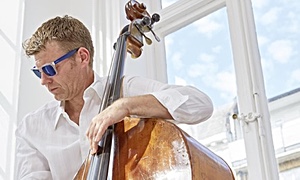
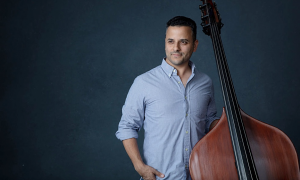
Local bassist and teacher Pierre Boussaget, who Marsalis composed "B is for Boussaget (and Bass)" for as part of the Marciac Suite album, came on stage near the end of the concert. During an unaccompanied upright acoustic solo to open the trumpeter's "Free To Be," he and Marsalis locked gazes from a few feet away and never broke eye contact. It's one thing to introduce someone with whom you claim to have a connection, another too see it so powerfully illustrated in such a large setting. Boussaget's swinging phrases were more easygoing than scholarly, but he went through an abundance of them as pianist Marcos Nimrichter and drummer Herlin Riley came in with some light support. Bassist Carlos Hernandez joined Boussaget and for the rest of the song they passed the bass between them, alternating phrases. Such moments aren't always successful, or take refuge in crowd-pleasing pandering, but their linkage stood out, sometimes continuing lines where they dropped off and sometimes starting others logically linked in the progression. While not as intimate as "the stare," it nonetheless imparted a message of two people with strong lines of communication.
The relaxed theme returned on "Stardust" and "For All We Know," but Marsalis sent the crowd home with an encore performance of his more lively "Big Fat In" and following it up with "Lazy Afternoon." If not achieving the pinnacle of a 1999 show featuring portions of the Marciac Suite that resulted in six encores, it still earned a place among the better main stage performances for 2005.
Coming up on day seven: A duel of pianist trios from Omar Sosa and Abdullah Ibrahim, plus discovering another mind-blowning regional talent.
Tags
PREVIOUS / NEXT
Become a Sustaining Member

Since 1995, All About Jazz has championed jazz as an art form and supported the musicians who create it. Over three decades, it has grown into one of the world's leading jazz resources, serving hundreds of thousands of readers, musicians, presenters and industry professionals each month.
Help Build the Future of All About Jazz
Your support helps us continue building All About Jazz for the next generation—expanding our editorial coverage, preserving jazz history, developing new community features and creating better ways to discover the music and the people behind it.
Become a sustaining member for as little as $20 per year and you'll immediately enjoy an ad-free experience along with access to subscriber features and future articles for a full year.
Together, we're not simply sustaining All About Jazz—we're building its future. Thank you for being part of the journey.