Home » Jazz Articles » Album Review » Miles Davis: The Cellar Door Sessions 1970
Miles Davis: The Cellar Door Sessions 1970

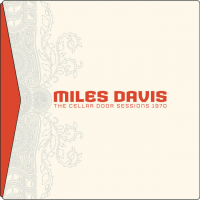
The music on these CDs has continued to evolve even from the heights of the four extraordinary studio LPs Miles Davis recorded in the previous 18 months: In a Silent Way (rec. February 1969), Bitches Brew (rec. August 1969, double LP) and A Tribute to Jack Johnson (rec. April 1970). Besides being a live date, the ensemble here was made up of a different cast of characters. Those earlier "electric" albums are masterpieces partly because the musicians were pushed to the extremes of their creative artistry, they were of a caliber that could provide surprises, and because producer/collaborator Teo Macero took the session tapes and chiseled into form the rehearsed tunes and hours of spirited improvising.
Here, on the live dates, the musicians fill hour-long sets by stretching out some of the material previously worked out in the studio. Teo is at the controls again, manning the recorder at the club, but this time without performing his post-session work of crafting the material into a collaged suite. This is a strictly live recording, excellent sound quality, with only a few insubstantial edits.
Miles is forging something extraordinary here. Without concession to audience expectation, he'd been using club dates to grow his sound. Never one to repeat himself, his concept by this time clearly was not to present tunes. While the repertory across the six CDs consists of eight composition—10 sets were recorded over four nights and six complete sets are presented here—each piece is a springboard from which to invent, unfettered by the restraints of chord changes or the need to serve a melody. Miles is leading the ensemble into free territory. There's no room for show biz slickness or pandering for dramatic effect. Miles is a patient listener and steps back to allow the other soloists to ignore 12-bar convention and reach full articulation. This is artistry of the highest order, creative expression at its most sophisticated.
The one-hour sets appropriate elements from funk and rock, but this is an entirely new uncategorizable beast—an amalgam of funk, rock and traditional jazz. The music is unlike anything. Comparisons are futile. It's even a stretch to say the music is an extension of what Miles himself had been creating in the studio. It's essentially a small group format, but is as far from conforming to a traditional jazz audience's expectations as the listening experience at the Fillmore East is from that at the Village Vanguard.
Occasionally, a head statement will be played in unison by Miles and saxophonist Gary Bartz, with the rest of the band filling in the chordal progression, but that melodic phrase is merely a concession to the audience's need for something familiar to tether their experience to.
Keith Jarrett's playing on Fender Rhodes is perhaps the greatest prize from the set. The timbre of the electronic keyboard might grate some listeners after a while, but his explorations transcend the funk/rock indications defined by Jack DeJohnette's solid 4/4 time-keeping and electric bassist Michael Henderson's precise vamps. Jarrett's keyboard utterances push into territory too colorful to be constrained by pulse. When the other musicians drop out to allow his cadenzas to go where they may, particularly during four "Improvisations," Jarrett takes advantage, maximizing the electronics to novelty effect, but more importantly, using the full range of the keyboards (he's also playing a Fender electric organ at times). His improvisations have more complicated intentions than the prescribed boundaries of the tunes' formal structure. When freed from the rigor of the funk/rock requirements, there's a chance for the expression of more complex emotions and an exploration instead of a proclamation.
Gary Bartz was a logical choice for the sax spot. He was already empathetic with the stripped down funk direction. He'd held sax chairs with Art Blakey, Charles Mingus, McCoy Tyner and Max Roach through the 60s, but in 1969 formed the NTU Troop in which he brought a funk groove to prominence. On this date, his melodious, refined and well-shaped runs up and down the horn unfurl into elegant Baroque-like solos and tender the oftentimes raucous activity swirling around him.
Although Miles is hitting high notes throughout the four-day gig, his playing is not as refined and virtuosic as it was on the prior year's studio sessions, or as commanding as on the live sets at the Fillmore East and Fillmore West from earlier in 1970. Rather than proclaiming his statements with rolling, melodious passages that ride the churning ensemble as in those earlier dates, here his trumpet sound stabs to emphasize the rhythmic focus.
Miles doesn't play notes to display his virtuosity or even to define a melody. He uses the notes to communicate intimate feelings ranging from longing to his assertive strut. His soloing through the wah-wah pedal conjures intangibles into form, evokes hints and variations of the head, and steers the ensemble to the briefest of unison passages. When Miles switches from playing through the wah-wah pedal to begin a new phase of a solo on open horn, it's a dramatic sensation like a change of key.
Miles allows it to happen and the musicians are up to the challenge. These guys are as attuned to each other as a flock of birds in flight.
Michael Henderson holds the whole package together. His touch is certain yet warm and rounded. His sense of timing is impeccable. His notes define the pulse of eternity. His electric bass playing not only gives structure, but at times contributes a playful attitude to the proceedings.
Electric guitarist John McLaughlin is only on discs 5 and 6, but his searing solos, even as he searches for a way into the ensemble sound, add an element of fearful grace. It's the sound of lightning brought indoors.
Airto Moreira's palette of percussive effects (including vocalizing), integrate rain forest influences and colors with decorative aural embellishments.
The reason the set is not simply a funk session is owing to the drumming of Jack DeJohnette. While he serves the time-keeping function of laying down a groove, his sensible propulsion continuously urges the band forward with rolls, cymbal work and a bass drum foot that releases a surge of adrenalin with each pounce. His energetic but precise rococo accompaniment sets a high standard that compels the other musicians to match his intensity and service.
In addition to the nearly six hours of music, over three hours of which has never been issued officially, the box contains photos and essays by each of the band members, all expressing enthusiasm for the gig and grateful that the music is finally getting a chance to be heard.
Every moment on these discs is killer. This band is at its peak and the intensity never wavers. This music is clearly not for everyone, but I envy the uninitiated listener with an open ear for whom these sets are a first exposure to Miles's electric music. Five stars.
The Red Light is Off: A Chat With Michael Henderson, August 16, 2005
"It never stopped, says Michael Henderson, electric bassist, referring to his career after six years with Miles Davis from April 1970-December 1976. "I've played with just about everybody on the planet—Snoop Dog, LL Cool J, Carl Thomas, Mobb Deep. I've been having a great time."
This is a man who has nearly 50 platinum records. Miles Davis plucked him out of Stevie Wonder's band when he was 19. But, he says, he was already "a hardened criminal of music at 13. He'd played in Detroit with the Motown session musicians who'd later come to be called the Funk Brothers. He was with Stevie Wonder for five years (including an appearance on Ed Sullivan's show in 1967), and at the same time backed Aretha Franklin. There were also dates with The Four Tops, Marvin Gaye, The Temptations, James Jameson (they recorded together on Marvin Gaye's "You're the Man from 1972), Earl Van Dyke (called the father of the Motown rhythm section) and others.
After he left Miles, he had a hit in 1975 with "Valentine Love," his song for drummer Normon Connors on which he sings a duet with Jean Carne. In 1976, the gold album You Are My Starship, under Connors' leadership, had a number of hits including, "We Both Need Each Other," a duet with Henderson and Phyllis Hyman, and the title cut featuring Henderson. Henderson also recorded and did arrangements for The Dramatics and Jagged Edge among others.
He sounds a bit peeved when referring to press at the time Miles recruited him which referred to him as a 19-year-old session player. "How serious is Stevie Wonder?" he posits. "Stevie is as serious as Miles, maybe even more. People say that Michael Henderson was the devil that changed Miles Davis's music, but they didn't know I came from greatness in Detroit. I came up with people who worked with Paul Chambers. Look at the musicians. How serious is Motown?"
When I tell him how blown away I am by the music on The Cellar Door Sessions 1970, which chronicles a four-day engagement with Miles Davis at a Washington, DC club, he says that wasn't even the greatest moment for the band. "Any date before that would blow your hair out." He singles out a date at Paul's Mall in Boston, circulated on a bootleg recording.
Speaking of the Cellar Door gig, he says it was a little-bitty club. "We just played unabashed, no hiding anything. We went for it. It's hard, brash, outgoing, ferocious. We knew we were doing something great."
It was raining the first few nights of the gig, he remembers, and the club was not full. But, he says, those who were there enjoyed what they were witnessing. Miles, he adds, paid the band out of his pocket.
Nobody played that kind of music, he says. "In this modern age, at sessions, guys stop being creative. If they play too much they want to get paid for it. When the green light goes on, you play what you're required to play."
There was no green light for us, he says, no red light. "Guys just don't do that anymore." He offers some advice for today's musicians, at least for those with creative ambition: "A lot of guys need to forget about the red light, forget about getting paid."
Henderson reveals one more moment from his time with Miles: "When the album [A Tribute to] Jack Johnson was about to come out, I told Miles, 'They don't put our names on the albums in Detroit.' I demanded they put our names on the record 'What You See Is What You Get' from The Dramatics. The other musicians were afraid that Berry Gordy wouldn't like the fact that they were moonlighting. But I was a bad ass. I told Miles and Miles called Teo and told him to put the names on the cover." First versions of the LP include personnel credits on the front. "I raised hell. I'm a fighter. That's why Miles hired me."
He says that he's been in the studio lately with two battery mates from Miles's mid-70s band—electric guitarists Reggie Lucas and Pete Cosey. He's also touring a band called Bass Players' Ball with Ray Parker Jr. on guitar (another teenage sensation on sessions for Holland-Dozier-Holland before playing on Stevie Wonder's Talking Book and Innervisions albums, and later under his own name, Ghostbusters) and George Johnson of the Brothers Johnson on bass.
"These are not just session guys," he says. "These are session guys with million selling records."
He adds that he's recorded a lot of music that is still in the vault, including his tune, "You Are My Starship," recorded with Keith Jarrett, Al Foster, Mtume and Reggie Lucas, and "Treat Me Like a Man," which he wrote for The Dramatics, with Jarrett and Al Foster.
And, my Miles fanatic friends on the Web will salivate over this tidbit: He says he has a black and white video shot live at a gig in Philadelphia in 1970 that documents the Miles band which a few months later played The Cellar Door. "That band was more incredible each night," he says.
Track Listing
CD1: Directions; Yesternow; What I Say; Improvisation; Inamorata. CD2: What I Say; Honky Tonk; It's About That Time; Improvisation #2; Inamorata; Sanctuary. CD3: Directions; Honky Tonk; What I Say. CD4: Directions; Honky Tonk; What I Say; Sanctuary; Improvisation #3; Inamorata. CD5: Directions; Honky Tonk; What I Say. CD6: Directions; Improvisation #4; Inamorata; Sanctuary; It's About That Time.
Personnel

Miles Davis
trumpet
Gary Bartz
saxophone, alto
John McLaughlin
guitar
Keith Jarrett
piano
Michael Henderson
bass, electric
Jack DeJohnette
drums
Airto Moreira
percussionAlbum information
Title: The Cellar Door Sessions 1970 | Year Released: 2005 | Record Label: Sony Music
About Miles Davis
Tags
PREVIOUS / NEXT

Become a Sustaining Member

Since 1995, All About Jazz has championed jazz as an art form and supported the musicians who create it. Over three decades, it has grown into one of the world's leading jazz resources, serving hundreds of thousands of readers, musicians, presenters and industry professionals each month.
Help Build the Future of All About Jazz
Your support helps us continue building All About Jazz for the next generation—expanding our editorial coverage, preserving jazz history, developing new community features and creating better ways to discover the music and the people behind it.
Become a sustaining member for as little as $20 per year and you'll immediately enjoy an ad-free experience along with access to subscriber features and future articles for a full year.
Together, we're not simply sustaining All About Jazz—we're building its future. Thank you for being part of the journey.