Home » Jazz Articles » Live Review » Festival International de Jazz de Montreal 2005, Day 9, ...
Festival International de Jazz de Montreal 2005, Day 9, July 8, 2005

With guitarist Pat Metheny's By Invitation Series this year, the Festival International de Jazz de Montreal has, in many ways, redefined the possibilities of scope and dimension. In his shows up to this point Metheny has played with old friends and new friends, revisited old and familiar compositions in new ways and taken a crack at new material and new contexts—as was the case with his show with bassist Me'Shell Ndegeocello's band on July 6—that don't even relate to his own extensive back catalogue.

While every show has been eagerly anticipated, perhaps the one most on the lips of festival goers was his performance last night at Place des Arts' Theatre Maissoneuve, reuniting vibraphone legend Gary Burton and bassist Steve Swallow—surely a musical partnership that, lasting over 20 years until the mid-'80s, defined its own specific space in modern jazz—along with Metheny's clear drummer of choice these days, Antonio Sanchez. Looking at the crowd, it was obvious that some were around in the mid-'70s, when Metheny played with Burton and Swallow for three years before leaving to begin his own sojourn into what would become Pat Metheny Group; it was also equally clear that there was a large number of attendees who were either too young—or not even born yet—when this group was in existence. So the show was a unique opportunity to hear a group responsible for defining one of the more influential musical aesthetics in jazz—before, during and after Metheny—take a look back at some of the material that defined them, 30 years on.
All kinds of platitudes exist that apply. "If I knew then what I know now," comes immediately to mind, since Metheny was only starting out during his initial tenure with Burton, and has evolved almost exponentially since that time. Still, hearing Metheny tackle material including his own darkly-hued "B&G," Chick Corea's medium-tempo "Sea Journey" and Carla Bley's rapid-fire "Ictus," one couldn't help but hear him somehow shift gears back into the kind of approach he took 30 years ago, only this time more fluid, more inventive, more harmonically advanced. Swallow—a player whose own approach has significantly impacted Metheny's own—has not only grown as a musician, but technology has caught up with his own view of the role of the electric bass, with a fuller sound and a greater range.
They also say, "You can't go home again." That may be true. Certainly last night's performance—which specifically covered material by composers who were major contributors to the Burton songbook of the time including Metheny, Corea, Bley, Keith Jarrett, and of course, both Burton and Swallow—was no mere exercise in nostalgia; the playing was too vital, too committed, too engaged—but it did somehow manage to recreate the vibe of that time for those who remembered it while, at the same time, feeling both completely contemporary and wholly relevant today.
Burton remains one of those improvisers whose every note, every phrase, just seems to be perfect. When Metheny spoke, a couple of nights back at the MMMIS Question and Answer session, about solos demanding a narrative construction, he clearly received a lot of onstage exposure to that philosophy during his early days with Burton. In fact, everyone on stage last night soloed with the kind of spontaneous sense of form and arc that explains why they have all become so influential. The inherent sense of logic that didn't preclude a certain degree of abandon, made every solo meaningful.

Even Sanchez, who was a second choice after Roy Haynes—one of Burton's early drummers who perhaps most defined the group's sound from a rhythmic perspective—was unable to change his own touring commitments, managed to somehow shift gears. He still performed with the dexterity and power that has defined his relatively rapid emergence over the past few years; but there was also a subtlety and delicacy about his playing that brought to mind another great drummer who worked with Burton's groups in the '70s, Bob Moses.
The only unfortunate aspect to the performance, as was the case with Metheny's Special Encounters show from July 6, is that this is a one-time event. With their immediate chemistry, still completely intact after 30 years, Burton, Swallow and Metheny could make one hell of a record. But for Montreal audiences, familiar with seeing many of their favourite artists in one-off contexts, this was truly a special event, one which will go down as a clear highlight of this year's festival. At just over 90 minutes including one encore, the set may have been short, and clearly the audience would have been more than happy to hear more; but still, in some ways, just like their solos, the quartet's construction of the set—with its own dynamic flow—was perfect just as it was, with its own inevitable logic and satisfying completion.
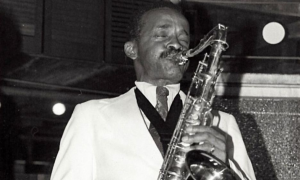
Metheny's final By Invitation performance at the small Gesu Theatre—although not his final performance in Montreal this year, as he brings his Pat Metheny Group to the outdoor GM Stage for the final show of their The Way Up tour on Sunday—again took the opportunity to reunite him with a couple of friends that have held a special place for him. First up was a 45-minute set with a man who Metheny introduced as truly one of the most under-appreciated artists in jazz, saxophonist Dewey Redman. Redman, who was seminal in so many groups, including Keith Jarrett's American Quartet of the early '70s, was a key player on Metheny's own first foray into a more open-ended approach to improvisation, 80/81. And so, with Redman's own rhythm section of bassist John Menegon and drummer Matt Wilson, Metheny tried to recreate some of the material from that album, including the title track, the beautiful ballad, "The Bat" and the Ornette Coleman piece, "Turnaround."

Redman may be walking a little slowly these days, but when he puts the saxophone to his lips, the tone and broad conception are still there—something he'll explore tomorrow night when his own quartet takes the staqe at Gesu. His phrasing is sometimes so relaxed that it feels like it might almost fall over, yet it never does. And Metheny, most notably in the theme to "Turnaround," demonstrated that same kind of behind-the-beat phrasing. When things got a little freer, as they did during "80/81," Redman demonstrated his ability to extract a number of unique textures from his tenor, including his trademark technique of singing through his horn.
A highlight was "The Bat," which demonstrated Redman's highly personal conception of lyricism. Always seeming to be just on the edge of something more outré, Redman's tone and ability to gently push-and-pull with Metheny's accompaniment proved that once a connection is made between two players, it's never lost—even with the passage of significant time.
Wilson, a leader in his own right and a significant member of a specific New York scene that includes his own group, Arts and Crafts, as well as the Herbie Nichols Project, meshed perfectly—not exactly surprising, but given the little rehearsal the quartet had, his simpatico playing with Metheny, which was rarely overt but more underlying, was immediate. Menegon, also, met the demands of the music with a combination of relaxed swing and more outward-looking freedom. His solos were the perfect confluence of rhythmic invention and melodic conception.
Like most of Metheny's shows this week—with the exception of the marathon Special Encounters performance—the 80/81 Revisited half of the show was over all-too-quickly. The entire group demonstrated that it's one thing to play free, but it's another entirely to do so with a strong sense of purpose. Some free players appear to be just pushing air; this group was always heading somewhere.
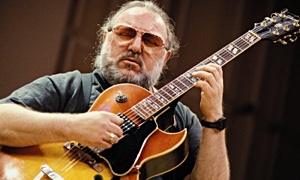
For the second half of the show, Metheny introduced guitarist Mick Goodrick, another player who, while never receiving the kind of accolades he deserves, has been hugely influential to more than one generation of musician. With him it's more than just technique; it's about approach, mindset, channeling emotions—whatever they may be—into the playing. Metheny indicated that, while they two of them have performed in duet over the years, it's always been in Boston, and so this was their first "road trip."
Playing through a programme largely consisting of standards, what was most fun about the set was not so much when they got there, as how they got there. Watching the free exchanges that acted as segues between known tunes, where the roles of accompanist and soloist were almost constantly in a state of natural flux, was like being privy to a private and intensely two-way conversation, as Metheny and Goodrick discovered ways to link their playing to the material in a purely instinctive yet always openly-aware fashion.
Goodrick's style is so fluid and natural that it almost appears unconsidered; yet when one hears him push the dual-improvisations to new places, it's clear that he's acting out of both pure intuition and planning at some level. Possessing one of the most beautiful vibratos of any jazz guitarist, his ability to find unique perspectives on even the most traditional of songs is remarkable.

Hearing Metheny play with both Swallow and Goodrick in one evening—and isn't it a shame that they didn't all play together?—underlines just how influential the two have been on Metheny's musical growth. While Metheny has, of course, developed his own unique voice, almost from the very beginning, there's a certain almost indefinable sensibility imbuing his playing that only becomes evident when heard in the context of these two artists. And hearing Goodrick and Metheny in tandem proves that even within the guidelines of set material, it's possible to be completely unencumbered and open to endless possibilities.
Continue: Day 10
Visit Pat Metheny, Gary Burton and Festival International de Jazz de Montreal on the web.
Tags
PREVIOUS / NEXT

Become a Sustaining Member

Since 1995, All About Jazz has championed jazz as an art form and supported the musicians who create it. Over three decades, it has grown into one of the world's leading jazz resources, serving hundreds of thousands of readers, musicians, presenters and industry professionals each month.
Help Build the Future of All About Jazz
Your support helps us continue building All About Jazz for the next generation—expanding our editorial coverage, preserving jazz history, developing new community features and creating better ways to discover the music and the people behind it.
Become a sustaining member for as little as $20 per year and you'll immediately enjoy an ad-free experience along with access to subscriber features and future articles for a full year.
Together, we're not simply sustaining All About Jazz—we're building its future. Thank you for being part of the journey.