Home » Jazz Articles » Live Review » Ottawa International Jazz Festival
Ottawa International Jazz Festival

After day five's inconsistencies, day six of the Ottawa International Jazz Festival returned to full strength. Despite its stylistic breadth, the diverse programme indicated just how dedicated the organizers are to keeping this unequivocally and uncompromisingly a jazz festival. Among the events: the ECM cool of Duchesne, Fraser & Wittet; a Mingus-inspired performance by bassist Dave Young; the Brazilian leanings of saxophonist Jean-Pierre Zanella's road-tested quartet; the wholly improvised music of British saxophonist Evan Parker; and the more approachable but no less uncompromising Trio!—featuring banjo whiz Béla Fleck, violinist Jean-Luc Ponty, and... well, more about that later. There was something for everyone, making this the strongest day yet.

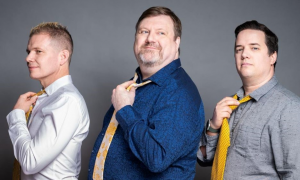
Local guitarist Ben Duchesne, bassist Mark Fraser and drummer Bruce Wittet (who seems to be all over the festival's local programming this year) put on a noon-hour show that, despite the incredible heat and humidity—temperatures, with the humidex reached well over 40°C—managed to prove the old adage of mind over matter with their lyrical and generally relaxed set. The group performed tunes primarily from their debut, last year's Passing Note—an album combining aspects of crystalline ECM cool with a slow burn all its own.
Duchesne blends the harmonic reach of John Abercrombie with a more traditional-leaning approach that brings to mind Wes Montgomery and Grant Green. Generally eschewing overt technical displays, he leans towards a lyricism displayed at its best on "Song for Isabelle. Still, he managed to swing lightly on "Yet Another Thursday and travelled into more folkloric territory on "Thank You. Fraser is an understated but firm anchor for the group, demonstrating his roots in Charlie Haden on Haden's own "Waltz for Ruth —a duet with Duchesne on acoustic guitar.
Wittet continues to be a versatile and astute player. In three shows this week he's ranged from the funk-jam of the Bitches Brew Tribute Band to the more straight-ahead but completely committed leanings of the Peter Brown Trio to this, his own cooperative project. Duchesne may write the lion's share of the material, but Wittet brings a penchant for temporal elasticity, with an eye to the kind of fluidity that characterizes Norwegian drum legend Jon Christensen.
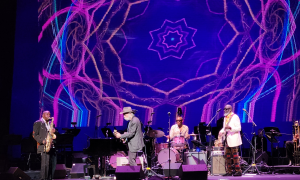
 This year's festival has already highlighted an inordinate number of legendary performers, with more to come. Canadian bassist Dave Young may not have the cachet of Dave Holland or Charlie Haden, but he's no less distinctive a player—certainly he's a legend of the Canadian jazz scene who's worked with his share of high profile artists, including pianist Oscar Peterson (with whom he's now back, following the tragic and untimely death of Niels-Henning Orsted Pedersen), Kenny Barron, Clark Terry, and Lenny Breau. For this year's performance at the Library and Archives Canada theatre, Young brought a quintet of musicians representing some of the best that Canadian jazz has to offer. His Mainly Mingus project captured the evocative spirit of Charlie Mingus, featuring trumpeter Kevin Turcotte, young up-and-coming tenor saxophonist Kelly Jefferson, pianist Gary Williamson and drummer Michel Lambert.
Young possesses a singular bass sound: warm and resonant, with a beautifully restrained vibrato and a certain relaxed gait to his playing. You can actually see the swing as much as feel it. Effortlessly managing to be both firm anchor and equal partner in the interaction rife throughout the performance, Young utilizes some distinctive stylistic devices, including interspersed chordal patterns that never take away from the essential groove. Mingus is a serious influence, but Young's a more fluid player, taking the late master's spontaneity and power and channelling it into his own vision of weight and substance.
Turcotte is arguably the country's strongest trumpeter, with the kind of virtuosity that never stands in the way of meaningful solo construction. Like Young, his technique may be formidable, but it's really secondary to his ability to get to the truth of a song, and his complete commitment is evinced with every note. Jefferson may be young, but he's already a remarkably confident player, with a frightening ability to find the melodic links between even the most challenging chord and tempo changes.
Williamson has had limited exposure, but he's a fixture on the Toronto scene and, like pianist Bill Mays from the previous afternoon, he's imbued with a refined elegance and rich melodic sensibility. Lambert, on the other hand, may be the dark horse of the quintet—distinctly mercurial, with an unpredictable way of holding down the rhythm section with a less-than-obvious approach to Mingus' signature triplet feel, keeping things just the slightest bit on edge.
The quintet's five song, hour-long performance mixed standards (Ellington's "Mood Indigo ), Young originals ("Bass Clef, "Dizzy Moves ) and two Mingus tunes. In an unusual look at the perennial classic "Goodbye Pork Pie Hat, the group took the theme at an unusually up-tempo 2/4. The closer, Mingus' ambitious reworking of "All the Things You Are, titled "All the Things You'd Be Right Now, If Sigmund Freud's Wife Was Your Mother, was clearly the most challenging chart of the set. Despite rapidly changing tempi and feels, each soloist made sense of the constantly-shifting terrain in a way that was nothing short of inspirational.
 After the Dave Young performance, festival goers were treated to a performance by yet another legendary Canadian bassist, Michel Donato—this time in the context of leader Jean-Pierre Zenella's quartet. Zenella, who was seen earlier this week as part of the Lorraine Desmarais Big Band, is a powerful alto saxophonist, whose own projects have looked at ways of putting Brazilian influences into a more contemporary post-bop setting. His group, which also included drummer Paul Brochu and pianist James Gelfland, is the same lineup that he brought to the OIJF two years ago. In a time where so many groups are temporary formations put together for a short tour or two, the chemistry of Zanella's quartet, which has spent some serious performance time together, was instantaneous and palpable.
Zanella combines fluid and free-flowing ideas with the kind of mindset that sees his solos as part of a broader continuum. Gelfland's roots in Tyner and Hancock are clear, but he's no mere knockoff. Another one of Canada's hidden gems, Gelfland plays every note like he means it. Brochu—who first came to international attention as part of the '80s Quebecois fusion group UZEB—has continued to evolve as a drummer. His combination of power, dexterity and, equally importantly, subtlety, makes him versatile enough to be able to realize Zanella's own kind of acoustic fusion. Donato, like Young earlier in the day, has an unmistakable tone and improvisational acumen which is so visceral that when he executes a long glissando, it goes straight to the gut.
But what made the quartet's performance special was its total sense of engagement. Unlike Michael Coté's group from the same time slot on the previous day, Zanella, Gelfland, Donato and Brochu had an energy that reached out to the appreciative audience. They performed originals from their '02 release Mother Tree and some new compositions to be recorded this fall. Zanella's writing is approachable enough to have broader appeal, but also deep enough to bear scrutiny: further evidence of Canada's vibrant jazz scene.
 For the second show of the festival's fledgling Improv Series at the National Arts Centre Fourth Stage, British saxophonist Evan Parker demonstrated just how captivating and diverse a single instrument (well, two—he alternated between soprano and tenor) in a solo context could be. Unlike others in the arena of free improvisation who have also created side projects with broader appeal, he remained steadfastly and unrepentantly uncompromising. His advanced facility on his instruments—including multiphonics and a circular breathing technique that allows him to play virtually endlessly without breaking up his phrasing to take a breath—allowed him to deliver a one-hour performance of stunning virtuosity, embodying limitless possibilities. Some of these unconventional techniques are used by others more as effects, but with Parker they're an integral part of his musical persona.
Upon hitting the stage, Parker launched into the first of seven improvisations—a seemingly endless cascade of notes on soprano that ebbed and flowed, waves of notes that would crest and then smooth over into a more even series of repeated phrases, constantly and gradually shifting and evolving. During the first part of the performance, listeners looking for overt melody were hard pressed to find it, but truthfully Parker's improvisations are better experienced than simply heard, demanding that the listener dispense completely with any kind of preconception.
While melodies would ultimately begin to emerge as the concert progressed, Parker's conception was as much about textured aural landscapes as it was any adherence to traditional melody, harmony and rhythm—although clear aspects of all three could be found throughout. And while some of his work can be incredibly dense, he's also aware of the value of space and the importance of giving a note time to breathe.
It's intriguing that many of the more advanced free players actually practice standards at home. Parker informed the audience that he'd been practicing a lot of Thelonious Monk and Steve Lacy as of late, and there were clear elements of both in his improvisations, lending some grounding—and a little humour—to a couple of his more adventurous explorations. While some may misconstrue Parker's work to be formless, the reality is that he's always building something each time he picks up a horn, never just delivering an endless array of notes. All the more remarkable is his ability to find new ways, without any apparent forethought—or perhaps it just happens so quickly that it just looks that way—to begin an improv, and develop it to a logical conclusion.
Sometimes a potentially disastrous situation can yield an unexpected and happy ending. The headlining act for day six was Trio!, a new supergroup with banjo virtuoso Béla Fleck, legendary fusion violinist Jean-Luc Ponty and Stanley Clarke—who, along with the late Jaco Pastorius in the '70s, completely redefined the role and potential of the electric bass. When it was discovered early in the afternoon that Clarke would be unable to make the performance—some kind of problem crossing the border that led to all kinds of unsubstantiated speculation—there were questions as to how Ponty and Fleck would proceed.
As luck would have it, Fleck ran into local bassist John Geggie at his hotel. He knew Geggie from last year's festival, where Fleck performed with his long-standing Flecktones group and ended up meeting the bassist, who was running the after-hours jam sessions. So he ended up enlisting him and local drummer Nick Fraser to flesh out the group for a concert where—like the Bill Mays/Bud Shank performance from day four—some quick thinking had to take place to put together a programme for the evening's performance. Lesser musicians might have been petrified at the short-notice recruitment and stress of working with two artists of such stature, but Geggie and Fraser are consummate players, flexible enough to fit in at a moment's notice, and imaginative enough to keep up with anything that Fleck and Ponty threw their way.

Béla Fleck, John Geggie, Nick Fraser, Jean-Luc Ponty
With only a two-hour rehearsal in the late afternoon, what could have been a train wreck ultimately turned into a thoroughly enjoyable performance. It was clear that everyone on stage was having a great time, and judging from the wild response from one of the season's largest crowds the audience was equally entertained. The decision to include a number of standards undoubtedly lessened the load on Geggie and Fraser, but when they backed Fleck and Ponty on the original material, it felt as though they'd been doing it all along. Geggie, in particular, demonstrated a side to his playing not necessarily heard previously by those who know him in Ottawa's jazz circles. Fleck's "Sunset Road gave him the opportunity to flex some funk muscle—there's no replacing the unmistakable identity of Flecktones electric bassist Victor Wooten, but Geggie lent the piece a distinct personal complexion that was completely in context.
Fleck and Ponty each took lengthy solo spots and demonstrated their ability to captivate an audience with a combination of staggering technique, musicality and a little bit of showmanship. They delivered their own compositions, especially Fleck's—often challenging tunes with constantly shifting time signatures—in a virtuosic fashion that was enough for their more devoted fans, but they avoided the excesses that, to be honest, early reports of the trio's forthcoming tour portended.
But the standards the group played were the most revealing of the two-hour performance. Geggie and Fraser were clearly in their zone, not only creating an energetic backdrop for Ponty and Fleck, but delivering consistently strong and inventive solos that garnered equal applause from an audience clearly thrilled to see two local boys share the stage. And while it's likely been a long time since Ponty has performed bebop tunes like Sonny Rollins' "Oleo and Charlie Parker's "Scrapple from the Apple, it was clear that, whatever personal musical choices he's made throughout his career, he's still an inspired player in a more purist jazz context.
All in all, one the strongest single days of a festival that's only at its halfway point.
Tomorrow: Roscoe Mitchell Quintet and Octurn.
Visit Duchesne, Fraser & Wittet, Dave Young, Béla Fleck, Jean-Luc Ponty, John Geggie, and the Ottawa International Jazz Festival on the web.
Photo Credit
Duchesne, Fraser & Wittet - Tara Wittet
All others - John Fowler
< Previous
Blinga
Next >
In The Ring
Comments
Tags
For the Love of Jazz
 All About Jazz has been a pillar of jazz since 1995, championing it as an art form and, more importantly, supporting the musicians who create it. Our enduring commitment has made "AAJ" one of the most culturally important websites of its kind, read by hundreds of thousands of fans, musicians and industry figures every month.
You Can Help
To expand our coverage even further and develop new means to foster jazz discovery and connectivity we need your help. You can become a sustaining member for a modest $20 and in return, we'll immediately hide those pesky ads plus provide access to future articles for a full year. This winning combination will vastly improve your AAJ experience and allow us to vigorously build on the pioneering work we first started in 1995. So enjoy an ad-free AAJ experience and help us remain a positive beacon for jazz by making a donation today.

Giveaway

Days remaining: 11