Home » Jazz Articles » Live Review » Ottawa International Jazz Festival
Ottawa International Jazz Festival

The sign of a great festival is its ability to not only deliver on expectation, but to provide some serious surprises along the way. Every year the Ottawa International Jazz Festival manages to bring in relatively unknown acts—or, at least, unknown to the vast majority of festival goers—that ultimately become the talk of the event. Last year, guitarist Kurt Rosenwinkel's show at the Library and Archives Canada Connoisseur series was on everyone's lips—those who didn't attend, just as much as those who did. This year the performance of the Moutin Reunion Quartet will no doubt go down as one of those shows: a clear highlight of a festival that hasn't even reached its halfway point yet.
Amongst the many local acts given exposure during the festival, the Tom McMahon Trio, which played an hour-long set at the Rideau Centre in the early afternoon, has its own distinction. McMahon plays an instrument called a baliset—an eleven-stringed cousin to the Chapman Stick. The baliset is a tapped instrument that literally looks like a large neck with strings, covering the range from bass to guitar and allowing the player, like a piano, to be completely self-accompanying. The instrument can be fed through all manner of signal-processing devices to further broaden its reach, but if that's not enough, McMahon has a synthesizer pickup installed over the top six strings of the instrument, allowing for even greater sonic possibilities.
McMahon and his trio, featuring violinist Sol Gunner and drummer Mark Rehder, performed a set of McMahon originals, most from his recently released debut disc Small Talk. As McMahon himself indicated at one point, there are some people who, based on the material—at times as much rooted in folk and even country as it is jazz—may balk at its lack of purity. But jazz has always been a melting pot of diverse influences, and so if Bill Frisell's Nashville can win Downbeat's jazz album of the year when it was released, then surely McMahon's compositions, which are almost all characterized by detailed and sometimes complex chord changes, can be equally considered within a broader jazz purview.
Some songs are closer to a reductionist definition than others. "Far Away Friend," one of two duets between McMahon and Rehder, could easily have fit on a '70s-era ECM recording; "Balanceo" found the trio in Gypsy swing mode, with Gunner delivering some suitably Grappelli-esque playing; and "Texada" ambled along with a relaxed bossa groove. Still, the gospel inflections of "Cox Creek" and the waltz of "April 25, 2003," with its distinct country vibe are a little harder to pigeonhole.
Throughout the set both McMahon and Gunner demonstrated an impressive ability to navigate McMahon's difficult charts, which manage to sound easy, but are considerably less so when you take a moment to really listen. Rehder has always been the perfect accompanist, with specific attention to drum sound and the kind of ears that allow him to respond at a moment's notice.
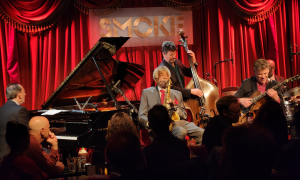
When it comes to delivering some of the real surprises of the festival, the 4 pm Connoisseur Series is the one to consistently deliver. The performance of Moutin Reunion Quartet will surely go down as not only a highlight of this season, but of any year. Co-led by twin brothers Louis on drums and François on acoustic bass, the group also features saxophonist Rick Margitza and Pierre de Bethmann on piano and Fender Rhodes. Margitza played briefly with Miles Davis in the late '80s, and he's one of those players who slowly but surely just keeps getting better and better and has, curiously, remained farther below the radar than his prodigious talent deserves.
 People often talk about twins sharing a special connection, and the two brothers indeed demonstrated a beyond-telepathic oneness during their 75-minute set. François relocated from France to New York City ten years ago, and this quartet came about a couple of years back, when they decided they just had to play together again. The incredible interplay between the two—especially highlighted three songs in, when they performed a bass and drums duet that incorporated a number of Charlie Parker tunes, including "Donna Lee"—was all the more remarkable in that, while Louis' kit faced the rest of the group, rather than the audience, his head was usually turned out, and so there was very little eye contact with François. The way that the two would converge from the midst of unfettered free play into a single voice was nothing short of magical.
The compositions, written by Louis and François, are heavily in the contemporary post bop camp, with clear respect for the kind of open-ended experimentation that defines the music of artists like McCoy Tyner and Tony Williams, although their writing is often more complex. The title track, from their forthcoming third release, Something Like New, is a prime example, with plenty of solo space, but adjoining passages found the group navigating through a number of rhythmic feels and harmonic centres. Margitza, a creative musician who moved from the US to Paris a couple of years back, played with the kind of conviction and a constantly-searching aesthetic that constantly begs the question of why he isn't better known. Both he and Bethmann performed with the kind of imagination that breaks through more restrictive bar lines, creating solos rife with broader narratives.
What made Moutin Reunion Quartet's set so invigorating was their clear and uncompromising spirit of "going for it." As the group charged out of the gate, the audience knew it was in for something special from the first few notes. François' rich tone and harmonic flexibility—reminiscent of Dave Holland at times—along with Louis' almost reckless Tony Williams-like abandon, created a relentlessly exciting and ever-shifting backdrop for Margitza and Bethmann. At the end of the show, the audience seemed as paradoxically energized and spent as the group itself. While there was no encore despite the audience's enthusiastic response, the Moutin Reunion Quartet's performance couldn't have been better. Satisfied yet at the same time hungry for more, everyone was talking about this performance well into the evening and, like guitarist Kurt Rosenwinkel's performance at last year's festival, this will undoubtedly be one of those shows that everybody's raving about long after the festival has ended.
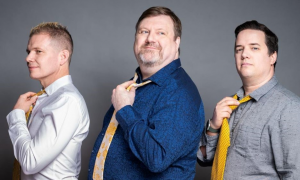
The 6:30 pm main stage performance of the Quebecois Blues Gitan quintet was in some ways the ideal followup to the Moutin Reunion Quartet's high-octane performance. The Blues Gitan performance had an unmistakable vitality, starting in the same space as legendary guitarist Django Reinhardt and the Quintet of the Hot Club of France, but expanding to include music from other countries, including Hungary and Russia. But it was altogether lighter fare, as much about entertainment and audience engagement as instrumental proficiency. As opposed to the unyielding risk-taking of the Moutin Reunion Quartet, Blues Gitan's set was more clearly structured and delineated. Attendees of Moutin Reunion Quartet's performance were given the opportunity to decompress from the sheer intensity of that concert, with Blues Gitan delivering an engaging but easy-going set and presenting little by way of challenge.
 The result was a fun show where violinist/vocalist Kristin Molnar and guitarist Stephane Teller were clear standouts. Within the restricted context of their music, both were passionate performers with a clear appreciation for its cultural roots, combining traditional pieces with their own compositions. Molnar sang with a powerful voice that bore some resemblance to Greek singer Savina Yannatou, but less mercurially so. Second guitarist Dioni Violetti also had a strong voice and a relaxed, comical way of connecting with the audience that made Blues Gitan an enjoyable, if not particularly memorable, performance.
Anticipation was high for saxophone legend Sonny Rollins' first appearance in Ottawa since '00, and the audience giving him a standing ovation the moment he walked on stage. His sextet, featuring trombonist (and Rollins' nephew) Clifton Anderson, guitarist Bobby Broom, bassist Bob Cranshaw, drummer Steve Jordan, and percussionist Kimati Dinizulu, delivered a show that, while considerably less than challenging, gave everyone ample opportunity to stretch out and was well received by the large and clearly appreciative crowd.
Rollins is unquestionably a jazz giant, and from the very first notes his distinctive style, which has pervasively influenced more than one generation of saxophonists, was in clear evidence. There are few improvisers alive who can comfortably carry eleven or more choruses through a song, and Rollins is one of them, with rapid flourishes offset by growling double stops, and a kind of endless harmonic variation that proves he hasn't lost any of his creativity. While the rest of the group was clearly talented—between them, the number of artists that they've worked with in a variety of musical contexts is almost infinite—they simply didn't match Rollins' ability to keep the interest level up for the long haul.
 Still, they were solid accompanists, if not a little on the safe side. Jordan is a multifaceted player, which should be immediately evident when one considers the range of people he's played with, from John Scofield to Keith Richards; and Sonny Rollins' gig may be the most mainstream of his career. Cranshaw is an in-the-pocket bassist who worked well with Jordan, although his playing seemed somehow nondescript. Dinizulu was, quite simply, nothing more than ear candy—adding some nice colour, but never really essential to what the group was doing.
On the other hand, Broom's warm hollowbody sound and approach, which blended a bluesy disposition with broader harmonic knowledge, allowing him to take things ever so slightly out without losing sight of the accessibility factor, made for some strong moments. Anderson has a warm tone that comes from Kai Winding and J.J. Johnson, but he was at his best when his solos were kept short enough to eliminate any concerns for longer-form sustenance.
The set was surprisingly short on bop, and Rollins' apparent infatuation with calypso music, despite its infectious and danceable rhythms, dragged the set down at times. With little in the way of harmonic or rhythmic variation, the songs seemed to drag out at times, especially when Rollins wasn't soloing. Still, his ability to develop a solo, building the dynamics and developing to its logical conclusion, remained the highlight of the performance. And isn't that what people came to see in the first place?
Tomorrow: Bud Shank and Bill Mays, Michel Coté Lapon Baleze, Norman Guilbeault, Benny Golson, and Robert Marcel Lepage.
Visit Tom McMahon, Moutin Reunion Quartet, Blues Gitan, and the Ottawa International Jazz Festival on the web.
Photo Credit
John Fowler
< Previous
Jack Sheldon Quintet at the Lighthouse
Next >
A Blessing
Comments
Tags
For the Love of Jazz
 All About Jazz has been a pillar of jazz since 1995, championing it as an art form and, more importantly, supporting the musicians who create it. Our enduring commitment has made "AAJ" one of the most culturally important websites of its kind, read by hundreds of thousands of fans, musicians and industry figures every month.
You Can Help
To expand our coverage even further and develop new means to foster jazz discovery and connectivity we need your help. You can become a sustaining member for a modest $20 and in return, we'll immediately hide those pesky ads plus provide access to future articles for a full year. This winning combination will vastly improve your AAJ experience and allow us to vigorously build on the pioneering work we first started in 1995. So enjoy an ad-free AAJ experience and help us remain a positive beacon for jazz by making a donation today.

Giveaway

Days remaining: 5