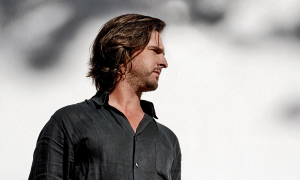
Home » Jazz Articles » Interview » Kurt Rosenwinkel: Latitude
Kurt Rosenwinkel: Latitude


For me what [music] is all about is containing some kind of fascination, or mood, or some kind of aesthetic quality that's pleasing to the ear. I'm only a conceptualist insofar as it translates to actual sound.
—Kurt Rosenwinkel
And in a time where major labels appear fixated on finding the next big thing Rosenwinkel has, for the past five years, maintained the kind of relationship with Verve Records that most artists only dream about. With four releases since '00 ranging from the more strictly-composed The Enemies of Energy and the electronica Heartcore to two albums that are decidedly more mainstream—The Next Step and this year's Deep Song—but all equally representing his diversified interests and distinctive emergent voice, Rosenwinkel has had an almost unprecedented (at least in these times) latitude for a young, less-established artist on a label more closely associated with legacy artists including Wayne Shorter and John Scofield as well as mega-sellers like Diana Krall. Clearly Verve recognize Rosenwinkel's potential; and with Deep Song charting on Jazzweek's Radio Chart since its release in March, so, apparently, are an increasing number of fans.
Beginnings
Rosenwinkel grew up in Philadelphia, and came from a musical family although not, by any means, with any great exposure to jazz. "My mother and father both play piano," says Rosenwinkel. "My mother is classically trained, she was actually studying to be a classical pianist—a concert pianist—while my father is a gifted improviser and also classically trained, but less so than my mother. So there was a lot of music going on in my family. Growing up I played piano, had a band with my best friend Gordon and we discovered music and kept playing together all through our high school years. When I was about twelve I got into guitar, after hearing the Beatles' Sgt. Pepper's."There wasn't really jazz going on in my house," Rosenwinkel continues, "I discovered it through the radio in early high school. Philly has a great jazz scene and it has a great jazz radio station, WRTI, so I used to listen to that all the time. Some of my fellow students were into jazz so that's how I got into it. And there was a weekly jam session at this neighbourhood club called the Blue Note—which isn't affiliated in any way with any of the other Blue Notes. It was just a neighbourhood club and they had a weekly jam session with some really great older players there who really presided over this Monday night jam session. There was a real community spirit kind of thing and from going to that I really grew to love and appreciate the community spirit of jazz.
"After traveling the world and seeing so many different places," concludes Rosenwinkel, "places where people love music but don't have that kind of experience, I look back and I feel really grateful that I happened to be where I was, because that kind of thing is really rare and it's getting rarer and rarer all the time. I really value and cherish the fact that I had the opportunity to be a part of that oral jazz tradition; it was great."
Gary Burton and Paul Motian—Formative Experiences
Rosenwinkel would ultimately end up studying at Boston's Berklee School of Music, but dropped out in '92 when Gary Burton asked him to join his band. "Gary's band," Rosenwinkel explains, "was the first really professional sideman gig that I had—it was the first international touring experience, it was the first kind of high profile scenario, so I really felt that it was a big break. It was a great experience from a professional point of view in terms of gaining experience and an entry into the world of what it means to be a jazz musician, what life is like as a jazz musician. Gary's a master musician, so listening to him play his solo pieces every night was the most musically inspiring experience for me in that band. He's a true master of the vibraphone."The same year, Rosenwinkel joined drummer Paul Motian's Electric Bebop Band, beginning a relationship that, as opposed to his relatively short stay with Burton, would last for the next decade. "Paul's totally different," Rosenwinkel says. "In Gary's band the parameters of the music were very specific, very specified, very controlled. In Paul's band some of them were set; there were some basic premises, like we're going to play bebop tunes, and this is going to be the arrangement—we're going to play the head and I'd take a chorus and Brad [Shepik, guitarist] would take two choruses and Josh [Redman, saxophonist] would take half a chorus. But beyond that there wasn't any musical guidance. So they had very different approaches as bandleaders. The Electric Bebop Band was a great experience playing with Paul, being alongside his incredible feeling of swing and rhythm. That was, for me, what I think I got the most out of it musically—just internalizing his feel on the drums and for music as a whole. That's what I come away with after having some perspective on it and years have gone by, that's really what I'm left with—a distillation of the entire experience for me was about absorbing his time feel and his feel for music."
East Coast Love Affair and Intuit
Concurrent with his work with Motian, Rosenwinkel was part of a nascent New York scene that included artists like pianist Brad Mehldau, saxophonist Mark Turner, bassists Ben Street, Larry Grenadier and Avishai Cohen, and drummers Jeff Ballard and Jorge Rossy. Regular gigs at Small's helped Rosenwinkel to solidify his own conception, both in terms of his musical approach and in terms of his tone. What is remarkable about hearing his first CD, East Coast Love Affair—a live album recorded at Small's—is that he already had a firm grasp on the things that would be important to him in terms of developing a distinctive musical voice and immediately recognizable tone.East Coast Love Affair was released on the Spanish Fresh Sound New Talent label—an imprint that has introduced a number of now-significant artists, including Mehldau and The Bad Plus. "I wasn't even thinking about any kind of long term strategy, in terms of kinds of albums I wanted to make," says Rosenwinkel. "At the time I was in New York, living hand to mouth and developing music with my friends. I happened to be doing a lot of sessions with Jorge Rossy—I've known him for years. We were doing a lot of jam sessions at each others' houses and in the New York scene.
"Jorge, is from Barcelona," continues Rosenwinkel, "and the Fresh Sound label is from Barcelona as well. So when Jordi Pujol, the owner of Fresh Sound wanted to start this label New Talent, he contacted Jorge, who he knew had all these contacts in New York, and he hired Jorge to be the A&R [Artists and Repertoire] person. So all of the first records on Fresh Sound were basically proposed by Jorge; just taking advantage of all the different scenes that he was aware of going on in New York at the time. One of those involved me and the music that we were playing, which was just basically playing tunes at sessions. Jorge and I had a nice hook-up as a trio with Avishai [Cohen, bassist], and so at the time the idea came to make a record that was what we were doing musically. We just felt like we wanted to do that, and so I didn't really think of it in terms of any kind of planning; it was simply an opportunity and we took it."
East Coast Love Affair, released in '97, and Rosenwinkel's next album—Intuit, released on Gerry Teekens' Criss Cross label in '98, were both essentially standards records. Rosenwinkel views playing standards and working on original material—like sessions he recorded for Chris Potter's '98 release Vertigo and Brian Blade Fellowship's '00 album, Perceptual, to be different aspects of the same continuum. "I think, in terms of the feeling I want to get to, it's the same thing," Rosenwinkel explains, "but in terms of the actual music it's very different. I have an awareness of my own relationship to standards that has evolved over the years, and it's an important part of being a jazz musician. It's a good backdrop to really see how your playing is, it's almost this sort of neutral stylistic context where you can discover what kind of player you are, what the qualities of your playing are. With original music, it's so much more about the mood of the tune as a composition; it already has this mood that you're trying to get inside of, and play from the centre of, so it's very different in terms of approach. With my tunes, for example, each song has its own real identity, so in that sense they're not sketches—skeletal vehicles like standards. The best music that comes from my writing is when the band is just playing the tune, in the most essential way possible. And then that unlocks all the doors to interaction and improvisation. So the approach to the two is very different. It's kind of like looking at the same thing from a different angle."
The Enemies of Energy, the Lost Album and Signing with Verve
While Rosenwinkel's first two releases concentrated on the standards repertoire, he was also honing his skills as a composer and, in fact, went into the studio only a few months after the recording of East Coast Love Affair with another of his bands—Mark Turner, Ben Street, Jeff Ballard and keyboardist Scott Kinsey—to record what would eventually become his first release for Verve in '00, The Enemies of Energy.But in the intervening years between that recording and his signing with Verve, Rosenwinkel was, in fact, signed to Impulse!, recording another entire album that ultimately got lost in the label shuffle that saw Impulse! picked up by Universal and himself moved over to Verve. "That record was called Under it All," Rosenwinkel says, "and my inspiration for that record was all the blueprints—all of the technical information and blueprints beneath everything we use on a day-to-day basis. My father's an architect and I've always been fascinated by architectural drawings. During the time we recorded Under It All my room was just covered wall-to-wall with architectural drawings. I didn't know what any of the symbols meant—I couldn't interpret them literally—but to me the specificity of all of the blueprints was inspiring to me, and yet was totally abstract because I didn't know how to interpret them; but I loved the idea of specificity and abstractness. And that, of course, is really what's underlying music—it's very specific but at the same time totally abstract.
And so that was my inspiration for the concept of the record," Rosenwinkel continues, "which was just a personal aesthetic concept of my own. I made the record with the same people as on Enemies—Jeff, Ben, Mark and Scott—and we recorded it, we loved it and then the merger happened and I got sent to Verve. Verve saw that I had this record that I had just made and I also had this record that I had made a couple of years before, and they said that they wanted to put out the one that I had made before, which became The Enemies of Energy. That was cool for me, because I had done that one all by myself, had raised the money and was in debt to people for making it. So Verve bought it from me and that was good—I was able to get paid and pay everybody back for it.
"Musically the two records are pretty closely related," continues Rosenwinkel, "in that they are both very compositional, very orchestrated, they have some production elements—although Enemies has some post production and Under It All doesn't—we played it all live. But one of the biggest differences, and I think this is one of the reasons Verve didn't want to put it out, on Under It All I was using a guitar synthesizer—not on the whole thing, but on some of it, and they weren't into that. They really wanted to put me forward as a guitarist and I think that they had a record that was very compositional and I wasn't featuring myself as a guitarist hardly at all. And when I was featured I was playing guitar synthesizer, so they didn't really see, from a marketing standpoint, that it would represent the new guitarist, Kurt Rosenwinkel.
"I don't really care if Under It All ever gets released," Rosenwinkel concludes. Copies are floating around here and there, but my work is done. I would feel conflicted if I hadn't had the chance to finish it; but having finished it, it's totally mastered it's all there—I don't really feel the necessity to see it released. I've finished it, I've done it, and I've completed what I had to do. So whatever happens in its life, I wish it all the best—and I'm sure it'll come out sometime in some way. It's already out as far as I'm concerned in that if anybody really wants to get it they can find it."
The Next Step and Heartcore
Rosenwinkel's next two releases, '01's The Next Step and '03's Heartcore, couldn't have been more different, although both garnered increasing critical and popular acclaim. "While with Enemies and Under It All, the core of those records was my quartet," says Rosenwinkel, "which was a working band, they were very compositionally-motivated records. The Next Step was a record where I really wanted to capture the sound of the band live, and so we're playing original tunes, and that's an important part of it; but the real thing of it is the live interaction of the band. In the beginning I had to fight a little bit more to get the go-ahead from Verve for The Next Step; they wanted me to do a different record. But I was totally resolved that that was going to be the record I made—I just knew it was the record I had to make, and so we kind of had a little bit of a battle over that and then I think that after the record came out and it got a lot of critical acclaim, I think that from that point on they kind of trusted my instincts."Heartcore, on the other hand, is a complete antithesis—while there was participation by other players including Turner, Street and Ballard, as well as production assistance by hip-hop artist Q-Tip from A Tribe Called Quest—it was essentially a solo record, made at home on studio gear that Rosenwinkel financed with the advance money for the record. "Heartcore was a huge thing for me," Rosenwinkel explains, "it was the biggest project that I've ever done, and for me it was a total success, just on a personal level.
"It took a long time," Rosenwinkel continues, "and it was really challenging, but it was something I had to do, it was like my solo record, totally just a solo record. It was like making a huge sculpture; I was sculpting every single moment of the record, and I ran the whole spectrum of emotions every day, from bliss and excitement, listening to what I had come up with, to absolute total dejected depression, like, 'Holy shit, how am I ever going to finish this?' There were all kinds of technical problems, all kinds of creative obstacles and challenges, and it was a huge effort. And so for me, I did it and it's exactly how it should be. That was my operating principle—I said, 'I'm not going to finish until I can have somebody come over, play them the entire record from start to finish, and not have one thought in my head that something should be different.'"
Heartcore literally took Rosenwinkel thousands of hours to record and mix over a two-and-a-half year period. "That was what I thought was the advantage of doing it myself," Rosenwinkel says, "and being in control of everything, not having any time constraints. I thought, 'If that's going to be the scenario, then that's going to be my goal,' and that's why it took two-and-a-half years. But I got it—there were some technical aspects that could have been better. I was using limited equipment, and now my studio is much better. If I made it now the quality would be better, but it's just fine—although we really had to work so hard to get it sounding like that. So it was a real adventure into the imagination, pure musical imagination; raw creativity, that's what that record is for me."
Sound and Musical Conception
Rosenwinkel's specific approach has, of course, been gradually evolving from his earliest days with Gary Burton. But throughout his recorded work for Verve, it's become absolutely distinctive—a combination of specific desires for tone and texture, as well as a personal conception for linear playing that is instantly recognizable. "There are qualities that I want to achieve, sound-wise, from the guitar," explains Rosenwinkel. "First of all there's strength of tone, in terms of the density of the notes. When you play a note it should sound full and not thin, and that's a very difficult thing to achieve on the guitar, especially without a big acoustic type hollowbody; my sound is in the semi hollowbody area, it's a mid-range sort of sound. So there's a balance I try to strike between woodiness and density. You can get a very woody sound but then again it might also sound hollow. And I want to get almost a solid body kind of density to the sound but also an organic nature so that it doesn't sound like a solid body. I want that organic quality but I also want that density to the notes themselves, and that drives my search for all the equipment I use—that's why I use Polytone amplifiers in particular."We go to great lengths to try to make sure that there's going to be Polytone amp on gigs," Rosenwinkel continues, "but even if there is a Polytone there, they have such a variety of different types. So I always bring a Boss EQ—the two pedal one, one of the newer ones. It's sometimes difficult to use amplifiers for tone, because you only have whatever frequencies the knobs are shelved at, so the low might be 100 or 200 or 60. And the mid might be shelved at any frequency, and sometimes those aren't the frequencies that you want to get more or less of, so the EQ enables me to get in there a little bit more and try to get the sound I need.
"Another element of my sound," continues Rosenwinkel, "is a kind of legato playing—a very strong left hand that can provide legato lines; that's really important to me, a big element of how I hear the guitar. You can get that legato feeling from a distortion pedal—you play a note and it's just going to sustain, like Allan Holdsworth does, but I want to get that same legato feeling with a clean tone, and that's difficult. It's much easier to get a kind of a sound where you play a note and the attack is strong and then the note just dies right after it. That's very easy to get—that's usually what you're going to get if you just pick up any guitar and plug it in to any amp. So that quest for sound has driven the development of my technique and my equipment.
"I work on that all the time," concludes Rosenwinkel. "With the right hand there's a kind of rhythmic fluidity that I strive for, that I'm just recently making some really good progress with. Kind of like a weighted hand feeling, like if you play the piano there's a kind of weighted attack, instead of non-weighted. The difference between a weighted attack and a non-weighted attack is huge on the sound and rhythmic flow. And so I strive for that with my right hand. Just the coordination between the two hands is really important, that they're working totally in unison so as not to waste movement or waste time to play a note."
Rosenwinkel also uses a fairly rigid practice regimen to attain his characteristic fluidity on the guitar. "I do a lot of scale exercises just to get warmed up physically," Rosenwinkel explains, "and I do things like going through the cycle of fifths, starting on the lowest note possible in the scale. If I start in the key of C I start with the low E, and continue, four notes on a string, all the way up to the highest note on the guitar in that scale. So I'll play a C scale from low E to high D on the high E string, and go from low to high and back, and when I get back, I'll get the E and that will be the seventh degree of F, and then I'll continue to do the same thing in F, and then I'll come back and stay on F instead of going to E because F is the lowest not in Bb, so then I'll go up and I'll go through the cycle of fifths like that all the way up and down the neck. Then I'll do different variations of that. Maybe I'll go all the way up and down two strings or one string, and go across all the strings. So I do a lot of very thorough scale exercises for technique and I'll go through different scales like harmonic minor, for example. And then I'll do some arpeggiation stuff and work on the chord scales, always going through the cycle of fifths. And then I'll start singing what I'm playing to give my body the feeling of the internal resonance of the notes, so I kind of graft my voice onto the neck and sing what I'm playing."
Singing what he plays is, in fact, another key aspect of Rosenwinkel's sound. While other guitarists have used this as more of an novel effect, with Rosenwinkel it's a natural and integrated concept. "It's something that's always come naturally to me," Rosenwinkel says, "I've never worked on it; it was never a concept that I wanted to get to and worked on, it just always came naturally to me; I was always able to sing anything I played. It's like I'll have an impulse to sing something, and then my fingers will just be coordinated with that impulse. And then sometimes, vice versa; if I have a visual idea, I'll know how that will feel to sing it as well, so whether the melody comes from the voice or whether the melody comes from some visual idea, I can always play what I want to sing, and sing what I want to play.
"I've recently figured out the best way to do it," continues Rosenwinkel, "which is that I have this little Levalier microphone clipped on to my shirt, so it's out of the way and nobody really notices it, and I plug that into either the effects loop in my amp or into another little amp. I sing quite loudly, so even before I discovered that microphone it had become part of my sound. That's the way I discovered that the voice was part of my guitar sound, in fact. People would come up after shows and say, 'What kind of effect are you using?' I'd say I was using a delay and a reverb, and they'd say, 'No, there's some kind of chorus effect or harmonizer,' and I didn't realize what they were talking about. Then I realized that what they were talking about was the voice and that's how I discovered that it was a part of my sound."
Deep Song
Almost a reaction to Heartcore's intense and solitary studio experience, for his next record, Rosenwinkel wanted to get back the basics of playing his instrument in a band context. While some have looked at the personnel on Deep Song—Joshua Redman, Brad Mehldau, bassist Larry Grenadier and drummers Ali Jackson and Jeff Ballard—as perhaps a clever marketing ploy to gain a wider audience, the truth of the matter is that the group evolved quite naturally. "I was playing quartet a lot with piano at the time," Rosenwinkel says. "And then I was in New York and we were playing at Fat Cat for three nights. I was recording on Joshua Redman's record [Momentum] out in New Jersey, and it just happened to be those days when he was in town recording and I was doing the sessions with him that I had these gigs at Fat Cat. So I invited him down to play, and he came down and it was great; I mean I always enjoy playing with Josh, but this time we played for three nights in a row and the chemistry of the band was just totally happening."So then I thought, 'OK, this is great, I want to make a quintet record and I want to have that be the thing,'" Rosenwinkel continues. "And so, of course, this connection Josh and I have was something I wanted to capture. Also, Brad and I have been playing together and recording together off and on for the past 10 years, and yet we've never really had the opportunity to be in a band together and work on our musical rapport, because we've always been sidemen on somebody else's recording date. So it's something we've always wanted to do, and we would say that over the years. The same thing with Larry Grenadier. Larry and I played together a lot when I was at Berklee, it was sort of the same scenario with him, so it was a natural thing for me to say, 'OK, I'm putting this band together, and here's the band.'"
The band, with Ali Jackson, would do a three-week tour of Europe in the summer of '04, before heading into the studio a few weeks later to record the album. For the album, Rosenwinkel would bring in Ballard for a few specific tracks. "Jeff has a way of playing straight eighths that I think is like nobody else," Rosenwinkel explains, "so he's on those straight eighths kind of tunes. Ali has so much fire, he's so swinging and he's so consistent in his groove. On tunes like 'Use of Light' and 'Brooklyn Sometimes' Ali is just a master of changing things a tiny little bit to propel the music forward, to create a forward momentum with the groove. It's a little like Vernel Fournier in Ahmad Jamal's trio. And on tunes like 'The Next Step' he's so swinging, like that community feeling I had in Philly—it kind of brought the Philly out of me, and I really loved that."
Surprisingly, Rosenwinkel would include material from his previous records—"The Next Step" and "Use of Light" from The Next Step, and "Synthetics" from The Enemies of Energy. "Basically, the first repertoire decisions I was making for this group were live repertoire choices," says Rosenwinkel, "and in that regard I was motivated by just having the strongest material for the quintet, so I just picked what I felt was my strongest material. I wasn't even thinking about recording 'The Next Step,' and it was Verve that heard it and said, 'You've gotta record that.' Some of the other tunes I wanted to do as well. 'Use of Light' I wanted to do because the whole function of the instruments was changed around. For me, if I'm playing that song with a piano then I can be the melodic voice and I can fly as the melodic expressive voice; whereas on The Next Step my role was chordal, keeping the tune happening, and Mark Turner was flying. So for me I wanted to redo that tune just for me, as another take on it, with me playing the melody. 'Synthetics' is a very challenging tune, and I thought that it had been a long time since we recorded the first version, that I'd grown a lot, and had more to say on the tune."
Deep Song may be Rosenwinkel's most accessible recording to date, although it's never been his desire to make anything other than music that's approachable. "I've always felt that my music is accessible," explains Rosenwinkel, "and that's a subjective reality, whether it is or not. But for me, I've never been trying to write something that's complicated, that's not my purpose at all in discovering sounds and organizing them into compositions. For me what that's all about is containing some kind of fascination, or mood, or some kind of aesthetic quality that's pleasing to the ear. I'm only a conceptualist insofar as it translates to actual sound. So for me, the stuff under the hood is really meant to be under the hood; it has to be there in order for the melodies to come out, for the mood to be accessible. But at the end of the day I want my music to be accessible because I want to communicate."
Future Songs
Having reached a certain stage in his career, Rosenwinkel no longer feels it necessary to live in New York and, in fact, relocated to Switzerland with his wife and newborn child a couple of years back. "I still do a fair bit of traveling," says Rosenwinkel. "Sometimes I go to New York and rehearse for a little while and then go out on the road, but at this point, if I have the right cats, we can just meet at the gigs and go over a few things at sound check. We're at a stage in our musical lives where we can do that, we don't have to be living in the same city, we can just meet at the gigs, and that's nice. I'm happy to get back to New York from time to time, I love New York—I love the people there. But there's a big appeal about being able to raise a child in Switzerland, the whole environment is healthier I think—not to mention the education and health care systems."Meanwhile, with Deep Song out for less than six months, Rosenwinkel is already looking towards future projects. "I want to do a live record," explains Rosenwinkel, "a new project with a new band, another Heartcore record—but acoustic this time. I also want to do a trio record of standards. I want to do all those things, but I don't know which will come first."
Regardless of what the next project for Kurt Rosenwinkel is, there's a growing audience that will be waiting to hear it. And like Metheny, Scofield, Abercrombie and Frisell, Rosenwinkel is in the enviable position of being able to pursue whatever direction he chooses, with full support from a major label ensuring that his music gets the widest possible distribution.
< Previous
Easy on the Heart
Next >
Standard Procedure
Comments

About Kurt Rosenwinkel
Instrument: Guitar
Related Articles | Concerts | Albums | Photos | Similar ToTags
Concerts
For the Love of Jazz
 All About Jazz has been a pillar of jazz since 1995, championing it as an art form and, more importantly, supporting the musicians who create it. Our enduring commitment has made "AAJ" one of the most culturally important websites of its kind, read by hundreds of thousands of fans, musicians and industry figures every month.
You Can Help
To expand our coverage even further and develop new means to foster jazz discovery and connectivity we need your help. You can become a sustaining member for a modest $20 and in return, we'll immediately hide those pesky ads plus provide access to future articles for a full year. This winning combination will vastly improve your AAJ experience and allow us to vigorously build on the pioneering work we first started in 1995. So enjoy an ad-free AAJ experience and help us remain a positive beacon for jazz by making a donation today.

Giveaway

Eligible winners: 15
Days remaining: 5
Days remaining: 5