Home » Jazz Articles » Live Review » International Festival Musique Actuelle Victoriaville, Day 2-5
International Festival Musique Actuelle Victoriaville, Day 2-5

What exactly is Musique Actuelle? Based on performances on the second day of the 22nd International Festival Musique Actuelle Victoriaville, it's a somewhat enigmatic classification. Is it jazz? Certainly there are elements, although one might be hard pressed to find anything that fits a reductionist definition that asserts it has to swing. Is it contemporary classical music? Again, there's no question that some of the artists are both informed and inspired by more left of center compositional constructs. Is it rock? Not likely, although there are certainly groups in attendance that would fit, either directly or through their more vigorous, groove-centric sensibility. Improvisation is certainly an element in many performers' musical universes, although there are some performers whose work is more rigidly structured.
No, Musique Actuelle is one of those hard-to-specifically define musical categories that is perhaps best considered by what it is not rather than what it is. It's not any of those previous definitions, and yet, in some ways, it also is. And while it incorporates numerous elements from a multitude of sources, it begins to take on its own life during the course of Victoriaville's festival. Certainly it leans to the avant side of things, often is as concerned with texture as it is more conventional concepts like melody and rhythm, and can range from sublime beauty to unnerving aggression. But the underlying philosophy is clearly one of experimentation and innovation.
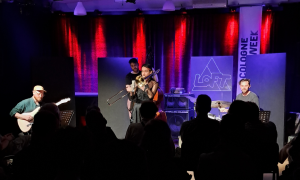
Michel Cote leans towards the gentler side of the equation, yet embraces a broad range of dynamics and sonics, favoring a conducted or rehearsed approach to improvisation. He opened the day's schedule with an ensemble that, along with his own electronic percussion and other electronics, included an innovative turntablist, a pianist/sampler, violinist, guitarist and theremin player. The hour-long composition moved from points of freer improvisation to clearly defined yet abstract constructs, often cued by the subtlest of hand signals. More about shape than specific form, there were times where the overall texture approached the ambient, but was just as likely to swerve into denser territory.

The combination of instruments gave the performance a distinct character. Turntablist Martin Tétrault asserts that the turntable can, in the right hands, be a legitimate musical instrument. Rarely using actual vinyl for his soundscapes, he could be seen using such odd devices as a wooden platter, where the needle of the turntable would create a soft sound that integrated with the samples going on beside him. Guitarist Bernard Falaise clearly comes from the Derek Bailey/Fred Frith school—at least in this performance, as he's known to be a stylistically diverse player in other contexts—utilizing a variety of techniques to draw more textural sounds. Thereminist Frank Martel—with the exception of one point where he resorted to the kind of vocalization effect that is the stereotypical space of the instrument—was remarkably innovative, extracting surprisingly visceral low tones out of the instrument, and elevating it beyond its more conventional use.
Cote himself found ways to extend the concept of electronic percussion beyond its more anticipated musical space. Hitting the triggers with a microphone resulted in deep, in-the-gut tones that, along with some of Tétrault's thicker sounds and Martel's rich bass timbres, created a powerful pad over which the guitar and violin could layer their own devices.
Meant to be experienced in a broader sense, felt as much as heard, the cinematic performance had its own arc. The ensemble was as likely to come together in apparently defined directions as it was to break down into passages of pure cacophony. Occasional moments of dark beauty would emerge, only to dissolve into discord.
With their intriguing blend where the unconventional instrumental mix would yield its own distinctive personality, Cote and his ensemble provided a fitting start to a day that would be highlighted by additional forays into unfettered discovery.
Two artists who have appeared frequently over the years in Victoriaville, yet have curiously never played together, are saxophonist/composer Anthony Braxton and experimental guitarist/composer Fred Frith. And based on their first musical encounter this year, one hopes that it won't be their last.
The two improvisers come from different worlds, yet managed to find many points of intersection. Frith, originally a part of British Rock in Opposition bands like Henry Cow and Art Bears, has long demonstrated a musical invention that has incorporated a number of pioneering extended techniques. (It's no surprise that guitarist Nels Cline dedicated his performance on the first night of the festival to Frith.) With an array of electronic devices, bows, metal cups, chains, alligator clips and more, Frith's unconventional approach to the guitar runs from the delicate to the deconstructive, from the obliquely melodic to the totally dissonant, and from the delicately spacious to the densely orchestral. Seemingly avoiding all rules of convention, Frith would, through the course of the fifty-minute performance, constantly detune his guitar, creating a constantly-shifting harmonic centre and the potential for new and unusual voicings.
 Playing to such a continually moving target would be a challenge for most players, but for Braxton it was clearly a source of inspiration. While Braxton has a more traditional jazz improvisation background than Frith, he's no less intrepid a player. Alternating between alto, soprano and sopranino saxophones, his ability to interact with Frith in a constant push-and-pull created an evolving landscape that ranged from almost unbearable tension to moments where silence and the decay of notes became paramount. And Braxton's ability to create dense clusters of notes one moment, more linear constructions the next provided its own demand for response, to which Frith was clearly attuned.
The performance had a natural ebb and flow, sometimes developing gradual dynamic shifts and other times more instantaneous and jarring changes in direction. But Braxton and Frith were obviously in sync, and while there were moments where each player was looking for the other to articulate where things would go next, the real magical moments occurred when the two seemed to synchronously head off in a new direction.
While most of the artists performing in Victoriaville operate without a safety net, Frith and Braxton's interaction had an incredible sense of immediacy. In the realm of free improvisation, it's all too easy to fall into expected patterns—but when faced with an empty slate, these two artists viewed each situation as a new opportunity, allowing their enraptured audience to fully participate in the thrill of discovery.
Electronic sound sculptress Ikue Mori and harpist Zeena Parkins have been mainstays of the Downtown New York Scene for some time. Originally a drummer, but having long-since migrated to a distinctive electronic drum/sampling setup, Mori has contributed to a number of projects, including various film scores by John Zorn and Dave Douglas' albums Sanctuary and Witness. Parkins is a fearless musical innovator who has expanded her avant-leaning harp work to include sampling and a unique electric harp that allows her, like Nels Cline and Fred Frith, to treat her instrument and explore a broader sonic palette. Like Mori, she has shared a longstanding musical collaboration with a number of "out of the box" thinkers, including Zorn and experimentalist Elliot Sharp. Her work on Cline's Cryptogramophone release The Inkling demonstrates just how far one can take an instrument by dispensing with preconception and tradition—although it is clear that Parkins has a significant background in contemporary new music.
 The hour-long midnight performance combined composed form with inspired free play in the context of pieces that were often the briefest of miniatures. Parkins and Mori could not be more opposite in their appearance—Parkins the more conspicuously engaged performer, Mori seated still in front of her computer, demonstrating little emotion. But the commitment from both was evident as they developed pieces that combined moments of sheer chaos with others of inexplicable beauty.
At times Mori's oddly textured percussion samples, when combined with Parkins' more aggressive electric attacks, could be uncomfortable, and even disturbing. Yet there were also periods of strange grace, with an attention to space and dynamics. Parkins seemed to revel in the quality of each note, the nuanced possibilities of each phrase and the raw emotional impact of extreme sonic clusters. What overt rhythms there were remained implicit, with Mori's oddly placed and seemingly random pulses creating more an ambient soundscape than any kind of forward motion.
Like others at the festival, Mori and Parkins created a complex and challenging premise for the juncture between form and freedom; a blending of the purely textural and a less than obvious, but nevertheless effective thematic sensibility. Their telepathic connection, regardless of the direction their music would lead, made for a compelling and moving experience.
Visit Fred Frith, Anthony Braxton, Michel Cote, Ikue Mori, Zeena Parkins, and the International Festival Musique Actuelle Victoriaville on the web. For a full schedule of this year's events, click here.
Continue: Day 3
Photo Credit
Martin Morisette
Tags
PREVIOUS / NEXT

Become a Sustaining Member

Since 1995, All About Jazz has championed jazz as an art form and supported the musicians who create it. Over three decades, it has grown into one of the world's leading jazz resources, serving hundreds of thousands of readers, musicians, presenters and industry professionals each month.
Help Build the Future of All About Jazz
Your support helps us continue building All About Jazz for the next generation—expanding our editorial coverage, preserving jazz history, developing new community features and creating better ways to discover the music and the people behind it.
Become a sustaining member for as little as $20 per year and you'll immediately enjoy an ad-free experience along with access to subscriber features and future articles for a full year.
Together, we're not simply sustaining All About Jazz—we're building its future. Thank you for being part of the journey.