Home » Jazz Articles » Profile » Bobby Few is Coming Through
Bobby Few is Coming Through

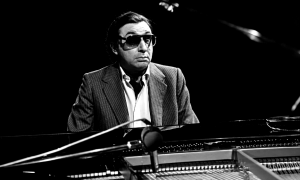
Few began playing piano at age seven at the behest of his father, who was a jazz aficionado, and studied both classical and jazz techniques. Cleveland classical organist Catherine Howland Forbes was his classical teacher, and he studied jazz under Benjamin Austin. Though Few began playing classical music first, it was not long before improvisation equaled classical form in importance for the young pianist: "I was actually learning classical first, from seven through eleven, and at that time I got a little certificate for playing Chopin's 'Polonaise,' and I continued playing classical until I heard my father's Jazz at the Philharmonic records, which gave me an incentive to try and play this way. I thought, 'wow, this is different,' because it didn't seemed to be so fenced in." Ms. Forbes evidently didn't quite approve of Few's jazz proclivities, though he was able to study both forms of music throughout his youth. He was therefore able to study the fundamentals of improvisation and swing, while still maintaining a propensity for classical pianistic tone and organization, eventually developing into a dense, arpeggiated style. At 15 Few assembled the East Jazz Trio, a group that became extraordinarily popular in Cleveland and the Midwest, with drummer Raymond Farris and bassist Cevera Jeffries, Jr. (who later joined Few on record dates with Booker Ervin and Marzette Watts). The group primarily played a repertoire of standards and was together until Few and Jeffries moved to New York in 1962, at the behest of Cleveland tenor hero Albert Ayler.
Though Few scuffled a fair bit while living in New York during the '60s, he was able to find kindred spirits rather quickly, for his apartment building was populated with a who's who of jazz musicians—the aforementioned Ervin lived upstairs, as did pianist Randy Weston, while tenor man Frank Wright lived downstairs. "One day I was playing in my apartment, and Ervin came down and knocked on the door and said, 'wow, what's your name' and I told him I'm Bobby Few from Cleveland. He said 'would you like to record with me?' and I said 'wow, with who?' and he said 'with Blue Note [The In Between, 1968]. I said 'yeah, oh man!'" Prior to that, Few had been playing with R&B singer Brook Benton and Benton was the impetus for Few's first foray into Europe, giving the pianist a chance to tour outside America fairly early. But it was working with the Frank Wright group that brought Few to France in 1969, where he has since made his home. Few, Wright, altoists Noah Howard and Arthur Jones (another Cleveland expatriate), bassist Alan Silva and drummer Muhammad Ali were looking for a new location and it seemed like a good opportunity to leave the pell-mell and increasingly dangerous environment that New York had become. "We all said 'where can we go' and Frank said 'well, what about Paris?' We said, 'hey, wow, but we don't know anybody or anything,' and Frank said 'well, let's just go.' So we packed our bags and came to Paris...and we were like pioneers. We knew nobody—we didn't know the language or anything—and there was this student revolution that had happened in '68 and it was still going on by the time we came. Four of us were walking down the street and hundreds of police came with gas masks on in the back of us and in front of us were these students burning cars and everything, and we just started running because we got scared. We saw a light on that we thought was a restaurant and ran into this place and this guy closed the door and said 'wow, who are you guys?' and we said we were musicians. He asked if we knew where we were and we said we thought it was a restaurant. He said, 'it is, but downstairs is The Jazz Cave.'..the owner said 'would you like to play here next week?'"
The Frank Wright Quartet, or the Center of the World as it became known (Wright, Howard, Few and Ali, later including Silva), rented a truck and drove around Western Europe showing up at festivals and getting in by the good graces of promoters. The Actuel festival in Amougies, Belgium as well as festivals in Amsterdam, Rotterdam and elsewhere helped to bolster the group's reputation and it was not long before they were invited to play at happenings like the Nancy Jazz Pulsations (Last Polka in Nancy?, Center of the World Records, 1974) and Berlin's FMP-spearheaded Workshop Freie Musik. The group dissipated in the early '80s, reaching finality with Wright's passing in 1990 and Few joined the ensemble of Steve Lacy, whom he had met at Amougies. Few and Lacy remained a team until 1992, when the saxophonist returned to trio and quartet formations. "Just recently I read an article that said that the reason Steve Lacy stayed in France was because he met me," Few said. Making the switch from the dense and very free, but nevertheless R&B-laced approach of the Center of the World to Lacy's Monkish koans was a unique challenge for Few: "It wasn't easy to play the music of Lacy because it was very special and very complicated. Sometimes I used to go crazy trying to figure out the parts, but after a while it began to grow on me...I had to adjust because he had written it in such a complex way, chordally...but I think it helped him increase melodically because he hadn't been using a piano and it gave him a great lift musically...sometimes he would write chords where my hands were at either end of the piano and you didn't know [what chord it was]."
Early training in classical music and jazz, the volatile, earthy funk of Frank Wright and the at-once hermetic and open miniatures of Lacy have given Bobby Few a unique conception that has yielded hundreds of compositions as well as, interestingly, a penchant for singing, a talent he began to develop while with Wright and that has continued to this day. "When you compose your own music and you're allowed to play it, you really have a lot of fire because it's your own. You see that people respond and want to record and talk about your music, you know it must be working." Few's performances have often seemed like marathons; in a duo with tenor man Avram Fefer, the pair ran through Monk, Ellington, Few's pieces and free improvisations like a juggernaut, running a stylistic and emotional gamut. Rehearsing, improvising and, most importantly, fostering empathy with both fellow musicians and with others who share in the experience are proof—it's working.
About Bobby Few

Tags
PREVIOUS / NEXT

Become a Sustaining Member

Since 1995, All About Jazz has championed jazz as an art form and supported the musicians who create it. Over three decades, it has grown into one of the world's leading jazz resources, serving hundreds of thousands of readers, musicians, presenters and industry professionals each month.
Help Build the Future of All About Jazz
Your support helps us continue building All About Jazz for the next generation—expanding our editorial coverage, preserving jazz history, developing new community features and creating better ways to discover the music and the people behind it.
Become a sustaining member for as little as $20 per year and you'll immediately enjoy an ad-free experience along with access to subscriber features and future articles for a full year.
Together, we're not simply sustaining All About Jazz—we're building its future. Thank you for being part of the journey.