Home » Jazz Articles » Interview » Orbert Davis: Trumpeting All Kinds of Music
Orbert Davis: Trumpeting All Kinds of Music
Music and life is a matter of study. It never ends.
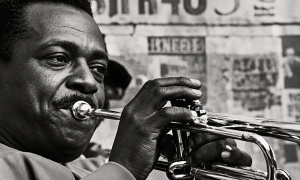
 Orbert Davis is one of the most active trumpet players on the music scene, heard in tons and tons of contexts and not just by jazz fans. He's credited with performing on something like 2,500-plus commercials. He's done film music, most recently helping arrange music in "Road to Perdition" with Tom Hanks and Paul Newman. His work with pop acts includes Stevie Wonder, Dionne Warwick, Duran Duran, Gladys Knight, The Temptations and others.
 He is known as a guy who can fit in anywhere. Regardless of style, he can work it. But at heart, as a player he's a jazz guy with a beautiful tone and strong technique. He can cut it with Ramsey Lewis, Kurt Elling, T.S. Monk, Paul Wertigo and anyone else, really. He's complete. He was featured soloist at the 1996 Chicago Jazz Festival, performing Miles Davis and Gil Evans' "Sketches of Spain." And last fall, a 55-piece orchestra he assembled headlined the Chicago Jazz Festival, a group that he wants to do a lot more working with and writing for.
More than a musician, Davis dedicates huge amounts of his time schedule to teaching kids. Not just aspiring musicians, either. At-risk kids. Kids who need a different approach; a chance to see there is something else out there. And he's a family man, usually staying home two days a week when his wife works, to help tend to his 4-year-old daughter while his 8-year-old son is in school.
It seems like he might need a large "S" emblazoned on a blue undershirt beneath his business suit. But not if you ask him. Orbert Davis is dedicated, hard working, yet unassuming and affable. He's comfortable in the Chicago area, where he grew up and still resides. At age 44, he has carved out a strong career in music. He's extremely busy when many musicians wish they could say the same.
What has propelled him, Davis says, is "perseverance, setting goals high and working extremely hard."
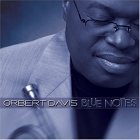 His latest effort is his new jazz CD Blue Notes that features original music from Orbert and his band mates, for the most part. His crystal tone is one of the highlights on this mostly straight-ahead gig. Ari Brown on sax is notable, as is Dee Alexander, who sings bluesy vocals on two numbers. On "Shaw Nuff" you can her Davis' chops fly through a number. But his trumpet and fluglehorn are so great in their sound, technique doesn't matter. It's no wonder that his friend, Kurt Elling, used Orbert on a song he wrote in tribute to Miles Davis, "Prayer to Mr. Davis" on The Messenger. Because Miles was first and foremost about sound.
"Tone is the most important thing in sound production, " he says. "Of course having the right equipment too. I play a Clifford Blackburn trumpet. I don't know of any other jazz musicians who do. If there are any out there, I would love to meet them. I know a lot of classical musicians who play it. It's the sound that I go after."
It's on his own label, Orbark Productions, which he runs with his business partner and childhood friend Mark Ingram. The label has produced some nice albums, including Priority, Davis' last release. Running the label, therefore avoiding direction from others, is important.
"We turned down a nice deal with a major label," says Davis. "But we didn't want to give up control. He'd rather have artistic control over the music that comes out, which you can lose going in with a major label where it's business first, not music first."
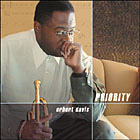 He says Priority did well and made various jazz charts here and abroad. But as far as sales go, "We broke even... But it's worth doing it, because it's our thing. We do it for the love of the music."
Davis grew up in the rock- and pop-dominated era and liked all kinds of music in Chicago. His parents didn't play music, but were fans. To say Davis took a liking to the trumpet is putting it mildly. "I became obsessed with the trumpet," he states. "My parents had to yell at me to stop practicing, not to start practicing." Gradually, he was drawn to jazz, listening to Lee Morgan and Freddie Hubbard. Raphael Mendez also as an influence "for his articulation and sound. As Davis moved to taste the pantheon of trumpet players, he realized "musicians have to be open to every voice," and in jazz, he found that it was a demanding place to hang one's hat. It didn't deter him.
In fact, "The challenge of the trumpet drew me into jazz," he says. "My voice as a jazz musician is my most important voice."
Davis worked hard in high school and college on his instrument, learning, as well as racing from studio session to studio session, carving out a living. He has a bachelor's degree in trumpet performance from DePaul University and from Northwestern University a master's degree in jazz pedagogy, "the art of teaching jazz, or learning what's needed to be a teacher in jazz... Preparing educators to head jazz departments or be an administrator in jazz departments at whatever level."
At one point, he became so busy in studios that he had to turn down work. "I tell students that I am trained as a studio trumpet player. That means in order to work I have to play anything. Even more importantly, the people who hire me have to know that they can call me for anything... In the heyday, when I would go from studio to studio, I would literally run from a classical orchestra and the next thing would be sounding like Harry James or sounding like Louis Armstrong."
Being a studio musician, his goal was to play everything, "but the most important thing was the sound. So the sound of the trumpet is neither classical or jazz nor Top 40 or anything. We would strive for the sound of the trumpet and simply adapt it to whatever environment I was playing in."
Davis worked hard to be adept at all styles of music in order to survive, but admits that some pop music isn't worth pursing anymore. "I was into all kinds of music until the melody left," he says, being somewhat diplomatic about much of today's techno and rap music. "It's about melody for me," he says, noting that much of today's music "is fed through commercialism. There's little that is artistically pleasing."
Now, he says that in addition to running the MusicAlive! program in high schools throughout the Chicago area, he is also dedicated "to do all I can do to elevate jazz" though teaching, writing and playing.
"Music and life is a matter of study. It never ends."
Part of that education was spending 14 years in the pit band of the "Nutcracker" in Chicago that taught him a discipline about bigger orchestras and the music. His first major gig in the realm of live jazz performing was the band of the hot Chicago drummer Paul Wertigo. "That was a catalyst that really pushed me into jazz," moving him from the shorter solos of studio work to "three to five-minute solos" which was an important experience.
Working with Bill Russo and the Chicago Jazz Ensemble was also important. "I was his right hand for a good number of years in the late 1980s." From Russo he learned "serious artistic integrity—the way he approached music and approached it as an art."
For Davis, the style of music isn't the most important thing. He can listen to Stravinsky and Mahler, then go to Cootie Williams trumpet in Duke Ellington's orchestra. There are things to be learned at each step, and things to be appreciated. "I can be listening to 10 minutes of Miles Davis where he's king of the world, then two minutes later be into Duke Ellington or Louis Armstrong."

His pet project is MusicAlive!, a program that brings music to troubled kids in various public and private school districts in the Chicago area. He and Ingram are heavily involved in it, and there are six other musical mentors "so the burden is not totally on my shoulders."
"It takes up a lot of my time," he says, yet its part of his calling and he hopes to keep expanding the program to make even more of a difference in the lives of youngsters. The mission "is very grassroots. Saturday night I can be in an audience of 500 or 600 people playing jazz and the next day be in a class of sixth graders who all are wards of the state who have special needs. But it's my job to bring the world of music to them. I tell them week after week I'm there because it's part of my life to make a difference."
"My ultimate goal is to see the Music Alive program expand all the way into the college level. It's tragic how bad the lack of music is in urban schools," he says. "At the same time, I think jazz at the collegiate level is flourishing. There's jazz programs everywhere. I would love to see that progression fulfill itself, where MusicAlive! can make an impact on a student; watch a student progress from the fifth and sixth grade level all the way into college.
"And it's not just about music. The idea is to use music to help people find what's important. In the process, instead of spending $40,000 to take care of an inmate, we'll invest that same $40,00 into someone who will make a serious contribution to helping other people."
Writing for huge orchestras, and merging elements of classical and jazz both in the writing and performance, is another mission of this trumpeter. He has written jazz symphonic works and loves that area of music. "I just want to grow and work with the orchestra," he says of the group that hit the Chicago Jazz Festival last September 4, to strong reviews.
"It was the first time that a Chicago resident headlined the festival. I can't say 'I,' because my business partner, Mark Ingram, should get as much or more credit than I do. One person cannot do it. We've been best friends since I was 14. All of our adventures we do together, even though I'm out front as being the artistic leader of it all."
"The musicians were phenomenal. I basically drew the orchestra from all my friends and colleagues I've known through the years performing and recording in Chicago. There were classical musicians and jazz musicians. Absolutely phenomenal," says Davis. With a strong concert and strong reviews "we have a future," he says. He wants to keep investigating the "third stream" of music and creating "a series of renaissance works of third-stream music... I don't see them (classical and jazz) as separate."
"Gil (Evans) and Miles (Davis) was the prime example" with their production of the classic Sketches of Spain and Porgy and Bess albums.
As for this work in films: timing, he notes, is sometimes everything. "I don't go after it. I get the call and say, 'Yeah. I can do that.'"
 "My last film job was, I was actually the jazz consultant to Sam Mendes for 'Road to Perdition.' He called me to sit and talk about jazz. And I had no clue who he was. I didn't see his previous movie. Timing is perfect, because they had shot the film in Chicago and I had just performed a concert in LA with my quartet. I used a string quartet from LA, but the guy who I called to contract the string players in LA got the call to be the music consultant for the film. They brought everybody from Chicago to LA. He was busy. He said 'Call Orbert Davis in Chicago.' A week later after being in LA, I get this call.
"It was fun. Sam gave me a lot of leeway and a lot in the decision making process, and a couple of the scenes, which was really cool. I ended up arranging the music. The consultant job was to sit with him and figure what the mindset of the musician was — even though the scene was like seven seconds long. But it was a great experience. He allowed me to select a lot of the music. When he first called me, I told him, 'Why are you calling me? You know everything.' He really did his homework, but we were able to stretch and find something really appropriate for it."
So it's all in a day's work — make that many days work — for this Windy City musical mainstay. Studios, his quartet, his orchestra, his teaching. And also his family.
"On the musical side, it's my goal day to day is to learn to play the trumpet better and better. And balance it all. I'm into so many other things that my playing gets pushed aside. I have to play a couple nights just to get back on track."
Maybe. But it's difficult to believe Orbert Davis is ever that far off the track.
Visit Orbert Davis on the web.
Photo Credit
B&W by Mark Ladenson
About Orbert Davis

Tags
PREVIOUS / NEXT


Become a Sustaining Member

Since 1995, All About Jazz has championed jazz as an art form and supported the musicians who create it. Over three decades, it has grown into one of the world's leading jazz resources, serving hundreds of thousands of readers, musicians, presenters and industry professionals each month.
Help Build the Future of All About Jazz
Your support helps us continue building All About Jazz for the next generation—expanding our editorial coverage, preserving jazz history, developing new community features and creating better ways to discover the music and the people behind it.
Become a sustaining member for as little as $20 per year and you'll immediately enjoy an ad-free experience along with access to subscriber features and future articles for a full year.
Together, we're not simply sustaining All About Jazz—we're building its future. Thank you for being part of the journey.