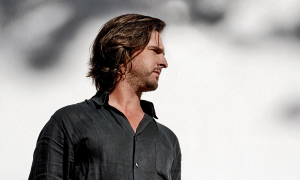
Home » Jazz Articles » Interview » William Parker: Everything Is Valid
William Parker: Everything Is Valid

 William Parker is, no doubt, the most remarkable bassist in the post-Mingus era. A great musician who is gifted with an uncanny ability to make any artist near him—musician, dancer, painter or poet—perform better. Parker presents a musical vision that is full with compassion and commitment to his community at large.
William Parker began his European tour in the Tel Aviv Jazz Festival, performing with Roy Campbell Jr.'s Pyramid Trio. Parker and drummer Hamid Drake recorded a trio album in Tel Aviv with Israeli saxophonist Albert Beger, and Parker performed with his daughter, dancer Miriam, who resides in Tel Aviv. On his tour he will play in a trio with Matthew Shipp and drummer Gerald Cleaver, with his Violin Trio alongside Billy Bang and Sunny Murray, and in a duo with bassist Joëlle Léandre. The interview was conducted in Tel Aviv.
The Bass and Other Instruments
"I got the underlying idea of music from my father, who played constantly the music of Duke Ellington since I was five years old, and he had the idea that one day I would join the Ellington Orchestra. When I was eight years old I began playing the trumpet, and when I got to junior high school I played the cello, and it was there that I began to get the idea of the bass. And when I got to high school I began to really think seriously about the bass, but I didn't start the bass until I was out of high school. I guess that I made the decision that I wanted to play music and I can make contribution to what was called the New Thing, the avant-garde, the free jazz, around 1968, '69.
"I got an instrument and my first formal training was in the Jazz Mobil School of Music up in Harlem and they had a nice faculty there with Richard Davis and Artie Davis, who taught the bass. We played charts by Oliver Nelson, but I was so interested in the sounds of the Fire Music, improvised music of any kind, music that was uncharted, no paper. So I began to study privately with Jimmy Garrison and Wilbur Ware and I began playing, on-the-job training, learning about the music by playing with the musicians.
"The bass was just the beginning of everything else. I began to be interested in other instruments. I began to be interested in the music of Africa, India, Mid-East, Japan, China. Right now when I take an instrument from a different country I adapt it to who I am and what I'm doing, rather take the traditional approach because that is life-long approach, you have to be there, you have to feel those rhythms. I'm playing the shaukahachi and it's adapting it into Afro-American concept, a William Parker concept. Right now it's all I can do.
"I did not go to Africa, as Don Cherry did, where African musicians will say, 'I'll teach you a song,' and then interpolated that into jazz. But there is definitely a connection between black African music and black American music. Pygmies' music is the first rap music. They're talking and telling stories, and you can hear the inflection—aha-aha-aha-aha. You hear Grandmaster Flash through the pygmies, though he is not listening necessarily to the pygmies, but there is a connection.
"There's always a thing about trained and untrained musicians. I have nothing against anybody who picks up a bass. They want to make a gig on Tuesday; be my guest. It's not for me to say, 'you haven't trained, you don't know music.' That's your business. If you can play the instrument and it works, go ahead and play. There's no fear of the mysteries that you will find in music. It can only be a joy when someone else is trying to participate in the music. Either the music will fly or float, and no matter what I say or don't say. Many people are saying he's playing by ears, he's just improvising, but little kids all over the world are picking instruments and just playing. There's no such thing as music police, saying this is music, this is not music. Everything is valid."
Spirituality and Freedom
"That was the reason I wanted to get into music, after putting together the messages of records called Love Cry and Spirits Rejoice [Albert Ayler], A Love Supreme [John Coltrane], Karma [Pharoah Sanders], Mingus' Fables of Faubus, Things Got To Change [Archie Shepp], Alan Silva, Sun Ra, so you got basically four things—spirituality, politics, the special ideas of space and time, and the tradition of folk and world music, Don Cherry, and all laced with the spiritual idea that you play music for music, to uplift, to enlighten, to change people lives. Not necessarily to get people to pray or get people to believe in something. Just the idea that love, basically, will change the world.
"The greatest revolutionary is a flower. A smile of a baby might stop a murderer from killing somebody, for a minute. Music has the same quality. It gets you into your deeper, deeper self. That's the purpose of the music, whether you play it slow, fast or loud or soft, rhythmic or arrhythmic, repetitious rhythms or broken rhythms, syrupy melody or long continuous blocked out melody, all of these things are the same manifestations of the same idea.
"That's when I learnt that it's not about a style that will set you free. The definition of what free music is that you are free to choose whatever style you wanted to play, and it broke down to that it wasn't about style, it was about music itself. It is about using any kind of rhythm, melody, a harmony that's available to use in the music and that's what free music is. It's not no-structure, it's free to use any structure that you want to use."
AAJ: And do you feel elated every time you are playing music?
 "That's the fundamental center of the music. Every time that you're playing you are trying to get into the center of the sound, bang, right there. That takes a minute, but once you developed that concept, every time you play, it's there. You have to be able to get right in there in an awaked trance state and immediately put yourself into a trance, getting to that area that just opens you up to the other, other worlds. If you don't have that, the music is not going to work, no matter what you are doing. The first time that I had that feeling was with ensemble Muntu at Rashied Ali's place, when one afternoon we played and the bass was lifting me off the ground. And many times we just break through into that area, the spirit area, it was a very elated period.
"We are now in the phase of using folk melodies, head-solo-head, but that's only one aspect of music. Eventually it's going to open up into all areas. Different musicians play in different ways—David S. Ware, Roy Campbell, Matthew Shipp, Dave Burrell, Charles Gayle, Billy Bang or Milford Graves, each has another way and areas of doing things. All these areas are just little specs of the whole spectrum of sound, but eventually what has to happen in everything you do is an a-ah, and when I founded that this a-ah can be as quiet as pin or can be so loud that it will run people out of the room. It can be so soft that people will say it's boring, nothing happening, I want to leave, so very quiet or very intense will run people out of the room, but the quiet can be just as intense as the intense."
The Role of the Musician
"Music has always been 'out of need things arise,' means no one will give you a gig, so you'll rent a church or a space. You have no money to fix your bass so you'll learn how to fix it yourself. You learn how to make things because you can't afford to buy them. You learn how to do things because it's survival.
"Out of it comes the idea of concern to the universe that is very important. You have to be concerned what's going around you. About the little kid down the block, the father who works and comes home late, the mother who got all these bags of groceries, so who is going to help her carrying.
"The Sufi definition of music is anything that is beautiful. Music is lining of beauty. What makes the flower, anything, beautiful is the music inside. Music is not just playing the instrument, it's many other things. Music is the kid who need a coat to the baseball team so you go out and help him out. Always helping people and giving the people, it's part of the music. Part of the service or training should be service to the community as a musician. You're trying to give in many other ways. It's all an extension of that idea, so supporting other musicians or doing your own events, it's a part of extending yourself to giving the community more."
Thirsty Ear's Marriage of Jazz and Electronica
"I have nothing against electronics. Personally I have not used electronics yet, except of short tape collages that I used in the seventies and the eighties, which I like to go back to, but I have not done anything yet with beats. It not the elements, it's how you use the elements. Electronics comes from lightning, and light is natural phenomena, so certainly it's valid."
AAJ: Can you refer to your utterance at the end of "Rocket Shipp" on Matthew Shipp's Nu Bop: "It took me a minute for my brain to go dead, but once it happened, I was in it"?
"When you're thinking too much you're thinking about what you're doing and not responding to the thing that you got to do, like I like/I dislike, rather than feel. Charlie Haden said in the sixties: 'Feelings come first, words come second.'
"Matthew is ten years younger than me, so he grew up in a different generation which is more akin to pop music. Matthew knows a lot about pop music. A song comes in the radio and he knows exactly who it is. I grew up listening to the Temptations, Four Tops, Curtis Mayfield, Platters and R'n'B stuff, Jimi Hendrix, Bob Marley, but my interest stopped there. His interest is much wide-ranging, that's his forte, though he keep playing the piano like he always played on the acoustic piano.
Playing Opportunities: Europe vs. USA
"In New York you can present your music every night, but can you pay your rent? No. It's very difficult to get an audience every night in New York. You can go to Kansas, Minneapolis, Florida and find some space to present your music every night, but how many will come? Two, three, ten people? We don't know. It's very difficult to make a living in America. New York is giving the appearance of being the hip place, but how many musicians are making a living?
"Most musicians make a living in the last years by going to Europe and that continues. It's adaptation to the situation. In order to survive you must keep hope alive and part of keeping hope alive is being able to be thrown any where, in any situation, and adapt. When I first went to Europe in 1981 I found out Paul Lovens, Han Bennink, Peter Br'ötzmann, Enrico Rava, Tomasz Stanko, Johannes Bauer, Connie Bauer, Alexander von Schlippenbach, all these players... you have rapport with them. If I were in Europe I would work with Schlippenbach, like I'm working with Matthew Shipp.
 "There's no improvement in the last years and can not be as long there's no improvement in the administration that runs the country. The temperament is that we don't value art, we don't value the artists. We value pop music. We value money, and pop music equals money.
"Persons like Norah Jones inadvertently may have destroyed the jazz aspect of Blue Note Records. Why have jazz when you can have Jones—who is a very nice person and tries to do what she's doing, is it pop jazz?—who sells so many millions. Why don't they buy Matthew Shipp in the millions? When you think about it, is it the music? The publicity? The mindset, in a sense that when you turn the radio in every city in America you hear Jones every five minutes, and you don't hear any Matthew Shipp, hardly, except in College radio. You can not hear in radio black music in its highest form. So we don't know if our music sells because it has never been offered to the people, to say do you like this music versus that, and until we'll get that opportunity no one can say our music does not sell."
The New CD: Luc's Lantern
 "The idea was brought to me by Matthew Shipp, who asked if I would like to do a piano trio album. I don't know if he used the word traditional or not, but I said that I always wanted to do one in the classic sense of the way without repeating what I have already done. I wrote about fifteen pieces of music and we used ten on the CD. Shipp had mentioned Eri Yamamoto as a pianist, because we were mentioning more established players, but we said that that sound was already been out there. I never heard her play, but he arranged a rehearsal and I said, yes, this can work. So we rehearsed every week, and then Michael Thompson joined us for two rehearsals, and then we went to the studio.
"The idea behind all this thing is that there is no idea. When I do music sometimes I have no idea how it is going to sound until it's done. In Little Huey Creative Orchestra and a lot of these bands, I write a piece and bring it and it takes a whole totally piece for people to do, and it's the way it's suppose to be. I didn't know what it's going to be, and than it began and take on a life. I let it fall the way it should fall, and it fell into the category of very meditative. I wanted it to be meditative, poetic, to tell a story, when you are listening to it you are thinking things. There is music that you just play when you are sad or lonely that you put just one track and listen to it over and over again.
"Sometime I am listening to Pat Metheny, and people ask me why I'm listening to Pat Metheny. Because I like it. He's an excellent musician. He can play any kind of music he wants to play. He's very cinematic to me, very clear music, it's not very ambiguous, and sometime you need music like that, but at the same time there is a gentle movement, there is a lot of things going on in it. In Luc's Lantern the tracks are not long, but there is a lot of information in them you can miss by listening to the outside sound. I wanted to tell a story, that when you listen to it you are thinking of things. There is music that you just play when you're sad or lonely, that you put just one track and listen to it over and over again. You really need repeated listening to that music, It's quite different from most the records that I put out."
Future Plans
"For Thirsty Ear there is one project in the can. Matthew Shipp and I did a record with John Medeski on organ and Nasheet Waits on Drums. I am also doing a project with Beans from the Anti-Pop Consortium and Hamid Drake. We will record in June and it's coming out this year.
"The Quartet is going to release Sound Unity on Aum Fidelity in April or early May. It was recorded live in Canada.All new material. With Raining on the Moon (the Quartet featuring vocalist Leena Conquest) we got now enough material for two CD's, so I hope that it will also come out some time in the future.
"We did a recording of Inside the Song of Curtis Mayfield project two or three years ago in America. Small chorus, Leena Conquest and Amiri Baraka, Guillermo E. Brown on drums. It's in a process of being released, maybe in early 2006.
"I'm working on putting out a Little Huey Creative Music Orchestra box-set in 2006. I'm trying to find out funding to put that out. And I hope to record another Clarinet Trio record, this time using Alvin Fielder who replaces Perry Robinson. There might be a release of In Order To Survive last concert and it might be on Boxholder.
"On May 6 I'm doing the second Songs cycle, this time with Leena Conquest and Eri Yamamoto. In this tour there is a bass quartet with Henry Grimes, Sirone and Alan Silva and Charles Gayle plays the alto saxophone. We will try to get that released at some point."
Playing in Israel
 "A lot of factors are involved in coming to Israel, whether you support Israel or you're supporting Palestinians, and what I'm trying to support is the music. It's a political issue, but people who are coming to listen to music they are into people, they are progressive thinking, and want the best situation for anybody involved as any right man or person wants. You have to have peace now, yesterday. You can't wait one second more to have peace. That's what the music is about. It's like the war in Iraq. And how you stop war, just put down your gun, I'm going home, saying it's not going to happen, on both sides. War and killing another human being is illegal, it's wrong, and no matter what kind of grievances you have, I can yell at you, we can talk, but it's never about I'm going to kill you, you're going to kill me.
"As human beings we should have been able to achieve world peace in two years and that would be a great accomplishment, but we still like bang-bang-bang. What's that? We are way beyond that situation. If we have a disagreement let's try to find out another way to settle, let's take it to the basketball court, play chess, let's talk it out until we will get a meeting ground even if it might take two years. Yoko Ono said 'war is over if you want it' and there's no truer statement."
Visit William Parker on the web.
Related Article
Tel Aviv Jazz Festival 2005
CD Reviews at AAJ
As Leader
William Parker Trio, Luc's Lantern (Thirsty Ear, 2005)
William Parker Violin Trio, Scrapbook (Thirsty Ear, 2003)
William Parker and the Little Huey Creative Music Orchestra, Mass for the Healing of the World (Black Saint, 2003)
William Parker Quartet, Raining on the Moon (Thirsty Ear, 2002)
William Parker Quartet, O'Neal's Porch (Centering Music, 2001; AUM Fidelity, 2002)
William Parker, Song Cycle (Boxholder, 2001) | Review 2
William Parker Trio, Painter's Spring (Thirsty Ear, 2000) | Review 2 | Review 3
William Parker & The Little Huey Creative Music Orchestra, Mayor of Punkville (AUM Fidelity, 2000)
William Parker's In Order to Survive, Posium Pendasem (FMP, 1999)
As Co-leader or Sideman
Phillips/Leandré/Parker/Saitoh, After You Gone (Victo, 2004)
Allen/Drake/Jordan/Parker/Silva, The All-Star Game (Eremite, 2003)
Brötzmann/Parker/Drake, Never Too Late But Always Too Early (Eremite, 2003)
Parker/Morris/Drake, Eloping With The Sun (Riti, 2002) | Review 2
Silva/Jordan/Parker, Emancipation Suite #1 (Boxholder, 2002)
William Parker & Hamid Drake, Volume 1: Piercing the Veil (AUM Fidelity, 2001) | Review 2
Simmons/Marcus/Parker/Rosen, The Cosmosamatics (Boxholder, 2001)
Eneidi/Parker/Robinson, Cherry Box (Eremite, 2000) | Review 2
Anderson/Drake/Jordan/Parker, 2 Days in April (Eremite, 2000)
Joel Futterman with Jordan/Williams/Parker, Relativity, Revelation & Authenticity (3 reviews) (Kali, 1999)
Jemeel Moondoc & William Parker, New World Pygmies (Eremite, 1999)
Alan Silva & William Parker, A Hero's Welcome: Pieces For Rare Occasions (Eremite, 1999)
Futterman/Parker/Williams, Authenticity (Kali, 1999)
Concert Reviews at AAJ
William Parker, 1/29/05 at Georgetown University, Washington DC | Review
William Parker/Patricia Nicholson/Hamid Drake/Rob Brown/Lewis Sanders 11/1/03 at Tampere Jazz Festival, Finland | Review
Milford Graves/Peter Brötzmann/William Parker, 3/29/02 at CB's 313 Gallery, New York City | Review
Web Resource
William Parker Sessionography by Rick Lopez
Photo Credit
Top photo: Ziga Koritnik
< Previous
Herb Alpert Triple Play from Shout! F...
Next >
Tel Aviv Jazz Festival 2005
Comments

Tags
For the Love of Jazz
 All About Jazz has been a pillar of jazz since 1995, championing it as an art form and, more importantly, supporting the musicians who create it. Our enduring commitment has made "AAJ" one of the most culturally important websites of its kind, read by hundreds of thousands of fans, musicians and industry figures every month.
You Can Help
To expand our coverage even further and develop new means to foster jazz discovery and connectivity we need your help. You can become a sustaining member for a modest $20 and in return, we'll immediately hide those pesky ads plus provide access to future articles for a full year. This winning combination will vastly improve your AAJ experience and allow us to vigorously build on the pioneering work we first started in 1995. So enjoy an ad-free AAJ experience and help us remain a positive beacon for jazz by making a donation today.

Giveaway

Days remaining: 5