Home » Jazz Articles » Live Review » Pat Metheny Group in Potsdam, NY
Pat Metheny Group in Potsdam, NY

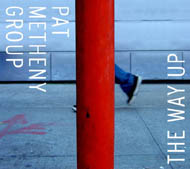
No more evident is this than on their latest release, The Way Up , a 68-minute continuous piece that challenges the sound-bite philosophy that is so prevalent in not just music, but all art forms these days. Filled with complex arrangement, a host of memorable themes that are at some times so subtle they almost go by unheeded, and at other times dramatically — but never melodramatically — stated, and solo spots for a group that was originally based around the improvisation skills of Metheny and Mays but has now grown to include equally vital contributions from trumpeter/vocalist/multi-instrumentalist Cuong Vu, chromatic harmonica player/vocalist/multi-instrumentalist Gregoire Maret and drummer Antonio Sanchez, The Way Up is unquestionably the most ambitious work the group has ever attempted. While some may bemoan the fact that Mays appears to be getting less solo space these days, it's only because the group, for the first time in its existence, has other soloists, besides Metheny and Mays, deserving of equal exposure. Past members, including Pedro Aznar, David Blamires and the late Mark Ledford, have all been key players in the incarnations of which they were members, but they were more about orchestration than strong solo voices. Now Pat Metheny Group is a strong mini-orchestra that also features a broad range of compelling soloists.
The Potsdam State University of New York (SUNY) performance on February 14, 2005 was one of a handful of warm-up shows, taking place before the group's official tour commences on February 17, as part of the University's Community Performance Series (CPS). Taking place in the gymnasium space of Maxcy Hall might, for some groups, be a challenge — after all, a gymnasium is hardly acoustically built for music — but given that the Metheny Group travels with their own PA, a crew of sound and light people, and guitar and keyboard techs, the sound, after a few adjustments in the first 15 minutes or so of the performance, was surprisingly good.
The two-and- a-half hour show began with the minimalist, Steve Reichian introduction to The Way Up being broadcast over the PA system. Metheny appeared on stage alone with his baritone guitar, and proceeded to layer a solo version of "This is Not America" over it. The rest of the band — Mays, bassist Steve Rodby, Maret, Vu, Sanchez and guitarist/vocalist/multi-instrumentalist Nando Lauria, who is a member of the touring group but not the recording group this time around — came to the stage through the audience, playing a variety of toy instruments. Once onstage the group dove into The Way Up in its entirety, stretching it out to over 80 minutes, including more extended solos and some additional composed segments not found on the album. While the contributions of Vu and Maret on the album might seem somewhat secondary to the layers of guitars and keyboards courtesy of Metheny and Mays, live it's a different story. Watching how seamlessly their main instruments are integrated into the larger orchestral texture of the group gives a whole new appreciation for their talents. And in order to reproduce — at least as accurately as is possible — the myriad layers of guitars Vu and Maret, along with Lauria, were often seen to be adding guitar parts to the mix. Sanchez even strapped on an electric bass at one point near the end of the piece, alternating between simple bass line and cymbal rolls. Rodby, during what is nominally called "Part Two'? on the CD, spent much of the time alternating between playing a fretless electric bass and slinging it behind his back while he returned to double-bass.
As for Metheny, one almost lost count of the number of guitars he used during the piece. Kudos to his long-standing guitar tech, Carolyn Chrzan, who made sure that every guitar was in place and in tune — and Metheny uses a variety of non-standard tunings throughout The Way Up , so this is no mean feat. Aside from the staggering musical complexity and challenge of recreating The Way Up live, the sheer logistics become evident when watching the show, with the band sometimes performing an almost sleight of hand where one would be busy watching one side of the stage, only to return attention to Metheny and find yet another instrument there at his disposal. At one point Sanchez was playing a large shekere, only to literally toss it behind him so that he could return to the kit — fortunately there was a tech waiting to catch it.
And, as usual, the back line — in this case Maret, Vu and Lauria — contributed everything from percussion to vibraphone, marimba and, in the case of Lauria, a second horn. What is always astounding about the players Metheny finds for his group is their ability to transform into strong multi-instrumentalists; and while none of these additional instruments are as strong as their main axes, they manage to be completely convincing. Special mention should also be made of Lauria who, while never getting a moment in the spotlight, is clearly a talented guitarist who had to learn some of Metheny's challenging parts and recreate them faithfully. While the role of musical chameleon is sometimes lost in the midst of all the strong voices present, Lauria's role was absolutely essential, and should not be underestimated.
The group also made some intelligent choices about performing The Way Up live, condensing the extended coda at the end of the piece, which would likely be swallowed up in any large concert hall. Still, the piece ended in a satisfying way, sticking to the almost circuitous ending of the recorded version and avoiding the temptation for a more definitive and bombastic conclusion.
The decision to begin the concert with an 80- minute epic was unquestionably a bold move; no chance for the group to warm up, as they so often would with pieces like "Have You Heard?" and "Phase Dance." So, after 80 minutes of continuous play, when Metheny finally stepped up to the microphone, one of his first comments, after introducing the band, was to say that, at this point, he almost felt like saying "Thank you, and good night." Fortunately for the nearly sold-out crowd, he had something else in mind.
The second half of the concert was an interesting blend of subsets of the group — duos, trios, quartets — culminating in full group performances for the end of the show. Starting the second half with "What Do You Want," an up-tempo duet between Metheny and Sanchez, both players had the opportunity to further demonstrate the astounding technique coupled with sheer musicality of the first half. Metheny has spoken, at great lengths, of his excitement playing with Sanchez. Much as the Metheny Group's first bassist, Mark Egan, was a fine player but it became clear, when he joined the group, that Rodby was simply the right player for Pat Metheny Group, Danny Gottlieb and Paul Wertico may have both made significant contributions to the band, but Sanchez is clearly the drummer Metheny has been looking for all these years, capable of everything from light textural playing to powerful polyrhythms. And as Rodby has become an essential part of the group's core over the past 23 years, one can only hope that as other players come and go, Sanchez stays for the long haul to become another core member.
Following the intense duet, Rodby fleshed things out to a trio for a very liberal reading of Offramp 's "James," where the chord changes revealed the tune long before Metheny actually got around to playing the familiar theme. More a solo vehicle than the structured format of the original piece, this felt more in line with some of Metheny's trio work with Larry Grenadier and Bill Stewart and, more recently Christian McBride and Sanchez.
Mays joined the group for "Lone Jack," from the group's self-titled first album . This time, however, instead of Metheny and Mays taking separate extended solos, they traded back and forth, building the tension and excitement and leading into a solo from Sanchez that, while staying true to the tune's form, combined unbelievable intensity with a distinctly melodic approach.
Metheny returned to his acoustic baritone guitar for a duet with Maret's chromatic harmonica on "Always and Forever," from Secret Story. Maret, even when soloing in the most tender of ways, seemed almost frenetic in his body movements.
Mays and Metheny then performed a duet version of "Farmer's Trust" — still one of Metheny's most provocative ballads — with Rodby joining in for the final theme.
As on the Speaking of Now tour, Vu and Metheny — utilizing his 42-string Pikasso guitar — played an introduction to the first of two staples from the Metheny Group catalogue, "Are You Going With Me?," also from Offramp. The Pikasso, liberally treated with reverb, literally filled the concert space. When the group entered, Mays, who traditionally took a synthesizer solo that emulated a harmonica, traded solos with Maret on the real thing before Metheny took off with a soaring guitar synth solo that demonstrated how, while this tune has been on virtually every set list since it was first recorded, it clearly provides him with a vehicle where there is still something new to say.
The show closed with "The First Circle," a piece that is the closest thing to a "greatest hit" as the group has. Unlike "Are You Going With Me?," which is largely a solo feature, "The First Circle," barring a strong solo from Mays, is largely a through composed piece, and while unquestionably a dramatic set closer, could easily be dropped from the Metheny Group set list. Unlike "Are You Going With Me?" there seems to be little to add to this tune. Still, it was a rousing finish to a second half which was, for the most part, more about liberal reinterpretation than faithful recreation.
The group returned for an encore of "(It's Just) Talk," a tune from Still Life (talking) that hasn't been performed live in some time. With a strong Latin groove and powerful solos from everyone, it was the perfect end to an evening that combined the complex with the straightforward; the abstruse with the lyrical; and the faithfully reproduced with the more broadly reworked. A show that demonstrated not only the continuing power of the Metheny/Mays writing team, but that this incarnation of Pat Metheny Group may well be the most versatile and capable thus far in a career that has spanned 27 years and 13 recordings.
If the group's warm-up shows are meant to give them the opportunity to work out the snags — and there were a few technical glitches — then fans who attend the "official" tour dates are in for a big treat. One can only hope that Metheny chooses to record and release a concert DVD of, at the very least, the performance of The Way Up. Given its logistical complexities and inability to be perceived as anything other than the extended piece that it is (one doubts there will be a The Way Up medley on future tours), this is most likely the only tour where the piece will be performed, and documentation of the event is clearly essential.
For more information and tour dates, visit Pat Metheny Group on the web.
Photo Credit
Dragan Tasic
< Previous
The Dana Owens Album
Comments

Tags
Concerts
For the Love of Jazz
 All About Jazz has been a pillar of jazz since 1995, championing it as an art form and, more importantly, supporting the musicians who create it. Our enduring commitment has made "AAJ" one of the most culturally important websites of its kind, read by hundreds of thousands of fans, musicians and industry figures every month.
You Can Help
To expand our coverage even further and develop new means to foster jazz discovery and connectivity we need your help. You can become a sustaining member for a modest $20 and in return, we'll immediately hide those pesky ads plus provide access to future articles for a full year. This winning combination will vastly improve your AAJ experience and allow us to vigorously build on the pioneering work we first started in 1995. So enjoy an ad-free AAJ experience and help us remain a positive beacon for jazz by making a donation today.

Giveaway

Eligible winners: 15
Days remaining: 5
Days remaining: 5