Home » Jazz Articles » Album Review » The Lincoln Center Jazz Orchestra: A Love Supreme
The Lincoln Center Jazz Orchestra: A Love Supreme

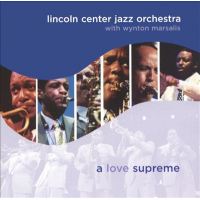
As big band jazz goes, this is pretty good, thematically engaging and musically rewarding, even though, as is often the case with the LCJO, Wynton Marsalis' charts owe as much to Duke Ellington's influence as they do Trane's vision. The suite, which is what I suppose one would call it, is comprised of four movements, with a slow introduction and finale encircling its warm-blooded nucleus. The placid "Acknowledgement," near-classical in concept, embodies a number of Ellington-like rhythmic and harmonic techniques, bolstering extended solos by trombone, tenor sax and trumpet and briefer exchanges among several other instruments including clarinet and baritone sax, leading to a vocal chant and peaceful denouement by unaccompanied bass.
Bassist Carlos Henriquez then introduces the second movement, "Resolution," which sets a faster pace, again with a Ducal ambiance pervading its ensemble passages, and ample blowing space for alto sax and piano. The ensemble has the last three and one-half minutes to itself, showing its backbone with precise and powerful give-and-take among the various sections. "Pursuance," the most contemporary of the four movements, opens with Herlin Riley's drum solo and a strapping statement by the ensemble, leading to a brace of spirited solos, most likely by Marsalis (trumpet) and Ted Nash (soprano), and further orchestral fireworks that once more end on a quiet note. The closing "Psalm" is an oasis of earnest supplication in which various members of the orchestra lift their "voices" in a dirge-like hymn to the Almighty, expressing in their own idiom the essence of A Love Supreme.
As noted, I can't compare this with Coltrane's forty-year-old masterpiece, written for and performed by his quartet, but I quite enjoyed the LCJO's expanded version and would recommend it based solely on that unschooled impression (those who worship Coltrane's prototype are free to disagree).
Track Listing
Acknowledgement; Resolution; Pursuance; Psalm (41:46).
Personnel
Wynton, Marsalis, trumpet, arranger; Lew Soloff, Marcus Printup, Ryan Kisor, trumpet; Wess "Warmdaddy" Anderson, Ted Nash, Walter Blanding, Victor Goines, Joe Temperley, reeds; Ronald Westray, Vincent Gardner, Andre Hayward, trombone; Eric Lewis, piano; Carlos Henriquez, bass; Herlin Riley, drums.
Album information
Title: A Love Supreme | Year Released: 2005 | Record Label: Palmetto Records
< Previous
Groove Station
Next >
Soul Project
Comments
Tags
The Lincoln Center Jazz Orchestra
CD/LP/Track Review
Lincoln Center
Jack Bowers
Palmetto Records
United States
A Love Supreme
For the Love of Jazz
 All About Jazz has been a pillar of jazz since 1995, championing it as an art form and, more importantly, supporting the musicians who create it. Our enduring commitment has made "AAJ" one of the most culturally important websites of its kind, read by hundreds of thousands of fans, musicians and industry figures every month.
You Can Help
To expand our coverage even further and develop new means to foster jazz discovery and connectivity we need your help. You can become a sustaining member for a modest $20 and in return, we'll immediately hide those pesky ads plus provide access to future articles for a full year. This winning combination will vastly improve your AAJ experience and allow us to vigorously build on the pioneering work we first started in 1995. So enjoy an ad-free AAJ experience and help us remain a positive beacon for jazz by making a donation today.

Giveaway

Eligible winners: 15
Days remaining: 10
Days remaining: 10



