Home » Jazz Articles » Live Review » Charlie Hunter and Bill Frisell In Cleveland
Charlie Hunter and Bill Frisell In Cleveland


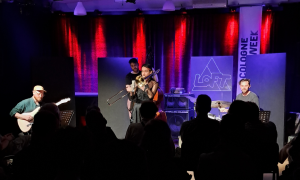
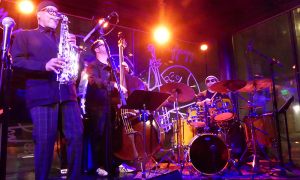
A no frills environment for experimentation of this sort, the Beachland Ballroom proved a perfect venue for this threesome's modest set-up on a warm late October evening, although the crowd was a modest one at best. In fact, by the show's nine o'clock start time there couldn't have been anymore than about 15 or 20 people in the place. As the first set got underway at about 9:25, the crowd had swelled somewhat, but the numbers were still on the low side. Without so much as an introduction, the trio launched into an hour's worth of music with the emphasis on extended jamming that made it hard to delineate one selection from the next. Previte was the man to watch, his basic four-piece kit augmented by a large number of electronic trigger pads that were used to bring forth a dazzling array of samples and odd textures. In fact, one would be hard pressed to tell whether the drummer or DJ Logic was creating a good number of the unusual sounds that mixed freely with Hunter's guitar work, itself quite oblique in comparison with his usual style.
I could be wrong, but it seemed fairly obvious that Hunter and Previte were making it all up as they went along. But spontaneous improvisation can be somewhat of a risky proposition considering that moments of pure magic can often be fleeting at best. So even while the second set seemed a bit more cohesive, there were only a few times when the trio hit a groove that you could latch onto for very long, making for a somewhat one-dimensional experience.
By contrast, guitarist Bill Frisell's set at Oberlin College's Finney Chapel a week later managed to balance structure with a definite sense of adventure. Clad in a button down shirt, jeans, and pair of black Converse All-Stars, Frisell was a man in motion, rocking back and forth and adjusting the various pots and faders on his control board that sat perched on top of a stool. This was folksy stuff, short on melody but definitely long on improvisation and development. The slower numbers were often supported by a backbeat and one piece even managed to recall David Bowie's "Fame" with its strutting groove.
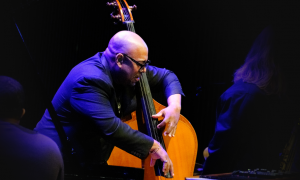
The chemistry between Frisell and his trio was obvious throughout and they managed to make a connection that was somehow missing from the Hunter show. Acoustic bassist Viktor Krauss provided ample bottom end, yet also managed some dazzling technical displays when offered the opportunity to solo. A veteran of the bands of John Zorn, drummer Kenny Wollesen was in many ways the ringer of the group, his musical approach very individualistic and yet chameleon-like enough to blend in with Frisell's varying structures. Many eyes were fixed on this creative drummer during his solo statements, his vintage gold sparkle drum kit adding to the overall allure.
Following a somewhat oblique vamp in waltz meter, Frisell broke into Burt Bacharach's "What the World Needs Now" much to the pleasure of the crowd. It's on a standard such as this that it becomes obvious that Frisell has jazz chops to spare. It's also to Frisell's credit that even after a generous set and one encore, many felt they could have heard more while remaining thoroughly engaged.
Photo Credits
C. Andrew Hovan
Tags
PREVIOUS / NEXT
Become a Sustaining Member

Since 1995, All About Jazz has championed jazz as an art form and supported the musicians who create it. Over three decades, it has grown into one of the world's leading jazz resources, serving hundreds of thousands of readers, musicians, presenters and industry professionals each month.
Help Build the Future of All About Jazz
Your support helps us continue building All About Jazz for the next generation—expanding our editorial coverage, preserving jazz history, developing new community features and creating better ways to discover the music and the people behind it.
Become a sustaining member for as little as $20 per year and you'll immediately enjoy an ad-free experience along with access to subscriber features and future articles for a full year.
Together, we're not simply sustaining All About Jazz—we're building its future. Thank you for being part of the journey.