Home » Jazz Articles » Album Review » Hugh Hopper and Matt Howarth: The Stolen Hour
Hugh Hopper and Matt Howarth: The Stolen Hour

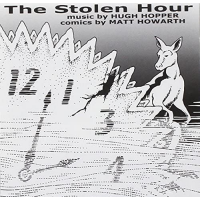
Hopper creates a diversity of rhythm loops over which he layers bass, guitar and the occasional synthesizer, providing a backdrop for a variety of guest artists to contribute, including ex-Soft Machine band mate Robert Wyatt on cornet and vocal loops, and ex-Gong woodwind multi-instrumentalist Didier Malherbe. Ranging from the direct funk of "Some Complications at Work" to the more hypnotically propulsive and aboriginally-textured "Craig's Distended Train Ride," Hopper builds twelve pieces that coexist with Howarth's art, telling the story of technology worker Craig's encounters and frustrations with the change in DST before heading to the Outback to escape the confines of time. There he meets The Old Spirits, who offer some spiritual revelations, and experiences a series of fatigue-and-hunger-induced hallucinations before encountering Mia, another political rebel who has come to the Outback for the same reason. Everything ends on a happy note with Craig and Mia watching the sunset together, operating on a schedule untouchable by governments and business concerns.
Hopper began experimenting with loops as early as the late '60s, and he introduced his uniquely personal concept on the now-classic 1984 (Columbia, 1973). But both technology and experience have come a long way since then. Experimental in its multitudinous textures yet approachable in its trance-like nature, Hopper's looping experiments bridge the boundary between abstruse structural innovation and improvisational freedom. Sometimes feeling rhythmically akin to the jungle density of Miles Davis' mid-'70s work on "Yearning for the Stolen Hour," other times tranquil and majestic on "Compatibility," Hopper's compositions are often ambiguously linked with Howarth's images. But as far back as his days with Soft Machine, Hopper has never been one to make things easy. The concluding "Sharing the Stolen Hour" revolves around an energetic John Marshall drum loop and soaring-but-slightly-outré sax work by Pierre-Olivier Govin that manages to be obscure yet emotionally uplifting at the same time.
One of Hopper's strengths has always been in creating music that is less than obvious. With rhythm loops consisting of samples that seem to include more than a few found sounds, Hopper creates an audioscape that feels otherworldly, yet is rooted in the here and now by its viscerally-driven rhythmic nature. The Stolen Hour ultimately makes for an engaging listen that is accessible enough to reach out to a significant audience, yet oblique enough to interest listeners interested in exploring new territory.
Track Listing
Craig's Distended Train Ride; Complications at Work; An Inescapable Encounter with Mrs. Pry; Yearning for the Stolen Hour; The Long Drive; An Unregulated Sunset; A Sideways Peek at Dreamtime; Snide Wisdom Involving the Immateriality of Time; The Stuff He Sees; Mia's Timely Emergence from the East; Compatibility; Sharing the Stolen Hour.
Personnel

Hugh Hopper
bass, electric
Robert Wyatt
drumsSimon Picard
saxophone, tenorDidier Malherbe
woodwinds
John Marshall
drumsHugh Hopper: guitar, bass guitar, rhythm loop, midi programming; Robert Wyatt: cornet and voice loops (1, 6, 10); Frank van der Kooy: saxophone (2); Pierre-Olivier Govin: saxophone (1, 2, 4, 5, 9, 11, 12); Simon Picard: saxophone (3, 6, 7); Jan Ponsford: voice (6); Didier Malherbe: flute loops (6); John Marshall: drum loop (12).
Album information
Title: The Stolen Hour | Year Released: 2004 | Record Label: Burning Shed
About Hugh Hopper
Tags
PREVIOUS / NEXT

Become a Sustaining Member

Since 1995, All About Jazz has championed jazz as an art form and supported the musicians who create it. Over three decades, it has grown into one of the world's leading jazz resources, serving hundreds of thousands of readers, musicians, presenters and industry professionals each month.
Help Build the Future of All About Jazz
Your support helps us continue building All About Jazz for the next generation—expanding our editorial coverage, preserving jazz history, developing new community features and creating better ways to discover the music and the people behind it.
Become a sustaining member for as little as $20 per year and you'll immediately enjoy an ad-free experience along with access to subscriber features and future articles for a full year.
Together, we're not simply sustaining All About Jazz—we're building its future. Thank you for being part of the journey.