Home » Jazz Articles » Interview » Rebecca Martin: Here, the Same, But Different
Rebecca Martin: Here, the Same, But Different

There is a great deal of myself exposed in these songs. I find this provokes what's underneath the surface in us all, which is what I want to achieve. That's when the healing can take place and is the reason that I'm drawn to do this sort of work.
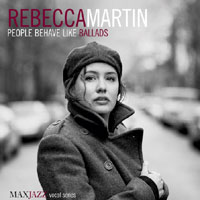
 Rebecca Martin's last recording, Middlehope, demonstrated conclusively that she is a unique interpreter of standards in intimate, beguiling, personal, enticing, sensual, captivating, alluring...absolutely enthralling... wonderful even... ways (see review ). One might assume, as does the first question in this interview, that her way with a chestnut probably got her signed to MAXJAZZ, a label with a growing roster of enchanting chanteuses of the jazz cannon. One would be wrong - assumptions won't do for Rebecca Martin. You see, whatever measure of skill and individuality she displays with her incendiary way with a torch song (a measure already in the five-star range), it is far surpassed by her own way with her own tunes. Now, we have People Behave Like Ballads , chockfull of sixteen originals. Heartrending, heartfelt, heartwarming and heart-wrenchingly real , her songs and her delivery of them, her "serving them up," as she likes to call it, triumph in realizing her ambitious goal to tell things the way she (and we) feel them, expressing sentiments rather than providing narratives. Similarly, their structure breaks new ground rooted in another of her ambitions: to have her words grow naturally from her melodies; that is, to have the actual lyric grow out of the sounds she makes when she originally composes, humming or scatting the tunes. Most obviously, you might hear this in the distinctive way Rebecca delivers strange, yet engaging (oh, she is soo engaging- swoon ) pronunciations of words in a lyric.
 Listen, and you'll hear other levels of sophistication in the songs. The last line of a "verse" will become a "chorus," yet the "chorus" will really be a theme only to be supplanted later by another melodic fragment which might turn into a "refrain." Where do these ideas come from? First and foremost, they come from her, but one look at her band roster, including Bill McHenry on saxophone, Ben Monder and Steve Cardenas on guitars, Matt Penman on bass , Darren Beckett on drums and Pete Rende on keyboards, shows she's inexorably tied to jazz. All her bandmates have recordings of their own or have appeared on others that share a common theme-the quest to find new forms at the crossroads of jazz, pop, rock and folk. So it is with Rebecca Martin, and it appears with People Behave Like Ballads , her evolution has been expedited. It's a reemergence, of a sort, for her, after the dissolution of the fantastic "Once Blue," her band with then-boyfriend, now Verve recording artist, Jesse Harris, in 1997. Evidence of the jazzy evolutionary chain would be the personnel in that band - Jim Black, Kurt Rosenwinkel, Anthony Wilson, Ben Street and Kenny Wolleson were all members. The independently released and under-heard Thoroughfare , also featuring her husband, bassist (to Pat Metheny and Brad Mehldau, no less) Larry Grenadier, and the aforementioned Middlehope provide documents of her logarithmic, but traceable progression. But People Behave Like Ballads is a breakthrough record, taking her complete game up a notch at the same time that the availability/publicity machine's been put into motion. New open ears are sure to find her a delight while the old ones will find her here, the same, but different.
All About Jazz: So is this new CD, the one for MAXJAZZ, standards, originals or a mix of both?
Rebecca Martin: All originals- 16 songs. Two of them were co-written. The first with Steve Cardenas , who is one of the guitarists on this record. We've been making music together for many years. The original version is on his first record She-bang (Fresh Sound). The song's title is "Para Ti," meaning, "For You." When he and I were touring back in '96, he was working on it in the van, and it inspired my lyric and new song title "Here The Same But Different". At the rehearsal for our record date, I thought it would be a good time to bring it out for the band to play- I'm very glad I did. It's one of my favorite tracks on the record. "It Won't be Long" is a collaboration with Richard Julian a singer-songwriter and an old friend of mine.
AAJ: I was thinking since you signed with MAXJAZZ, this might be another standards record along the lines of your last one, Middlehope .
RM: I'll do another one for sure some day. We're fleshing out songs for that project currently while I continue to write. MAXJAZZ had heard Middlehope which was brought to them through my friend, Ron Simblist and Jana La Sorte. Richard came to New York to hear the band because, to his credit, he makes a point of getting to know the artist and musicians personally before making any sort of decision. At that time, Middlehope was a project that I had done several years prior, so the current music that I'd been working on was a body of original tunes, which is what he heard in NY that day. He was really open to it...and I was able to make People Behave Like Ballads the way I'd envisioned.
AAJ: I'm sure the reception for this will be amazing.
 RM: Thank you. I'm really proud of it. The band is wonderful. It features Steve Cardenas, Ben Monder , Bill McHenry , a drummer named Darren Beckett - someone I only recently met, a musician from Ireland who was a gold mine find - he's very soulful and earthy- and Matt Penman on acoustic bass, and finally, Pete Rende , who is a big part of what I do now. Pete plays a myriad of instruments on this record that include piano, pump organ, Wurlitzer, Fender Rhodes, Pedal Steel. His music is a beautiful, textural backdrop for my songs and my singing.
AAJ: Well, you picked some great players.
RM: I've been quite fortunate, I know.
AAJ: Those are two of the best guitar players on the planet, Cardenas and Monder, not to mention the rest of the guys.
RM: I really think so.
AAJ: Are they playing together on most of the tunes?
RM: Yes. I can't ever get enough of that sound.
AAJ: These guys can get very textural-both of them. Where was it done?
RM: Sear Sound, in New York City. It's Walter Sear's place . He has a very impressive studio with probably one of the best mic collections in New York - maybe in the country. Maybe even on the planet. We were downstairs, using the board that was rebuilt by Walter himself. With a bit of budget, we were able to record the basic tracks in two days. It was luxurious to have that extra time.
AAJ: Did you rehearse it a lot?
RM: We rehearsed at my place a few weeks prior to the record date. I made a weekend of it upstate at the house, with a paella and late night poker games.
AAJ: Did you say paella slash poker?
RM: Yes! A lot of the pre-production work had been done by performing so regularly together over the years in NYC. So the weekend was more of a run through and an excuse for all of us to spend time together like that.
AAJ: You don't seem to gig a super lot .
RM: I haven't so much outside of the city in the last few years. New York is accessible, and all of the musicians are in town. I was not willing to put my energy into being on the phone to get things going outside of our area. Playing in NYC on a regular basis made it practical for us to develop the music and build an audience here. I've halted that recently to re-fuel, as it just felt like the natural thing to do. This particular record was a big process, and I've needed the time afterwards to lay low, practice and write. I'm looking forward now to get out and present the music and musicians, especially with the support of MAXJAZZ.
AAJ: It's a good thing you want to be on the road, because I would assume they're going to want to put you out there.
RM: I'm very dedicated to it. Not since my time in " Once Blue " have I been on the road in the way that I'm anticipating now. I've been working with the same booking agent and tour publicist Roadwork Music , two great women who've stood by me for about 5 years. We've been preparing for this for a long time. With the addition of MAXJAZZ I'm ready to go.
AAJ: Well, by my ears you're way more wonderful than a lot of folks that are hugely popular already, and you beat some of these folks to the punch a long time ago, but people didn't get the chance to hear it.
RM: It's been a long road to get to where I am now. I feel very strong about where I am creatively.
AAJ: Do you have loads more than the sixteen on the record?
RM: About 40 more currently that I feel are truthful and balanced.
AAJ: When you speak about writing the truth, I think about the lyrics.
RM: I do too, mostly...
AAJ: But you're writing the truth on the musical end too, if you ask me. Now, you could say the music emphasizes jazz with pop sensibilities or you can turn that around and say it's pop with jazz sensibilities. How did that evolve?
RM: The music's truth always seems to be there. It's the source. I am not worried about being self-conscious when it comes to harmony and melody. As for the music as a whole, without a doubt, the sound that we've created is a complete collaboration with all of the musicians. Everyone I've ever played with in NYC has added to it. My own influences are mutt like, I suppose like all of us who grew up in rural areas in the 80's. My household was quite eclectic, musically speaking. I had a pretty mean diet of pop, classical and jazz. My mother is a beautiful pianist and we would sing together most nights the songs of George Gershwin, Cole Porter and various Broadway musicals. My family was also very involved with our Acadian heritage, which is what I mostly am, so there was a great deal of Acadian fiddle music as well...and my grandfather Joseph Agape played a mean fiddle. After our Sunday family dinners each week there would be some sort of music session. My mother sought out a recording studio for me to be involved with when I was about nine years old. I spent my entire growing years there exploring sound and music. Growing up on 200 acres in Maine was a wonderful place to process it all organically.
AAJ: Please expand a little on the music studio thing.
RM: My mother was searching for an outlet that would allow me to grow as a singer when she came across "The Outlook Recording Studio". I began going for voice lessons and soon it became this great opportunity to record. Conni, the co-owner of the facility was very supportive of my singing. I was surrounded by musicians and sessions consistently. I started spending more and more time there as a teenager, of course, and made several recordings by the time I was 16. I have never been intimidated by the studio as an adult, and I believe that being exposed to one at an early age was responsible for that.
AAJ: Yeah, most people don't have a comfort level at a studio until after they've gigged and had bands and everything else.
RM: I watched the studio evolve from 16 to 24 tracks, using Studer/Trident equipment. It's gone digital now, which I know is the going trend, but a shame. I will always appreciate that I grew up using tape. I was able to get to a deeper appreciation with my first real studio experience having Joe Ferla at the helm. He engineered the first Once Blue Record back in 1995 (there were two, a second recording by Steve Addabbo in 1997), and my first solo recording, Thoroughfare in 1998. Joe recorded Middlehope to tape as well.
AAJ: Ok, now wait. How did you get from 9 years old in Maine to Once Blue? Did you just do music forever?
RM: I have.
AAJ: Did you ever go to music school?
RM: Yes, at the University of Maine in Augusta to study Jazz Performance. After a year there, I was ready to get to New York. I eventually came to the city by myself. I found an apartment in the Bronx and landed a production job at MTV.
AAJ: Really?
RM: I was in an art-punk band that played in rock clubs throughout New York City. I was the background singer and keyboardist...not much of a keyboardist.
AAJ: So where were you playing? Like CBGBs?
RM: Exactly, CBGBs and Woody's , an assortment of rock clubs. I had to be in the city to do so and had to find a way to support myself. On my way to NYC from Maine, I had a short stint at SUNY New Paltz studying film production. At MTV, I began in the graphics department as a production coordinator, and later moved to on-air promos in the production management department. I met Jesse- Jesse Harris —within a year or so of coming to New York.
AAJ: Did you start working with the band right away?
RM: No, we were a couple first. For six months he accompanied me on guitar. I hadn't heard much of his music until about a month after we were already together. I went to hear him play at the Ludlow Street Café, and I have to admit I was a little nervous. I was waiting for him to begin with a friend, and whipped around so quickly when he started his set. I 'd never heard anything like it. It took some time before we wrote together. One of our first collaborations was "I Haven't Been Me" which I feel is the signature song on the very first Once Blue record.
AAJ: Care to comment on his new record for Verve?
RM: It's a great record. There are two songs that I listen to over and over, "I Wish I Were a Bird," and "I Have No Idea." The other record of his that I enjoy is his first with the Ferdinandos. It has his version of "I Don't Know Why" and another called, "It's Alright to Fail". What a lyric, so absolutely penetrating and sad, which is my favorite kind of song (laughs).
AAJ: Penetrating and sad is just wonderful, which your stuff gets to as well. How do you get the Once Blue CDs now?
 RM: It was re-released by EMI Toshiba in Japan. They've included 9 extra tracks to the original record, which are the rough mixes of the second record. It's still hard to find, but it's out there.
AAJ: I saw you guys play in Harvard Square.
RM: Anthony Wilson was on that gig...
AAJ: He's with Diana Krall now, right?
RM: He is. I loved working with him. In Once Blue he was very part-oriented, as well as being a great improviser. He would come up with guitar parts that could define the song. He's a good friend of Jesse's from way back. I believe they met through a connection at Bennington College.
I want to say something about Once Blue, because so often people ask me about it. I'm really proud that I was a part of that music. Once Blue was a definitive moment in my music. Crossing paths and collaborating on a regular basis with Kurt Rosenwinkel, Kenny Wolleson , Jim Black, and Ben Street had a big influence on me. Talk about good timing. With Jesse, I was writing melodies that were uncompromised. And lyrically, what we were coming up with was the most poetic writing I could ever have hoped for. The melodies dictated the lyrics. That is true with my own writing today.
AAJ: That's a different approach than the norm, isn't it?
RM: Everyone has they're own way of doing it. Most of the folks I know are very crafty and have a narrative in mind. I'm driven to express a strong emotion or sentiment. There is a great deal of myself exposed in these songs. I find this provokes what's underneath the surface in us all, which is what I want to achieve. That's when the healing can take place and is the reason that I'm drawn to do this sort of work.
AAJ: Tough to explain but probably the most important thing you've said so far.
RM: Sometimes people ask what a song is about which is really hard to answer for this reason. The inspiration for my songs are for me. The result, I choose to make available on a record for anyone who is interested to hear.
AAJ: Can you talk me through a couple of examples from your new record?
RM: All of them are good examples because they are all written in the same way. I was asked recently what "These Bones are Yours Alone." was about. I decided to turn it around and ask that person what their interpretation was. "Skeletons in the closet?" I thought it was wonderful and quite fresh to my ear, but not my intention. It had never even occurred to me. That is why its source needn't be important to anyone- so long as it's my truth, it can be a universal truth. I want those who listen to have their own relationship to these songs. That is what I mean when I discuss balance in my lyrics. Even though the songs are very personal to me, my overall objective is for the listener to make them into whatever it is they need them to be.
AAJ: Kind of like jazz or instrumental music, all of which involves putting your own thing on it.
RM: That's a wonderful compliment. I don't ever want the lyric to encumber the music.
AAJ: Anything about the musical compositional aspect that you go through-like influences, jazz changes versus pop changes, etc. Do you compose on guitar?
RM: I do it all on guitar and by ear, organizing sections that I think sound good so as to inspire a melody. The band helps in deepening the harmonic and emotional quality. Steve, Bill and I have been working together for such a long time...
AAJ: How'd you meet those guys?
RM: Once Blue brought Steve and I together. Bill and I were in line for at least an hour one night at Small's waiting to hear Kurt's band, with Mark Turner, Ben Street and Jeff Ballard many, many years ago. We had met over the years, but never spent much time together. We decided that night that we really should get together and play. The first session I had with Bill was at his place. He had me hold one note for an entire song! I actually found that work tape recently. I remember thinking, "Does this guy know that I write songs?" But it was a marvelous musical experience. It made me think about tone, breath, intonation as well as how to blend with a collection of instruments. Both Steve and Bill are excellent teachers. Pete Rende, Matt Penman, Ben Monder, Darren Beckett and Dan Rieser have come to the music through mutual friends all at different times. There has never been a methodical thought process in putting people together. But I know that by working with great musicians there will be a beautiful outcome. As you can imagine, being with this stellar group, my ears have had the chance to develop in an intense way.
AAJ: Would you say that perhaps, with some of the tunes you've written before that they've reharmonized or recontextualized, that now, as you go, you're starting to add these elements yourself? To tell you the truth, it's very surprising for me to hear you don't know theory. You're tunes are so hip in so many ways, it just seems to me you would.
RM: It is my ear and the relationship that I've developed with my guitar that I depend on for songwriting. I'm definitely not trying to be hip about it. I explore the guitar for bass lines and build rich harmony around it - so to inspire something challenging melodically for me to sing. The musicians have had a lot of time through performance to flesh out their parts.
AAJ: Every one of them are great composers too.
RM: Yes. So it seems songwriting and putting bands together is a mix of intuition and good fortune. I've witnessed many songwriters hiring folks because they've played on this record or that, and are looking for a similar sound. There aren't any shortcuts in the long process of developing trust and relationships with musicians.
AAJ: Uh, you've assembled a pretty bad-ass posse there.
RM: Thank you.
AAJ: I was surprised to find out you didn't already know McHenry from Maine.
RM: That's right. Ben Street 's from Maine too, but I met him in New York City as well. It's been fun to watch their careers develop, even in some cases from a far. I met Ben Monder through Ben Street many years ago at a birthday dinner. I'd always hoped we'd have the chance to work together, and I'm really happy that we crossed paths recently. He's an amazing player as you know, and one of the brightest guys...
AAJ: A total intellect. A quiet genius. A quiet hilarious genius.
RM: I know that amongst the musicians he's an important part of their diet.
AAJ: I'd say he's an immense figure. You mention his name to anybody who knows his playing, his music, who plays any instrument, their eyes widen! I'd love to be his agent! My problem is I have his number but not the numbers of the people I need to call on his behalf!
RM: T hat's really nice of you to say. I feel the same way. I saw Ben play with Bill's band recently at The Village Vanguard with Paul Motian and Reid Anderson. What Ben was doing that night was just outrageous.
AAJ: I'd say he's the best musician in any band he's in and leave it at that.
RM: The musicians are crucial, though I anticipate playing a few solo performances in the future so to experiment and strengthen the songs and their structure so they and I improve.
AAJ: Have economics ever made you think about that? You could easily pull off a solo gig.
RM: It is a big investment to have a band, but I've never thought of doing it any other way.
AAJ: In the Lillith Fair days, you were always with a band as well?
 RM: With Once Blue, yes indeed. We opened a lot of shows for wonderful artists in pretty big theaters. The sound was excellent, though I prefer small rooms. The intimacy of a small place matches the music. The label was paying for us to be on the road, so we did whatever came our way. My favorite tour was opening for Shawn Colvin. That audience was fresh, forward and always growing. There was an energy that was current and exciting, not unlike the Jazz audiences that I, too, am a part of. I'd like to work in front of them with this record, though there's a bit of a prejudice toward female singers I think.
AAJ: C'mon, jazz singers are enjoying a great resurgence.
RM: Yes, it's true, but I'd say it's still tough. Women are encouraged to be as polite and non-threatening as can be in order to have commercial success.
AAJ: Well, you have such your own bag.
RM: I hope this new audience will be open to what I am doing.
AAJ: I can't imagine that they wouldn't. I know they'll be crazy for you.
RM: I'm real comfortable making this music.
AAJ: What about Thoroughfare ? Did you release that yourself?
RM: I did.
AAJ: How was that for you?
RM: That was the last project that I made that went without a hitch. It just magically came together. It was recorded in a day, as was Middlehope. Just more simple, and fresh out of the demise of "Once Blue." I worked with Joe Ferla as an engineer and co-producer. Larry, Kenny Wolleson and Steve were the musicians I was current with then. A lot of the songs on that record were intended for the second "Once Blue" release. They never got the chance to be recorded, and I was happy to do a different version of them on Thoroughfare. I had just picked up the guitar in a serious way, and wrote a few songs that were included. The historical aspect of making records, to look back and see where you were then and how it helped to define you is a great process. Very journal like. It was Larry and my first project together. We had our little 1974 Beetle that we'd drive out to the recording studio. Exit 13 off the Palisades Parkway (laughs). A magical, magical time in my life. Larry used an electric bass for Thoroughfare which is really unusual for him. When we were rehearsing the songs at Kenny's, Larry didn't bring his bass because Kenny had always had one there. When we arrived, we learned that the person who it belonged to took it back, so Larry picked up Kenny's old Danelectro that was in pretty poor shape. It's pickup was held together by a matchbook! We all loved it's sound and decided to use it on the record.
AAJ: Yeah, he doesn't play that axe much.
RM: He doesn't, though he does have a few electrics at home.
AAJ: Middlehope is a real personal take on the standards. Personally, I think that after this new record , Fresh Sounds will have to do a special pressing for your Middlehope record the way they did with the first Bad Plus record.
 RM: I would never have made Middlehope without my Fresh Sound experience. Being who they are ultimately encouraged me to make a record of standards. I wanted to keep my band recording and together while I continued to write, so decided to move forward with it. It was a wonderful experience working with Jordi. He gets excited about the music though doesn't interfere with the Artist's vision. Working with MAXJAZZ is very much the same. Richard and Clayton were there for the recording, and it was really comforting for me to have them there. They brought the loveliest wine along with their musical spirits...
AAJ: That's what I want to be when I grow up.
RM: What?
AAJ: One of those guys who gets to bring wine to your recording date and hang out.
RM: If you don't know already Phil, you're in the fold and have an open invitation to the next one. I'm not kidding.
AAJ: I'm going to hold you to that- in print! So, you implied earlier that this new one was a tougher record to make. Can you expand on that?
RM: We had some major problems with the end result of this record and I had to have it remixed.
AAJ: Did you make them remix it or someone else?
RM: I made the decision. I could not pass the original mixes on to MAXJAZZ.
AAJ: Wild-ass guess. Was the first mix a huge Rebecca and an eensy teensy rest of the band?
RM: That is logical, but the problems with the sound were much more complicated then that. It was all wrong without going into detail. Steve Addabbo helped me coordinate another overdub and mixing session. James Farber saved the day once again. He did the same on Middlehope. Without his wonderful work, his openness to any situation, his patience, long hours and good humor - both of these records would not be what they are.
AAJ: Well, it sounds like you have a confluence of things that have come together for you here.
RM: Absolutely. I'm working with some of the best musicians and engineers a person could ever hope for. I've been able to work in the most wonderful studios on the East Coast. I've had many people over the years work very hard to help me realize my goal and navigate my career in this nutty business, and I've now found a wonderful, sophisticated label who supports me now in what I do.
AAJ: Anything you want to leave us with?
RM: I'm just really happy to be where I am right now, and am looking forward to many more recordings. I try not to look too far ahead, but I have to admit, the future of our music does excite me.
Visit Rebecca Martin on the web at www.rebeccamartin.com .
< Previous
On Campus
Comments

Tags
For the Love of Jazz
 All About Jazz has been a pillar of jazz since 1995, championing it as an art form and, more importantly, supporting the musicians who create it. Our enduring commitment has made "AAJ" one of the most culturally important websites of its kind, read by hundreds of thousands of fans, musicians and industry figures every month.
You Can Help
To expand our coverage even further and develop new means to foster jazz discovery and connectivity we need your help. You can become a sustaining member for a modest $20 and in return, we'll immediately hide those pesky ads plus provide access to future articles for a full year. This winning combination will vastly improve your AAJ experience and allow us to vigorously build on the pioneering work we first started in 1995. So enjoy an ad-free AAJ experience and help us remain a positive beacon for jazz by making a donation today.

Giveaway

Days remaining: 4