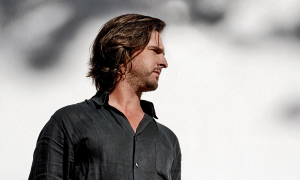
Home » Jazz Articles » Interview » Jacob Young: Lyricism and Elasticity
Jacob Young: Lyricism and Elasticity

Early Days
Born to an American father who had relocated to Norway to marry, Young picked up the guitar around the age of twelve. While he did not come from a particularly musical family, he was exposed to a variety of styles from an early age. "I guess my first memory of music," says Young, "was a cassette tape that my mother had. On one side was a Norwegian folk singing group that was popular in the '70s, and the other side was Miles Davis' Sketches of Spain; that's one of my first memories of listening to music with real joy. Also, my father had a lot of Motown albums, Frank Sinatra records, classical music also—so I was exposed to a lot of different kinds of music when I was growing up, in all different genres."When I first started playing guitar I learned the basics from a friend," continues Young. "We were on a mountain trip together and everyone was out skiing. He showed me a few things on the guitar and I just decided I wanted to stay inside and learn this basic stuff, which was guitar blues. I really got hooked and decided to spend time with it. I first started getting interested in jazz after a few years, before that I was listening to The Clash, Jimi Hendrix, and other rock stuff. But I listened to a lot of different music, and I didn't really care so much if it was jazz or rock or whatever."
New York and The New School for Jazz and Contemporary Music
Young studied music in Oslo, but the emphasis was more on classical music—analysis, four-point counterpoint, music history and composition theory. But after a year-and-a-half he decided to move to New York and attend the New School for Jazz and Contemporary Music, although his original reasons for relocating to New York were hardly artistic. "I didn't go to New York to study music in the first place," Young says, "the reason I started at the New School was because I was going after this woman that I was dating and she moved to New York. I was so much in love with her that I tried everything to be around where she was. And she found out that I liked jazz, so I could check out schools in Manhattan for music. She sent me a few things and I applied and got in, but my motivation wasn't really music in the first place. And then I met Jim Hall and all these other great guys who were so much ahead of me at the time, it was really a wake-up call for me. And ultimately she didn't want to have anything to do with me, so I was stuck at school, but it was kind of my way in I guess."Interestingly enough, while Young obviously studied theory, harmony, composition, all the subjects that a young student would, his exposure to music through people like Jim Hall, John Abercrombie, Kenny Werner and Richie Beirach was less about what to play, and more about how to play. "Jim talked a lot about playing the melody," Young explains, "trying to improvise and stick to an idea thematically; focusing on the song you're improvising on. The best solos he plays sound like compositions, they're so well-shaped, and the form is so masterful. We never talked about theory, more about basic things like attitude and approach. We never talked about scales or chords or anything like that. It's not because I knew everything and we didn't need to talk about it, but I talked to other people about that stuff. He spoke more about the basic flow of music, and in a very inspiring way. So by watching him and listening to him and being around him, it was very inspiring.
"I knew John Abercrombie from Norway, before I came to New York," Young continues, "from listening to a record he'd done with Jan Garbarek called Eventyr, which I really liked. So I knew a little bit about his playing before I came to New York, although I knew nothing about Jim Hall, which is kind of strange. Anyway, I would ask John some questions, but mostly we just played. He's a very positive guy, he showed me a little bit about how he thinks when he's improvising. He superimposes triads and he was one of the first to play with that kind of dual harmonic concept. And he uses contrast a lot. He has his own style, with a harmonic concept where he's basically pretty free, and we'd just play standards and discuss things while we did.
"Also, he uses his ears as a musician," continues Young, "even though he clearly knows his theory. We talked about that also, that it's something you have to practice, you can't really read your way through it, you have to do it. Basically what I'm saying it that for me jazz has to be an oral tradition, like folk music; the information is handed down through exercise, through practice and through meeting masters like John and Jim. So that was the most important thing I learned. Everything about theory you can read.
"Kenny Werner," Young concludes, "who was a staff member at the school and taught advanced theory and composition, talked about how everything is possible, how there really aren't any rules in music, that it's just the way you make the connection between one chord or one note and the next. It's like a Zen space. He'd have his hands hovering over the keyboard and he would say, 'The next sound is the most beautiful sound I've heard in my whole life,' and he would just smack his hands down on the piano and there'd be this cluster of sounds. So he would talk about attacking the music from that angle, to open up and get away from strict formulas. He was great for opening up like that, he would have exercises where you would write down letters on pieces of paper, mix them up in a hat, arbitrarily pick them out of the hat and make a new. And that opened up a whole new world, because there are so many ways of attacking improvised music, so it's about trying to have a concept, not sticking too closely to rules, and learning to express yourself in a way that's convincing."
This is You
While Young didn't return to Norway permanently until '95, he recorded his first album, This is You, for the Norcd label, in '94, when he was home for the summer. An interesting blend of various styles, the album reflected Young's exposure to the great musical melting pot that is New York. "I had done professional gigs in Norway since '92," says Young, "and when I went back to Norway in the summers I'd do three or four concerts in Oslo, or a small tour. I had already played with [drummer] Per Oddvar Johansen, but never with [bassist] Terje Gewelt, who [saxophonist/producer] Bendik Hofseth brought in for the session. I also flew in [pianist/organist] Larry Goldings, who I had met at the New School; he's a few years older than me and had finished the year before I started, but he was hanging around and playing a lot with Peter Bernstein, who is a friend from my New York days and is one of my favourite guitar players."I think that This is You is not as focused as my other records," continues Young, "because there are so many genres going on. There's one swing tune, a bossa nova tune, a free tune, a straight eighths tune, a bluesy tune. I guess I didn't really know what I wanted to do, so I tried to do a little bit of everything. But I always had a predilection for lyricism, for melodies; that's been important to me since I started playing guitar and writing, humming, just trying to put together my own melodies or stretches of chords. And I still play the title song live sometimes. So I'm proud of it, there are things that I wish I could have done better, but I think it has some nice writing, some nice compositions."
Pieces of Time
For Young's next project, '97's Pieces of Time, released on the Norwegian Curling Legs label, he recorded with a group that he had been playing with on a regular basis, and the difference is palpable. The same sense of melodicism is evident, but there's a stronger sense of interplay and unity about the record that makes it a more compelling listen. The group features saxophonist Trygve Seim, who has gone on to record his own albums for ECM, keyboardist Vigleik Storaas, Per Oddvar Johansen on drums and bassist Mats Eilertsen, with whom Young continues to work to this day. "That was a working band," says Young. "We had done a few tours in Norway, Denmark and Sweden. We were all about the same age and knew each other, so Pieces of Time was definitely more of a group record."Trygve Seim was an old friend of mine from high school," Young continues, "and we've had some of the same influences and steps in our careers. I went to New York and he studied in Norway at the Trondheim Conservatory. He was a very familiar person to have in the group, both professionally and socially. Mats Eilertsen was very young when we started playing, I think he was only nineteen, and he was still a student at the conservatory. From '96 to '97 I had a gig every Thursday at a club in Oslo called "The Young Market," which was basically a session where I invited different players to play, ending with a jam session. But for the first hour we would prepare material for musicians that had basically never played together before. We would play songs, not just free improvisation. I was playing with this Norwegian drummer in a group called the Young Love Trio, and he had heard about Mats, and we flew him over for this gig with [trumpeter] Nils Petter Molvaer, and we went on and played some groove-oriented free, energetic music and he locked in right away.
While there is still stylistic diversity on Pieces of Time—including "Wonder Why," on which Young pays homage to one of his influences, Keith Jarrett's European Quartet, and "In a Subtle Way," with it's swinging hip hop-informed rhythm, songs including "When We're Talking" and "The Promise" demonstrate a stylistic approach that could have easily fitted into the ECM aesthetic. Young also began to augment his warm, clean electric tone with acoustic guitar, another foreshadowing of Evening Falls, where the record is split almost fifty-fifty between the two instruments.
Glow
For his third record, '01's Glow, also on Curling Legs, Young chose to use a more experimental approach, with a broader palette of sounds, including a three-piece horn section, resophonic guitar and more. " Glow is an album that I worked on much more," explains Young, "it was more arranged, heavier in a way. Pieces of Time is more about tunes we played as a group and we arranged them partly on tour, partly in the studio, but with Glow it's more mixed. It consists of three tracks for septet, recorded live at Rainbow Studio in Oslo, but the rest of the album was done in a smaller studio, where we did the rhythm tracks and then overdubbed additional elements. The initial tracks were recorded live as well; the four of us would play on a tune like "Cartoons," for instance, and then we'd record the four of us again on top of the first set of tracks, playing with or against each other. Then we would cut out some things, use others, and work a lot with effects; it was a very time consuming process."But while Glow is more of a studio concoction, Young's compositional priorities remained. "The writing has always been the most important aspect of my records," Young says. "The melodies and tunes are what I look for when I listen to music and also when I write and make my own albums. That's the most basic and important thing."
Karin Krog and Where Flamingos Fly
In '02 Young received a call from Norwegian vocal legend, Karin Krog, to work on a project of mainly standards, in a stripped down duo context. "She had heard something I'd done on Norwegian radio from one of my records," Young explains, "maybe from Pieces of Time, and she liked it, called the radio and asked who it was playing, and they gave her my name. Coincidentally we'd met in a store and just said hello to each other, but then, later, she called me. She'd been thinking about doing something with a guitarist for a long time and she called and suggested we do a radio show together, for Norwegian Public Radio. And I was thrilled; in Norwegian jazz she's a big figure, hers was the first group that Jan Garbarek played in and she was the door-opener for Norwegian jazz musicians before ECM, and also for that ECM generation."It was very hard," continues Young, "very challenging, and in a way it was great because I hadn't really been working with standards since coming back to Norway. We spent a lot of time trying to find the material. And I had to dig into that kind of area that I had been taught a bit at school and more in the jazz scene in New York; it was a big challenge to make a whole album with basically just guitar and voice. In some ways it was terrifying but it was fun too, because I got to do all the arrangements and I could spend time working out chord substitutions. And what I tried to do most was not think so much as a guitarist, because it can be so limiting, it can limit your sound somehow. My idea was to try and imagine in my head that I was a pianist. As if I was one of those stride piano players that would play the bass, but of course pianists can play the bass on every beat and impose chords and melodies; that is, of course, impossible on guitar. So you have to play only so much of the bass and then come in with some chords and some counterpoint, and then go back to the bass so that you superimpose it, so the listener will hear what's not been played, they'll hear the missing bass notes. We rehearsed a lot before we did that album."
Where Flamingos Fly, on the Grappa label, was produced by Krog's long-time partner, British reed player John Surman. "John would listen," explains Young, "he would intensively listen to what we were doing. He would occasionally come up with suggestions about the tempo, or try to get us to relax more. He's a great musician, and a great guy, he can be hilarious, he's really good at putting people at ease. But he was strict too—he would have to kick me in the ass sometimes. I'd be struggling with something and he'd say, 'you have to get it together for tomorrow!' So he had a mix of being very friendly and humorous, and also making sure I knew he was depending on me. It was very comforting to have someone that I trusted. When you're in the studio it's always difficult because you've just been performing and it's hard to say if it's any good. I mean sometimes you can instantly feel it's not a good take, and then two months later it turns out it was a good take. So that's why it's good to have a producer."
Throughout '02 and '03 Young toured the world with Krog. "We toured the year the album came out," Young explains, " all of last year we also toured a lot. Around the world—Japan, India, Poland, Austria, the US and other places. It was a concept that was easy to travel with, just the two of us. And I learned a lot performing with her, because in the same way that Jim Hall taught me about melody and trying to be clear in my statements, she would be an exponent for the same kind of way of delivering. I think she really delivers a song and a message; and her interpretations, even though English is not her native language, give me no reason to doubt her."
Meeting Manfred Eicher and the Evening Falls Quintet
Young came to the attention of ECM label-owner and producer, Manfred Eicher, in '01. Eicher was in Oslo doing the mix for Trygve Seim's album, Different Rivers, and showed up at Young's CD release concert for Glow. "He came to the release concert that I had for my album Glow," says Young, "we had a concert at a well-known jazz club in Oslo, and he was there for the whole show. He had been mixing with Trygve at Rainbow Studio, which isn't far from the club, so Trygve invited him and he showed up, liked what he heard and asked for my record. He told Trygve that he liked the show, although I had given him a CD of the master before it was released, with hopes of him maybe releasing it on ECM or wanting to do work with it, mix it again or something, and he just never got around to listening to it. Oskar, who gets all the demos for ECM, also told me that he had listened to it and told Manfred about it, saying, 'Check out this guitarist from Norway, nice music,' and then Manfred said 'Yeah, I know it, I'm going to work with him in the future,' so I guess there are different stories leading to the same place."At that time I had a trio with Jon Christensen and Mats Eilertsen," continues Young, "and we applied for some money to make an album, and we got some from the Norwegian Cultural Fund. We were discussing what to do with that and Jon called Manfred and asked if he was interested in releasing something with us. Manfred was kind of hesitant about recording a guitar trio album, because that's a tough format; it's a tough thing to pull off, to make an interesting guitar trio album. So then Jon said that we also had a quintet with bass clarinet and trumpet and Manfred said, 'Yeah, let's do it.'"
By the time Young came to record Evening Falls in December of '02, the group had been together for nearly two years, including Christensen and Eilertsen, bass clarinetist Vidar Johansen and young trumpet player, Mathias Eick. "Mathias," says Young, "he's just a tremendous talent. The first time I heard him he was twelve years old, sitting in with a group that Trygve and I had in high school, and he would play on quite difficult standards, making a solid impression, just playing by ear. The first rehearsal he came to with my group, he was the first guy there and he was playing piano, and playing through songs from one of my albums, and I picked up the guitar trying to jam with him, and he was playing in a different key than they were written in. So I said, 'Mathias, you know this song but I think the key is wrong.' And he said, 'Oh, it's in a different key,' and he changed keys instantly. He has a remarkable ear and he's very dedicated and very serious, yet also very humble about his talent. He's a scary young player, there's no limit to what he can do if he really focuses. And he's also been a good catalyst for the older musicians, to me but also to Jon and Vidar, because he makes them notice that there are these young guys who can really play in the group, and they had better get their shit together too! He's definitely someone who is well on his way to getting a very strong voice on the trumpet."
Working with Christensen has been a liberating experience for Young. It has allowed him to stretch the conception of time, making it looser and more implied. "First of all," Young explains, "let me say that I think Jon is one of the geniuses of modern music. It's a big honour to have the opportunity to play with him, and I've been playing with him off and on, since '96, from that same Young Market gig I was telling you about. There was no money in it, it was just a bunch of young musicians who would get together, and we had an audience and we had a venue and the guy wasn't too nasty about beer prices, so we would play every Thursday and Jon would come and sit in sometimes, so I asked him once if he wanted to be on the gig, and he said, 'Sure.' At that time I was unsure whether I was going to go back to New York or stay in Norway, as I had some offers in New York that I had turned down because I was moving back. I think I could have stayed in New York, although I don't know what would have happened; I would have struggled, probably more than I've done here, but Jon was one of the guys who said, 'You don't have to go back to New York, it's not where you are that's important, it's what you do.' I mean he's never lived in New York, you just don't have to. It's more a state of mind thing. He encouraged me to stay, and he's been very supportive."
Christensen's contribution to the success of Evening Falls cannot be underestimated. "I think his playing is what makes the album," says Young. "Even though I think there are some nice songs and nice playing, I think what makes that album special, makes it stand out a little bit from other quintet albums, is that when Jon is playing, he's really making his own time, and he's pushing the music in a very open rhythmic landscape. It's very hard to play like that; there are so many guys who try, but not always successfully. He's really a master at that.
"So for Evening Falls," Young continues, "I think there's been one producer, one composer, and one director. If you call Manfred the producer, I'm the composer and Jon is the director. He's more of a director than a drummer in a traditional sense, at least the way he plays now. I mean he can push the music in any direction he wants, and he can make a tune that's maybe not that interesting to begin with interesting in the way he colours it, and the way he makes tension and release."
Recording Evening Falls
That Evening Falls represents a huge stylistic leap for Young is not to imply that things hadn't already moved that way before the recording. While Eicher's role in the recording is not to be understated, the group was already a solid working unit with a specific aesthetic and approach. "We had rehearsed," Young says, "so there wasn't much need for change when we got into the studio, because we had already worked out the arrangements. I'd written the tunes with arrangements, and then we tried them out with the group over time, and we did some concerts to try out the material live. So when we were in the studio we were well-prepared. What Manfred did have were suggestions about the order, maybe put an introduction here, maybe cut a part there. But basically he didn't change the music as it was already predestined. He was more of an influence on the feeling of how we played the music."The great thing about Evening Falls," continues Young, "is that I really had a chance to get some weight off my shoulders because I didn't have to produce it, I didn't have to sit there and watch the time or decide when we should jump to the next tune, because that's what Manfred did. He wouldn't say, 'This is good enough, let's go on to the next tune,' he would say, 'Yes, but are you sure this is the potential of this tune? Only you can know.' He would ask me questions like that. At first I was very nervous, I mean I'd hardly ever met him and then there I was in the studio and he was going to produce our album; but after ten minutes we just relaxed and tried to play and do our best."
Evening Falls also blends a stronger folk-like sensibility with Young's already firm sense of melody. "The first tune, 'Blue,' is actually a celebration of Joni Mitchell," Young says. I don't know why, I haven't analyzed it myself, but that tune had a name when we were recording, it, and that was 'Joni Mitchell.' When it came time to name it for the album Manfred said, 'No, we can't call it that, we have to change it.' I explained why I'd called it 'Joni Mitchell,' and so that's why we ultimately called it 'Blue,' because that's her most famous album; because I've been a longtime fan of her music, her guitar playing and her songwriting."
While Evening Falls is only now being released in North America, the group has clearly evolved in the nearly two years since it was recorded. There are more tunes in the repertoire, but even more importantly, the group is more tightly knit, more secure with each other, with an even stronger sense of trust.
New York Versus Norway
One of the amazing things about the Norwegian scene is how vibrant it is for such a small country. As someone who has experienced the New York scene and the Norwegian scene, Young is in a particularly good position to assess the differences. "Well, first I must say that I was never really established in the New York scene," says Young. "I mean I played a lot, but I was just one of many struggling young musicians, and occasionally I had some good gigs and occasionally I had some less-than-good gigs. But the good thing about New York versus Norway, being a small country, is that in New York, at least when I was there, there were so many different places you could play. The last two years I was there I think I played three gigs a week—small cafes, and not every gig would be with a great audience—or with any audience—but it was great living the musician's lifestyle in New York, being able to play with young hungry musicians. If you have a gig people come in and listen and all of a sudden you are playing with some legend you didn't know."It's just such an inspiring environment to be in for a musician," continues Young. "And if you're not playing yourself you can go listen, and there's jam sessions; so it was basically music the whole time. I played a lot, even though I didn't make a lot of money playing. And back then you had Smalls, which was just opening when I was living there, so you could sit up and listen to music and play twenty-four hours a day; playing and listening to a lot of music the whole time, meeting musicians. And sometimes there'd be a wedding gig or some not-so-fun gig, but still you would learn something about what it is to be a musician. And the level of the musicianship in New York is amazing, the versatility. Most of them know how to play in different genres. So it's very inspiring.
"In Norway, on the other hand, it's a small country," Young continues, "with a very high level of musicianship for the size of the country. It's a huge question—why we have so many great musicians? I guess it has something to do with the fact that we're situated a little north of Europe. I mean we are in Europe but we're really not, it's so far away that you have to really plan it if you want to go out of the country. We're a little bit isolated here, and I think it was even truer before, when travel costs were much higher and we didn't have the internet. And Norway didn't have Dexter Gordon living here for fifteen years, or Kenny Drew, like in Copenhagen, where they were living. And they were teaching the Danish musicians how to play American jazz and the whole lifestyle of it, the whole attitude towards that art form. In Norway we didn't have that much direct American influence. In a way that's one element that might have twisted Norwegian music in its own direction, of standing more on its own two feet.
"And because we aren't so firmly rooted in the American tradition, labels like 'jazz' don't matter," concludes Young. In recent years we've had a great younger generation coming up because there's been a strong focus on a good level of music education here in Norway. When you get players that are good they inspire new players to come out, and that's a great thing. Because we're so small everything is more accessible and because everyone knows everyone we can basically feed off each other. In New York it's more clique oriented. Here it doesn't really matter if it's jazz or if it's rock or if it's free bag or classical music, it doesn't seem to matter so much. And that's why it's more open here; it's not so genre-oriented."
Evening Falls clearly transcends narrow genre definitions. And as Young looks forward to wider international exposure with its release, and hopefully some North American tour dates in '05, he continues to explore the convergence of strong and memorable themes with a freer time conception that makes his work stand on its own. In a recording career that now stretches back ten years and covers a variety of different approaches, these are the constants that have emerged as unifying characteristics. With a unique instrumental line-up, and a band that mixes the energy of youth with the wisdom of experience, the past ten years have only been a precursor to what will undoubtedly become a broader, more expansive career.
< Previous
Johnny Griffin
Comments

Tags
For the Love of Jazz
 All About Jazz has been a pillar of jazz since 1995, championing it as an art form and, more importantly, supporting the musicians who create it. Our enduring commitment has made "AAJ" one of the most culturally important websites of its kind, read by hundreds of thousands of fans, musicians and industry figures every month.
You Can Help
To expand our coverage even further and develop new means to foster jazz discovery and connectivity we need your help. You can become a sustaining member for a modest $20 and in return, we'll immediately hide those pesky ads plus provide access to future articles for a full year. This winning combination will vastly improve your AAJ experience and allow us to vigorously build on the pioneering work we first started in 1995. So enjoy an ad-free AAJ experience and help us remain a positive beacon for jazz by making a donation today.

Giveaway

Eligible winners: 15
Days remaining: 4
Days remaining: 4