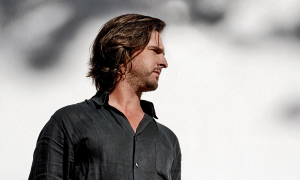
Home » Jazz Articles » Interview » Martin Speake: His Ideal
Martin Speake: His Ideal

...I think that as I get older I am becoming more and more about playing concisely and economically...
—Martin Speake
A Late Start
Speake came to music relatively late. Growing up he listened to popular music of the late '60s and early '70s, including Yes, Mahavishnu Orchestra, Pink Floyd and Led Zeppelin. "I listened to a lot of rock music," says Speake, "and went to loads of rock gigs, so I wanted a guitar. I remember ordering one of those learning-in-the-post kinds of things, where I got an acoustic guitar delivered with a book, but that didn't work at all, for some reason it didn't suit me at all. That was at fourteen or fifteen."I left school when I was about sixteen," continues Speake, "and I had a friend who played guitar, who played me a lot of jazz albums and turned me onto a lot of British jazz. But it seems to me that one of the first albums that I bought in jazz was Ornette Coleman's trio record, The Golden Circle, and I really identified with it because I found him incredibly melodic. So I went out and bought an alto saxophone.
"I had a not-very-nice first experience with that alto," Speake continues, "I bought one of those plastic ones that Ornette used to play; I just looked in a second-hand paper that sold musical instruments, and there was one available, so I got it, brought it home and couldn't really play it. I thought it was just me, so I went to a teacher and he said the alto was in a really bad state, and he didn't think we could buy parts for it, so I was immediately in tears. I remember my mother being very nice, though, and buying me another cheap alto, and I was set."
With no previous schooling, Speake began taking lessons to prepare him for studying music in college. "There was an incredibly nice music teacher," explains Speake, "who spent his time with me, one evening a week, just to get my knowledge of music theory up to scratch so that I could get into the college courses, because I hadn't done any music at school prior to that, and didn't know anything technically. This guy, a very nice guy, tutored me for a few months to get me to the required level of understanding. And at the same time I was also having lessons with a wind band saxophone/clarinet teacher, more of a technical thing really, to learn how to get around the instrument. Then I went straight into Trinity College for music.
"Surprisingly, at Trinity, the tutors there were ok technically for about a year or so," Speake continues, "but all I did was read classical music, play a classical repertoire, which was certainly good for me technically and musically, because I didn't know anything about it, but wanting to get into improvisation I had to be more-or-less self-sufficient. Jazz education in England thirty years ago was at quite a low level in terms of imparting knowledge; I was studying with a lot of my heroes, and these guys could play great but they really didn't remember how they had started out, or how to impart good practice routines."
It was at Trinity that he began making some connections that would allow him to develop as an improvising musician. He met pianist Simon Purcell, another overlooked British jazz player, who started up a jazz society at Trinity, and managed to obtain some work at a local pub. "Looking back on it we really couldn't play," Speake explains, "but we were keen, we rehearsed a lot, learned some standard tunes and listened to a lot of music. So that was the formative playing when I was at college. We had a quintet of players who were all studying classical music, but were all into jazz.
"I also remember answering an ad in Melody Makerfrom a pianist, Veryan Westin, who is involved in quite a lot of improvised music now, and I remember playing a lot with him then, and it was completely free, unstructured music. So I was playing tunes with Simon and free with Veryan, so they were two of my earliest playing experiences.
Influences
Aside from Ornette Coleman turning his head around at an early age, Speake cites two other main influences. "Keith Jarrett is a primary influence conceptually," Speake says. "There's a very high degree of melodicism in his music, which I think is paramount for him. Also, he's a totally committed improviser. I think it's quite interesting to compare piano trios, to see how loose, unrehearsed and very spontaneous he is. I had a student who was comparing Brad Mehldau to Jarrett. Brad, of course, is great as well, but in a very different way; when we actually worked out what was going on in two different versions of "All the Things You Are" it became obvious that Brad was incredibly worked out and Keith was very spontaneous. He's a very in the moment kind of player, which is why you hear mistakes on some of his albums. It's a bit of a shame that he doesn't compose any more, all those '70s albums with the American and European Quartets are incredibly influential. At different times I've transcribed most of the tunes from My Songand Belonging; I've never played them, but did it to soak up what's going on melodically and harmonically. While I don't have the same sense of harmony, I think it has influenced me."Another big influence is Paul Motian," continues Speake, "who comes out of Jarrett and Bill Evans. As a matter of fact I really like Paul's tunes, simple yet incredibly beautiful. His trio with Bill Frisell and Joe Lovano is probably my favourite band in jazz, especially their first album, It Should Have Happened a Long Time Ago.
Itchy Fingers
While Speake was at Trinity, he would also visit the nearby Royal Academy of Music, where he now teaches, and met a number of musicians, including saxophonists Mike Mower, and Howard Turner, "After we left college, this would be in the early '80s, we were doing a few gigs," Speake says, "and Mike got commissioned by the BBC to take a group to a jazz festival in Zurich. He wanted to take a thirteen-piece band and they would only allow a six-piece, so arranged to take four woodwind players, bass and percussion. He wrote a load of music for it and we did the gig, which we all really enjoyed, so we thought we'd drop the bass and percussion and just do it as four saxophone players. And that became Itchy Fingers. There was a bit of a resurgence of jazz interest by record labels at the time, people were putting a few gigs on, and in actual fact I was able to earn a living from that band for about two years. We played all over the world, Europe, South America, Africa, even the Lincoln Center. They loved us because we didn't have any gear -just four saxophones."The reason we became reasonably successful was because of a competition sponsored by Schlitz Beer," Speake continues. "Joe Zawinul was one of the judges, and we ended up winning it, and the performance was televised. The next day Virgin Records rang us up and asked if we wanted a record deal, which is pretty unusual. Virgin gave the band thirty thousand pounds, which was a lot of money, especially for a jazz band -even now -and two weeks in the studio, and that's when a lot of the friction began and it all started to go wrong. Although there are some very good things on the album, it's very produced, with a rhythm section, and a big band on some tracks; even McCoy Tyner came in and played a solo on one tune. I think we could have done a great record with just the four of us and three or four days in the studio, but I think Mike, who was the main leader in the band, wanted to do it this way, as a showcase for his composition and arranging skills.
"Still, the album was very well received by critics all over the world, and there aresome very good things on it," Speake continues, "although much of it sounded quite ordinary. Then we did another album on a subsidiary label, Venture, and Airto Moreira played on it. There are some great things on it, but for me the best times were when it was just the four of us. We did very well, and could get festival gigs all over the place, but it became a bit more of a show. I've always been committed to improvising and things being different, and it became too much of a show for me, very little improvising and the pieces became very fast -in the end I couldn't play them, I'd never played anything so hard in my life.
"So this friction began to bubble up," concludes Speake, "although it wasn't just me. At one stage the band had fallen out really, but in the end I got sacked and that ultimately turned out fine because I had a concept for my own thing and it did me a lot of good, but at the time I lost a lot of confidence because it wasn't done in a very nice way. So that's my history with the band. They went on to record two or three more albums, interestingly enough as just a quartet."
Banff and Steve Coleman
In 1990 Speake attended a summer workshop in Banff, Canada, where he met up with Steve Coleman. It was to be an important time for Speake. "He was incredibly influential," Speake explains, "not necessarily in the way he plays, because if you're going to play like that then that's all you can do, you have to devote your life to playing like that. Aesthetically it's not really where I want to be, although I do think he's one of the most important alto saxophonists in the past thirty years. He's very original and very outspoken, and these are attributes of his that are influential and significant."One of the biggest influences was that he didn't use any music," Speake continues. "Everything he did was by ear. I do quite a lot of teaching now, and I never use any music. If I say we're going to learn a tune we learn it straight off the CD, or I tell the student to go home and learn it. It develops the ear, and is very important."
First Quartet and In Our Time
Following Itchy Fingers, Speake worked with a number of artists, including subbing, on occasion, in Django Bates' group, Loose Tubes. He also worked with artists including British saxophonist John Williams, recording the octet record, The Year of the Buffalo. But it was with the formation of his first quartet, featuring guitarist John Paricelli, bassist Steve Watts and drummer Steve Arguelles (brother of saxophonist Julian), where Speake began to develop his own concepts and compositional skills. Recorded in '92, his first album, In Our Time, was released in '94 on The Jazz Label, and demonstrated a number of key features of Speake's approach, most significantly a pure dedication to lyricism, and a compositional style that crossed a number of genre boundaries. Paricelli's guitar style seemed to marry the idiosyncratic best of Bill Frisell with the more linear approach of John Abercrombie. "John and I go farther back than the quartet," says Speake, "I've known him nearly twenty-five years, and we played in some fusion groups before starting my quartet, including one with Simon Purcell. Steve Arguelles was a very early developer, playing fantastic stuff when he was only eighteen. He moved to Paris about ten years ago, and he spends a lot of time there involved not just in jazz, but also doing some free playing and producing."Phil Lee
Guitarist Phil Lee is another British treasure who is less known on this side of the Atlantic, but perhaps more so for his work with progressive Canterbury groups in the '70s including Gilgamesh. Speake has worked intermittently with Lee for a number of years, recording the beautifully subtle album, Amazing Gracein '96. "It's more of a shock for me to hear those old Gilgamesh things," says Speake," because he's known here more like Jim Hall really. He knows loads of tunes, has a fantastic sense of harmony, a beautiful sound and plays incredibly quietly, very like Hall. We still play together, not a lot, just tiny little duo gigs occasionally. I would never be amplified, and Phil would play really quietly. This makes things feel very strange when you do the other gigs, where you're amplified, because you realize you're missing out on the degree of dynamics that you can have."Trustand The Tan T'ien
1996 turned out to be a very busy year for Speake. Along with the Amazing Gracerecording, he recorded his second album with his quartet, Trust, as well as a duet recording with pianist Nikki Iles, which was to be the beginning of another long-term musical relationship. "I had heard of Nikki," Speake explains, "and I started teaching at a jazz summer school in Wales where she also taught, and we began playing together, it really seemed to click. I decided I wanted to record it, so we just went into the Royal Academy of Music studio, where I teach, and recorded The Tan T'ienin a couple of days, just a couple of mornings. We both chose tunes we liked, and then, at the end, we had an hour or so left and decided just to improvise, short improvisations but with a parameter for each one. Like playing in G and making it really diatonic, almost like classical plainsong. For another one, Nikki said she'd heard this Lee Konitz workshop where he said he'd play everything in minor thirds and semitones, so we used that as a starting point. Another was to do a swing thing, but open. So with all these little ideas we came up with nine improvisations that we alternated with the composed pieces on the album. I must say that I like playing completely free, but I do like having those little parameters as well."Fever Pitch
Concurrent with Speake's interest in jazz improvisation and composition, he has always held a fascination for Middle Eastern and Indian music. "The majority of the world plays music that doesn't have much harmony in it," Speake explains, "it's only the west that has a lot of harmony, so it was a shift for me to listen to a lot of world music. This Irish bassist I know turned me onto Rabih Abou-Khalil, gave me a tape of some of his music and some other world music kinds of things, and I really liked them, so I went on this little craze for a while, picking up Abou-Khalil's recordings and transcribing them so I could internalize what was going on. It was around the same time as Steve Coleman influencing me, with things not always being in 4/4, and thinking about music more rhythmically."So I wanted to weigh into playing in this kind of way," Speake continues, "and put together a band to play music that was more rhythmically based, with a lot of unison lines, a very powerful unison thing with different instruments, and room for improvisation. The original band had John Paricelli in it, an acoustic bass guitarist named Dudley Phillips, and percussionist Paul Clarvis, who I used to play with Phil Lee in a trio, just around Paul's house, playing standards. Paul suggested two other percussionists, because he liked the idea of three percussionists, with him being the leader, setting the grooves, and trumpeter Chris Batchelor.
"So I wrote the music and rehearsed it," continues Speake, "and we did a tour but it wasn't quite right. I think John felt uncomfortable; it wasn't really his area, so I thought I'd change it. And I wanted an excuse to play with Oren Marshall, a great tuba player. I wrote tunes in five and seven, and all these other patterns. How it would come about was I'd listen to a recording and think that I really liked a groove. I'm a great one for stealing -steal a groove off an album, a three-and-a-half or four-and-a-half, and then on another thing I'd hear a scale that I hadn't heard before, and I'd write a tune around that scale."
The resulting album, Martin Speake's Fever Pitch, featured Speake with Batchelor, Clarvis and Marshall, along with string multi-instrumentalist Stuart Hall, and percussionists Dawson Miller and Dave Hassell. Predating some of Rabih Abou-Khalil's later works that included a similarly odd instrumental line-up, Fever Pitchwas an important cross-genre recording that, sadly, was never released outside of England. "It was kind of a mixture of all the different things I was into at the time," Speake explains, "I was quite inspired during that period, with that area of music."
Unfortunately, busy schedules and a feeling that the larger ensemble was too rigid caused Fever Pitch, as recorded, to disband, although Speake did reform the band with guitarist Mike Outram, Oren Marshall and percussionist Asaf Sirkis. Since then Speake has pared it down even further. "I've started playing with Oren," says Speake, "and a young drummer in a trio, and we play some of that music. But we also do other material; I'm planning to do a Jackson Five tune and some Paul Motian tunes, with that line-up. I can tell you who I've been influenced by in that respect, and that's Ellery Eskelin, but just in the sense of an unusual line-up and a wide range of music. I don't think my music's going to sound anything like his because what I do with melodicism is very different, more textural; but I do like his concepts."
Changes to the Quartet
By the time '99 had rolled around, Speake had a new rhythm section for his quartet, which recorded Hullabaloo. Gone were Steve Watts and Steve Arguelles, and in their places, bassist Mick Hutton, who played on Amazing Grace, and young drummer Tom Skinner. "I've played with Mick for a long time," says Speake, "in fact I can remember playing with him at my mom's house when I was quite young. I needed to change the band and I really wanted him to be in it, I think he's one of the greatest bass players in the world. He's got an incredibly strong personality, which I really like. A lot of bass players seem to be quite passive people, and maybe it's something to do with the nature of the instrument they choose, because it's in a supportive role most of the time, and apart from people like Dave Holland and Charlie Haden and a few others, there are not many bassists who lead bands. But with Mick, he's a really unique individual, and incredibly strong."Tom Skinner is from a younger generation of musicians," continues Speake, "he's still in his early twenties, but he's one of the most mature musicians I've met, and at that age it's ridiculous. I started playing with him when he was about eighteen, a mutual friend had introduced us, and we had a play and really hit it off. He's an incredible listener, listens to loads of music. So I've had a relationship with him for five or six years now."
Since Hullabaloo, John Paricelli's increasingly busy schedule has forced Speake to recruit a new guitarist, Mike Outram, for the quartet. "Mike's actually more appropriate for the quartet than John," Speake says, "as much as I loved John. He's actually got more jazzin him than John. He can actually play anything, and to an incredibly high standard. He knows quite a lot of tunes, which is nice; I like the idea of just calling tunes, I like to be able to do that with people. Some people who are into playing original music all the time, they don't know many tunes. That's quite an important thing for me, if I want to play in that area. Mike really likes bebop and he really likes playing groove things, contemporary developments; he even likes to thrash out and turn it up if the situation calls for it."
While Speake has developed quite a book of music for the quartet over the past decade, he never looks back. "I know Tom likes to do that, he pushes me to play completely different material," Speake says. "I remember Pat Metheny talking about the energy that people have between the ages of sixteen and twenty-five, and I get a lot of that from Tom, he's got a sense of urgency that you seem to see in people that age. But we also do tunes by other people now. I rearrange some things a little bit, like 'Where You Are,' a very old tune that Dexter Gordon recorded, I do that with a pedal point. And we do 'For All We Know,' but with a different coda that I wrote for it. We're doing a Neil Young tune, and a bit of the Indian/Arabic thing as well, so we mix it up a fair bit."
Unhappy circumstances have also caused Speake to recently recruit a new bassist, Tom Herbert, for the band. "Sadly Mick Hutton isn't playing any more," Speake explains. "Six years ago he fell and tore a ligament in his left hand, had an operation and thought it was okay, but it's gone again. A few months ago he was telling me he had to change the keys of tunes on some sessions in order to be able to play them, and now he just can't play at all. I'm hoping he's going to recover, but I got a note from him a few days ago, saying that for the foreseeable future he wouldn't be playing. It's incredibly tragic."
Secret In 2000 Speake heard from a Canadian bassist, Duncan Hopkins, who he'd met briefly at Banff back in 1990. "I got this letter from him saying that he'd heard one of my recordings on the radio in Canada," Speake describes, "and it jogged his memory to write to me. He said he was coming over to England because he had family to visit, and if I fancied getting some gigs together and playing that would be great. In the meantime I went to play at a jazz festival in Jersey, as a guest soloist with a rhythm section, and the drummer was Anthony Michelli. We played and hit it off musically. When I mentioned to Anthony, who lives in Toronto as Duncan does, that I'd heard from Duncan recently, he said he'd played with him in Toronto. So I thought there was some kind of fate going on here, and decided to put together this band with Duncan and Anthony, and recruit Nikki Iles. I managed to get about two weeks of gigs consecutively, which is pretty rare, everyone was free and really up for doing it, and so we did the tour and then went into the studio and recorded Secretjust as if it were another gig, which is my favourite way of recording."
While Secretis a true cooperative recording, with everyone contributing compositions, one of the most notable characteristics is that, amongst the varied compositions by all concerned, Speake's compositions stand out as having a distinct voice, a unique language. And that's all the more remarkable considering the tunes range from the Arabic-informed "J.T.'s Symmetrical Scale" to the ECM-inflected "Secret Wood." "Melody is definitely the most important thing for me in my writing," says Speake, "it might have to do with my being a terrible singer, but most of my tunes are quite singable and this is really from Keith Jarrett and Ornette Coleman I'm sure."
Exploring Standards
In '01 Speake recorded one of his most unique albums, the trio album Exploring Standardswith Mick Hutton and Tom Skinner. With a vast number of artists interpreting standards, what makes Speake's take on the subject so different is that the approach was to look at each tune as a miniature, with most tunes running around the four minute mark, and some, including Sonny Stitt's "The Eternal Triangle," lasting a brief thirty-eight seconds. Monk's "Evidence" is presented as a surprisingly melodic and inventive one-and-a-half minute drum solo."I know Mick Hutton gets bored really quickly, so I knew I had that threat under me," Speake muses. "But, seriously, it's a nice idea doing really short takes; I think it can sound incredibly fresh. I'm not Charlie Parker, I can't play a hundred choruses, and I think that as I get older I am becoming more and more about playing concisely and economically, whereas when I was younger and couldn't play as well I'd play far too long. I try to think about it a bit more now.
"Two minutes is a long time, three minutes is a long time," continues Speake, "and I'm very proud of that album mainly because of the other two players. I think it's one of the best documentations of Mick's playing, and in light of his recent problems it's especially important. He's on a lot of other recordings, but I don't think he's on any trio albums where he's that exposed, where he's at the whole centre of the music, so for me that's like a tribute to him, that record."
Ethan Iverson and My Ideal
In late '02, Speake and The Bad Plus pianist Ethan Iverson, whom Speake had also met in Banff in '90, teamed up for a short UK tour, performing only ballads. "That was his idea," says Speake. "We thought about doing our own tunes when I was getting the tour together, and then he said he'd been thinking about doing just ballads, so I said fine as I knew they'd be slightly different from what they are normally, and I love playing ballads."Iverson and Speake come from very different backgrounds, with very different influences and emphases, and the resulting recording, My Ideal, recorded in just four hours at the end of the tour, reflects the tension, the push-and-pull that these differences create. "Ethan's very textural, and dynamically he's much more extreme than I am," Speake says, "much more dramatic. I come more from the lyricism of Bill Evans and he comes more from rhythmic approach of Monk. In fact, Ethan is one of the few piano players who will say that he doesn't really like Evans. Evans, of course, had a major drug problem for most of his career, and Ethan says that, while some people could play under the influence, it really affected Evans' playing, and that he really rushed in the latter part of his career."
The International Quartet
An album that is sure to help put Speake on the international stage is his forthcoming ECM recording with Paul Motian, Bobo Stenson and Mick Hutton, recorded in '02 at Rainbow Studio in Oslo. While the recording is relatively recent, the group has actually played, intermittently, for ten years. "About '93 I'd been listening to Paul's music a lot," Speake explains, "and I thought, 'I've got to play with this guy before I'm gone, or before he's gone.' So I sent him a tape of In Our Timeand asked if I got some gigs would he do the dates. A week or so later he got back to me, said the album sounded great and of course he'd do it. So I got John Paricelli and Mick Hutton, and we played mostly my tunes, but a couple of Paul's as well, and did about a week of gigs, including a well-paying festival gig in Ireland that tied the whole thing together."So then I thought, 'I have to keep this relationship going,'" continues Speake, "but it was very difficult, and it didn't happen again for another seven years. I made a proposition to the promoter of the Cheltenham Jazz Festival, that he commission me to get an international group together. He went for it, and I got Paul, Mick and Bobo, I wrote the music for it and fixed up two weeks of gigs consecutively from there. I got decent funding from the Arts Council, so on top of the Festival commission it was going to be one of the best tours I'd done, not having to worry about the money. It worked out really well, everyone just wanted to play and we did two weeks with no days off.
"Around that time, I think, either Paul or Bobo had mentioned it to Manfred Eicher," Speake continues," because the group was working and they were both into it. Then a couple of years later we did another tour, but the funding fell through. It was incredibly stressful for a number of reasons, but again it was mentioned to Manfred, and I also called him and he knew about it. So we fixed up a time to record, but it was something like six months after we had done that last tour.
"It was a challenge working with Manfred, as he's an incredibly hands-on producer," concludes Speake, "it was the hardest thing I've ever done. He wanted everything a certain way and he was actually in the studio with us while we were recording, which was stressful. He'd be singing my tunes to me, telling me how they should go, and he'd be gesticulating around the room with his arms, saying, 'it should be more flowing, like this.' He clearly knows what he's doing, though; although I haven't heard the session since we recorded it, it will be interesting to hear how it turns out."
Current Projects
With My Idealwell-received, and gaining some attention on both sides of the Atlantic, Speake continues to remain busy, with a number of projects on the go. "I have a new record that's going to come out in September," Speake says, "with a trio that I've had probably longer than my quartet, with two Indian musicians, a tabla player and guitarist. In the last year or two we've been doing more concerts and eventually got a recording deal with Black Box, a subsidiary of Sanctuary, so this will be coming out on their jazz label. We're going to do some concerts in the autumn with the band, and I actually have high hopes for it, as it's something that can play more than just jazz venues."I'll also be doing a project that celebrates the anniversary of Charlie Parker's death, the 50th anniversary," continues Speake. "I'm organizing a tour to play his music, and I'll be arranging it a bit, but nothing drastically different except that it will be with Mike Outram on guitar rather than piano. I'd never listened to him with this level of detail, so I'm re-evaluating it and it's fantastic stuff. I'm hopefully going to record that in the autumn, so the album can be out for the tour in the spring."
Meanwhile Speake continues to work on honing his own skills and keeping things fresh, very much in the same way that guitarist John Abercrombiedevelops his playing. "I'm playing tunes, playing changes" says Speake, "and I'm also transcribing things, trying to internalize the language of music, like with the Charlie Parker project, just because I think there's so much in it. It's kind of fresh to me because I've never done it before. I also keep fresh by playing with different people, and I seem driven to do all these different projects, and I think that also keeps me fresh."
With a body of work that continues to grow at a pace that is remarkable in these days of artists only releasing a new album every two or three years, Martin Speake's discography is notable for its diversity of style and context. Hopefully his new releases will continue to see more exposure internationally, and Speake will gain the recognition he deserves as an alto saxophonist, composer and bandleader of consequence.
Comments

About Martin Speake
Instrument: Saxophone, alto
Related Articles | Concerts | Albums | Photos | Similar ToTags
For the Love of Jazz
 All About Jazz has been a pillar of jazz since 1995, championing it as an art form and, more importantly, supporting the musicians who create it. Our enduring commitment has made "AAJ" one of the most culturally important websites of its kind, read by hundreds of thousands of fans, musicians and industry figures every month.
You Can Help
To expand our coverage even further and develop new means to foster jazz discovery and connectivity we need your help. You can become a sustaining member for a modest $20 and in return, we'll immediately hide those pesky ads plus provide access to future articles for a full year. This winning combination will vastly improve your AAJ experience and allow us to vigorously build on the pioneering work we first started in 1995. So enjoy an ad-free AAJ experience and help us remain a positive beacon for jazz by making a donation today.

Giveaway

Eligible winners: 15
Days remaining: 5
Days remaining: 5