Home » Jazz Articles » Book Review » Blue Note Jazz Photography Of Francis Wolff
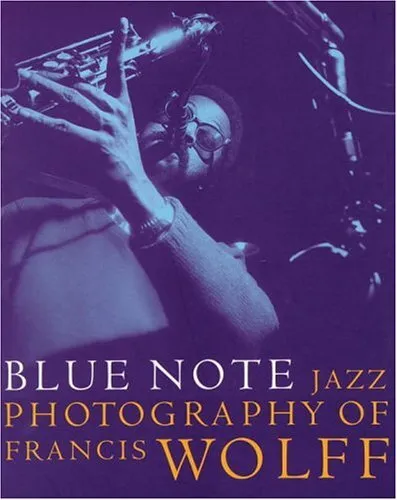
Blue Note Jazz Photography Of Francis Wolff

 Michael Cuscuna
 Charlie Lourie
Oscar Schnider
176 pages
Universe Publishing
For those of us who can't erase from our minds the haunting photography of Francis Wolff, Universe Publishing offers solace in the form of Blue Note Jazz Photography Of Francis Wolff. The 1995 book, The Blue Note Years, enjoyed critical and commercial success. Thank goodness.
That success has led to another compilation of Wolff photographs, this time numbering 200. Blue Note Jazz Photography Of Francis Wolff documents the creative process and brings visual life to the musicians whose music has enriched the listeners' lives.
If a jazz enthuasiast's listening discoveries were contemporaneous with the original release of the Blue Note albums mentioned in this book, he or she may have thought at the time that the photographs existed to promote the music through appearance on the album covers. That was only a small part of the story, it seems.
Wolff shot over 30,000 photographs of some of the most significant jazz recording sessions of the 1950's, not to mention documenting the faces of the label's artists from Meade Lux Lewis in the early 1940's to Jimmy Smith in the 1960's.
Obviously, this is a massive achievement, implying Wolff's almost fanatical dedication to the music he loved. Michael Cuscuna's introduction to the book mentions that Wolff often got in the way of the musicians and of his fellow German immigrant Alfred Lion during the recording sessions as Wolff always sought the perfect shot. That perfectionism and dedication left us with a seemingly inexhaustible archive of jazz photography that was as innovative in its approach as was, say, Rudy Van Gelder's unconventional recording techniques in his first makeshift studio.
Thumbing through Blue Note Jazz Photography Of Francis Wolff it becomes evident that it wasn't just the music that spoke louder than words. So did the photography. Only recently, it seems, has the influence of Wolff's photography become appreciated. The shot of J.R. Monterose, angled upward from knee height, enlarges the bell and lower keys of his tenor saxophone and the spidery fingers of his right hand. Monterose's absolute concentration as he plays, even behind sunglasses, looks eerily familiar. Was this shot the model for Zoot, the Muppet character?
Speaking of Zoot, Zoot Sims is documented as well from his 1956 session with Jutta Hipp, his trousers pulled up far above his waist and the microphone intruding above the saxophone as he too is in the zone of a performance high. In fact, 166 jazz people appear in the book. I hesitate to say that "166 jazz musicians appear" because Wolff even was fascinated by the jubilant face of Pee Wee Marquette, the doorman at Birdland and the emcee of Art Blakey's "A Night At Birdland" session in 1954. Lou Donaldson appears bemused in the background.
Speaking of Lou Donaldson, the George Benson photograph from Donaldson's "Alligator Boogaloo" session has become so well known that it has been made into a postcard.
Typical of the conscientious documentation now attached to Cuscuna's reputation, the book lists biographical information about all of the photographed subjects, including date/place of birth/death, as well as noting the pages on which their images appear. The caption below each photograph includes the artist's name, the name of the album's session or the location of the live performance and the date.
Beyond the specifics of Wolff and Lion's stewardship of one of the world's greatest record labels, the implications of the images in Blue Note Jazz Photography Of Francis Wolff lead one to marvel at the benefits of technological advances. Consider that musical performances before the twentieth century involved directly and solely performer-to-audience communication, with only the print media (its inadequacies as a describer of musical inspiration patently obvious) perhaps as a recorder of the event. Recording technology allowed broader audiences to hear spur-of-the-moment improvisations—the essence of jazz—which otherwise would have been ephemeral. The combination of Lion's and Wolff's dedication to recording outstanding jazz and their visual appreciation, not to mention the dissemination of those images, froze those otherwise-fleeting moments in time for discovery and enjoyment by successive generations.
Thus, Bobby Hutcherson, Herbie Hancock, McCoy Tyner, Wayne Shorter and many others remain forever young on the pages of the book, even as their music remains fresh almost 40 years later. Musicians we knew all too briefly come alive in the recording sessions, allowing jazz enthusiasts to study their visage and surmise their personalities. Examples of short-lived musicians that Wolff photographed include Fats Navarro, Doug Watson, Lee Morgan, Wardell Gray, Eric Dolphy and Clifford Brown. Wolff shot mature musicians toward the ends of their careers such as Pops Foster, Baby Dodds and James P. Johnson. In a style unconcerned with age, Wolff shot young prodigies like Chick Corea and Al Foster, who were flush with excitement.
As color photography went mainstream, Wolff gradually converted from his favored Tri-X black-and-white film to Ektachrome with, naturally, astounding results. Shooting Don Cherry against the gray marble of what one assumes is an office building, Wolff contrasted the rainbow of colors in Cherry's thick and long scarf against the muted burgundy of his sweater and the tan of his slacks.
But those famous black-and-white photographs defined the image of Blue Note in its heyday as they were printed in dark blue or in duotones on the covers of the albums. A person could identify a record label from its cover, even upon entering the store. Ahead of their time, Wolff and Lion recognized the importance of packaging in selling a product and in creating an its image, even though their enthusiasm for the music was the actual stimulus for such extensive documentation of legendary performances.
As noted, words are inadequate for describing musical and visual media. How can a person describe Lee Morgan's pensiveness or Tal Farlow's concentration or Curtis Fuller's pensive amusement or Joe Henderson's cool or Clifford Brown's finger-snapping joy or Bunk Johnson's assured ease or Tadd Dameron's obvious moment of conceptual discovery? It's impossible.
That inexpressible conveyance of thought, motion and emotion establishes the value of visual art. It also creates the inestimable value of Blue Note Jazz Photography Of Francis Wolff.
Tags
PREVIOUS / NEXT
Become a Sustaining Member

Since 1995, All About Jazz has championed jazz as an art form and supported the musicians who create it. Over three decades, it has grown into one of the world's leading jazz resources, serving hundreds of thousands of readers, musicians, presenters and industry professionals each month.
Help Build the Future of All About Jazz
Your support helps us continue building All About Jazz for the next generation—expanding our editorial coverage, preserving jazz history, developing new community features and creating better ways to discover the music and the people behind it.
Become a sustaining member for as little as $20 per year and you'll immediately enjoy an ad-free experience along with access to subscriber features and future articles for a full year.
Together, we're not simply sustaining All About Jazz—we're building its future. Thank you for being part of the journey.