Home » Jazz Articles » Highly Opinionated » Aziza Mustafa Zadeh: Body and Soul and Mugam!
Aziza Mustafa Zadeh: Body and Soul and Mugam!

The mugami-jazz of Azeri-born pianist and composer, Aziza Mustapha-Zadeh belongs right here is this wellspring and outpouring of emotion. It illuminates everything: strength, drive, courage like flamenco; essence and virtue like a child; wisdom like the ancients!
 To go back to the very beginning, to go back to a Sephardic ancestry, there is the soul – voluptuous in connotation. It is, at once, the invisible shadow of the body – with a sense of self and person, reaching out to its life in the spirit-world. It is desire, appetite, emotion and passion. So... spirit and emotion! Small wonder why in calo, the ancient Romany-Flamenco-Gypsy language, born in the blazing heat of the sun, we learn the word ‘vengue’, a street word that means ‘duende’, or ‘jaleo’. Although all three words were sometimes translated as ‘soul’, their meanings actually acquire an almost hallucinogenic blur! For each word describes more a state of mind, a transcendent moment of perception that can occur when the flamenco musician or dancer – or, for that matter, the Moorish and the Dervish musician and dancer too – sublimates him or herself into a seductive matrix of the emotion they are seeking to express, taking you out of time with them. It takes all of their life, all of their instincts, intuitions, emotional imagination and this complexity is poured out like a metaphorical waterfall, monumental in its impact! It cannot be manufactured. You can't see it. Still, it exists, large as life. Like the waves of duende, jaleo or vengue... it appears and disappears, as it overwhelms you.
 Like the griots of Africa, the mugami-jazz of Azeri-born pianist and composer, Aziza Mustafa-Zadeh belongs right here is this wellspring and outpouring of emotion. It illuminates everything: strength, drive, courage like flamenco; essence and virtue like a child; wisdom like the ancients!
It was 1980 and I was in India, working on a documentary – with Bob Gill – on ‘Bhavai’, the ancient and dying form of folk theatre in the Western state of Gujarat. Of course, I woke and wound myself up to music – hours of it – as essential to brushing my teeth, bathing and eating! Having run out of things to listen to in my portable collection, I borrowed an unlabeled audio-cassette from a friend in the crew, as passionate about music as I was. The music that played out of it was strange and beautiful – a piano virtuoso – but more than that – a magician who was capable, I soon found out, of calming the savage breast – literally! The pianist had dazzling technique, a masterly sense of harmony and his soulful music made me struggle for breath. It was a song about impending death. I forget the title of the track no. But the music was from the album, ‘The Man from Baku’, by Vaghif Mustafa Zadeh, Aziza Mustafa’s father, who so stunned Dizzy Gillespie when he heard Vaghif, that he was moved to say, “Vaghif’s music is from another planet. It’s the music of the future!” I had to have a copy of it – which my Azeri friend was happy to make me. I was fortunate and also knew that no new music would ever be made by this genius of mugami-jazz. Vaghif Mustafa Zadeh had died on the 16th of December, the previous year. He died leaving behind a wife, Eliza Khanom – herself an accomplished singer, who gave up performing with the shock of her husband’s death – and his only other passion. This was Aziza. She was 10 years old when her father died. But he left her with the best inheritance a man of musical genius could possibly bequeath his child. This is a precocious talent and discerning passion for music. And this has grown into a fiery pianistic brilliance and the most extraordinary sensitivity for the Azeri mugam (inherited from her father), which she has most astutely blended in with the idiom of jazz.
To the relatively uninitiated – and I still count myself among them – mugam is an ancient, highly developed and complex form of music peculiar to Central Asia, Turkey, the Middle and the Far East. Its composition and performance demands a high degree of learning and professionalism. Much like the ancient griot traditions of African music, mugami music requires the musician to attain a higher – almost altered – state of being, because, despite the fact that mugami composition is based on the modal scale and rigidly structured, in its interpretation and performance a heightened state of emotion takes over the performer.
To back track, just a bit, mugam is based on many different modes and tonal scales where different relations between notes and scales are envisaged and developed. The music is meta-ethnic – almost omnipresent throughout Central Asia and the Middle East. Musicologists often mutter incomprehensible things when attempting to dissertate on the mugam tradition. Their explanations are so roundabout that it is impossible to work out the exact nature of the music. In reality ‘mugam’ has two different, but related meanings. The Azeri composer, Kara Karayev, writing in Sovietskaya Muzkya (1949:3) has the following explanation: “The expression ‘mugam’ is used in two senses in the folk music of Azerbaijan. On the one hand the word ‘Mugam’ describes the same thing as the term ‘lad’ (Russian for key, mode, scale). An analysis of Azeri songs, dances and other folk-music forms show that they are always constructed according to one (of these) modes. On the other hand the term ‘Mugam’ refers to an individual, multi-movement form. This form combines elements of a suite and a rhapsody, is symphonic in nature, and has its own set of structural rules. In particular one should observe that the ‘Suite-Rhapsody-Mugam’ is constructed according to one particular ‘Mode-Mugam’ and is subject to all of the particular requirements of this mode.”
Mugam also describes a specific type of musical composition and performance, which is hard to grasp with an understanding of western concepts of music most notably because mugam composition is improvisational in nature. This brings the music close to jazz. At the same time – and this is antithetical to the heart and soul of jazz – it follows exact rules. Furthermore, in the case of the suite-rhapsody-mugam the concept of improvisation is not really an accurate one, since the artistic imagination of the performers is based on a strict foundation of principles determined by the respective mode. The performance of such a mugam does not present an amorphous and spontaneous, impulsive improvisation. The songs are often based on the ancient poetry of Azerbaijan, and although love is a common topic in these poems, due to their immense complexity many of the intricacies and the spiritual and romantic allusions are lost on the untrained ear. For one, the poems do not primarily deal with worldly love but also with the mystical love for God. Yet, strictly speaking, this is still secular music/poetry, as opposed to, say, Sufism. Nevertheless, mugam composition is designed very similarly to Sufism in that it seeks to achieve ascension from a lower level of awareness to a transcendental union with God. It is a spiritual search for God.

There are over seventy mugam and derivatives – based on known Azeri modes. The operatic scores and symphonic compositions were added on later, when musical intercourse was resumed with the west. Almost all have outlived the harsh and repressive elements – including the spread of militant Christianity and erstwhile Soviet era, whose fearful adherents tried their best to suppress the mugami opuses. That the tradition of mugami – first heard of and developed between the 10th and 11th centuries B.C. – has survived until this day is a tribute to the musicians who have struggled to keep it alive. Uzbayir Hajibeyov – who incorporated mugam into operatic scores in the 1910s, Fikrat Amirov, who introduced mugam into Western symphonic form for the first time in the mid-1940s... Singers such as Babayev, and Gasimov... the tar players Guliyev and Abdullayev, kamancha player Sheik Eyvazova... Even today, their names and music reverberates through the streets and auditoriums of Azerbaijan.
But Vaghif Mustafa Zadeh was always different. Like Mingus, Coltrane, Dizzy and Miles, and now Laswell, Vaghif had a world view. He saw through the haze of painful repression that he could fuse its concepts through performances, blended with that other great dialect of liberation – jazz – and take a centuries-old tradition into the modern era. And he was persecuted mercilessly. Vaghif – it was believed – used the emotive elements of mugam to communicate secretly with the liberated world – to subvert the closed society that he lived and died in.
Vaghif had a symbiotic relationship with his wife – and especially – with his then-young daughter Aziza, who carries on the monumental task of fusing the dialect of mugam with that of contemporary jazz. The language of love, spoken with (the) sonic emotion of mugam and cast in the dialect of jazz almost unified them spiritually, even as Aziza was growing up. His almost mystic musical abilities had a deep effect on the child. Aziza, speaking to the Ms. Betty Blair (reprinted from Azerbaijan International magazine – Winter, 1996 (4.4) narrates an incident in her childhood. It forms a memorable illustration of how the sonic emotion of mugam became the well-spring of her life: “Once, my father was improvising at the piano, playing in the mugam mode known as ‘shur’, which creates a mood that evokes very deep, sad emotions. As my father was playing, I started to cry. Everyone wondered what was happening to me. Why was I crying? And then my mother realized the correlation between my feelings and the music. ‘Vaghif, please,’ she told my father, ‘Change the scale... Go to ‘rast’’, which he did. Now ‘rast’ (Another mugam) is characterized by its joyfulness and optimism. And sure enough, with tears still running down my cheeks, I started to make dance-like movements! And Mom pointed out, “Look! Look what she is doing! Change back to ‘shur’! And when he did, I started crying even louder than ever before. ‘Back to ‘rast’, Vaghif’... and I began dancing again!”
Just how deeply the genius of her father, the Azeri tradition of mugam and her own ferocious talent – and grasp of every mugam and element of jazz – have come to meld into the soul of Aziza Mustafa Zadeh, like the spell of an ancient druid in a ‘Bird-like skin, is evident from the first notes of her very first eponymous album, Aziza. This was no tentative ‘first step ahead’, but a full-blown record of an artist who had arrived and was speaking in her own ‘Aziza-idiom’, where mugami form and emotion flowed like hot metal into cascades of classic, avant-garde and Parkeriana!
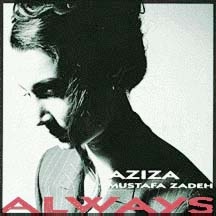 In 1993, Columbia released Always , where Aziza was accompanied by then Chick Corea alumni, Dave Weckl (drums) and the irrepressible John Patitucci (bass). The album roared through Europe, dazzling listeners and wowing critics. It was awarded the ECHO prize from the German Gramaphone Association. Was the album pure breathtaking jazz? Never quite so. Aziza can never be put into a singular groove. She had already lit up the sky with her otherworldly interpretation of mugam, appropriated to the landscape of jazz! Azeri mugami harmalodics buffeted with the clash and crash of Weckl’s percussion pyrotechnoques and the deeply resonant pedal-point and ostinato of Patitucci’s bass. Mugam-jazz-harmolodia was born at the slender hands of the soulful Azeri pianist.
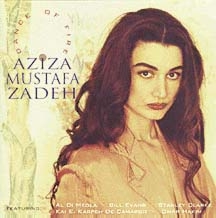 Then Columbia (Bless their souls!) released Dance of Fire two years later. On this spectacular album, Aziza came into interstellar space, surrounded by such luminaries as Al DiMeola (guitars), Omar Hakim (percussion), Kai E. Karpeh de Carmago (bass guitar), Stanley Clarke (acoustic and electric bass and –an inspired choice and performance from the breathtaking Bill Evans (saxophones). Now we heard a definitive, new musical voice. With her pianistic genius and command of expression, complete mastery of the mugam elements – both classic and folk – and watched over by the spirit of her now-almost sanctified father, Vaghif, she further stated the expected-unexpected: That the Woman from Baku had arrived to torch things up with her unique and as yet unheard offering of body+soul+mugami! Dance of Fire was not simply an album – as audiences across Germany and, later, all of Europe was to discover, during April and May of 1991. The album turned a new ascendant path! It was a tinderbox of music exploding with the dazzling display akin to the fireworks celebrating millennia in a state of beautiful flux! The twists and turns of the music bolting between earthy funk and playful coquetries proved to be a blazing hit. With DiMeola and Clarke providing a full-bodied string section, while she brought a distinctive Moorish tinge to her voice. And sang, she did – scat melting into the mugami emotions and modes. The result was pure witchcraft (in the most adorable kind of way, of course! Vocally, at any rate – not since Flora Purim, that other spectacular Brasilian vocalistics star, had an artiste (Aziza) been able to carry off the almost entire gamut of human emotions and feelings!
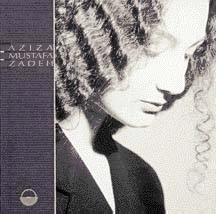 Then in 1998, Aziza a touching tribute to her father’s memory (and, incidentally, using the very name Vaghif Mustafa Zadeh had given her as a child prodigy), Aziza turned the world of jazz onto her deep-rooted mugami side. Joined by Jean ‘Toots’ Thielemans’ (harmonica), Philip Catherine (the ‘gypsy’ guitarist), and Eduardo Contrera (Brasilian percussion). She turned Paul Desmond’s “Take Five” into a dervish romp through an Elysian field of dreams; Rogers and Hart’s ‘My Funny Valentine’ and ‘Orfeo Negro’ became odes to the tradition of mugam and the mugami musicians and actually appeared to race in and out of both songs! Antonio Carlos Join’s ‘Insansatez’ became the ‘shur’ mugam mode and Charlie Parker’s ‘Scrapple from the Apple’ became the ‘rast’! On this album, Aziza also showcased her compositional genius with two new compositions – ‘Sunny Rain’, and another which is pure Aziza – ‘Butterflies’ – with its explosive intermezzo for piano and scat performed with baroque strictness and splendor!
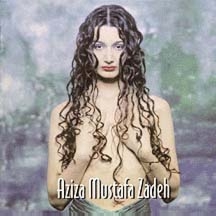 But perhaps the purest and most intriguing – body+soul+mugam album that Aziza has ever made was Seventh Truth , a soaring solo album that is a return (well, almost) to her roots. With this definitive statement – running, almost breathlessly track after track – Aziza runs the gauntlet of her deepest emotions. I have heard nothing like this since the Latin ‘Lachrymae Christi’ and the heart-felt ‘crying’ of the song by the great Brasilian chorinhos. Pianistically, she is every match – not just with the likes of Gonzalo Rubalcaba and Art Tatum, but also Vaghif and Franz Liszt!
Aziza Mustafa Zadeh arrived, musically speaking, when, as a baby, she was moved to tears and dance by the mugam of her father, Vaghif Mustafa Zadeh. Now, thanks to her record company’s wisdom and guts Aziza is here to stay... to attempt to move the hearts and souls of a callous world. Yet, with characteristic wisdom and humility beyond her years, she says: “I see progress in my music. I sense it in that music that I have recorded. I’m developing. Getting better. My aspiration is to be able to achieve what my parents have. That’s my dream...!
With such talent and faith in her divinely inspired gifts, it feels good to listeners to wake up – both literally and figuratively as well to the music of the queen of body, soul and mugam. Today is as good a day as any!
Related Links
Article at Fly.com
Discography
Article at Azer.com
< Previous
It's About Love
Comments

About Aziza Mustafa Zadeh
Instrument: Piano
Related Articles | Concerts | Albums | Photos | Similar ToTags
Concerts
For the Love of Jazz
 All About Jazz has been a pillar of jazz since 1995, championing it as an art form and, more importantly, supporting the musicians who create it. Our enduring commitment has made "AAJ" one of the most culturally important websites of its kind, read by hundreds of thousands of fans, musicians and industry figures every month.
You Can Help
To expand our coverage even further and develop new means to foster jazz discovery and connectivity we need your help. You can become a sustaining member for a modest $20 and in return, we'll immediately hide those pesky ads plus provide access to future articles for a full year. This winning combination will vastly improve your AAJ experience and allow us to vigorously build on the pioneering work we first started in 1995. So enjoy an ad-free AAJ experience and help us remain a positive beacon for jazz by making a donation today.

Giveaway

Days remaining: 5