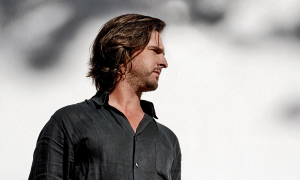
Home » Jazz Articles » Interview » A Fireside Chat with Michael Marcus
A Fireside Chat with Michael Marcus

I've always felt that some of the classic tunes have been great vehicles for improvisation. I feel that if you can go and explore it and tell your own unique story in it that it's still a way of contributing to the music...
Michael Marcus: You have my deepest condolences, Fred. I heard Billy Higgins died.
All About Jazz: He passed away yesterday.
MM: That's very sad, Fred. The first jazz record I ever did, I had the pleasure of being on with, he was on it, 1982, a Sonny Simmons record called Backwoods Suite (West Wind). Billy Higgins was the drummer with Joe Bonner and Herbie Lewis. That was my first jazz record.
AAJ: I have profound regret that he was unheralded in life. Perhaps we will learn to cherish him in death.
MM: Oh, he was the greatest master drummer of the Twentieth Century, well, Twenty-First. I read your really nice review on William Parker.
AAJ: Thank you. Let's start from the beginning.
MM: First, I was exposed to rhythm and blues through the Chess Records, listening to Howlin' Wolf and Muddy Waters and Sonny Boy Williamson, and somebody had exposed me to Lester Young and Charlie Parker. So that's how I got exposed to the music was through the records because unfortunately, I wasn't around where they had that much live music. I grew up in Daly City, which is a suburb of San Francisco, so it was through the records. It was the swing that attracted me so much and the beauty of the tone of those horns, Bird's tone on alto and Lester's tone on tenor, also, Gene Ammons. Yeah, that was real important. Gene Ammons was the third one. I really dug his tone. All three were really great blues players, so after loving the blues so much, we used to hear Albert King and Howlin' Wolf at the Winterland Ballroom. When I heard the tone and the phrasing, it was very attractive to me and it just drew me in. Then once I got a little bit of the essence of the spirituality that was occurring there, I was gone. My first instrument was actually harmonica, which was related to Sonny Boy Williamson. He was my idol from the Chess Records. But then when I heard Jug's tone and Bird's tone and that phrasing, I got an alto saxophone. My first instrument was harmonica.
AAJ: Did you try to mirror Bird's tone?
MM: I never tried to emulate another artist. I've always been a firm believer of being, of trying to express the music in your own image. So I never tried to, Fred. As a matter of fact, Bird's my study. I'm still studying his phraseology and his superior harmonic concept, but I've never tried to copy him. I've always just tried to incorporate their feeling.
AAJ: A likely principle when you bear in mind that you played alongside Sonny Simmons, a superb alto player that is nearly a forgotten soul in today's hype.
MM: Well, the first time that I had the privilege of meeting Sonny was at a blues recording with an Oakland blues guitarist and the Bishop Norman Williams and Eddie Henderson was the other horn on that. I was playing baritone sax at that time because by then, I was playing for a lot of the local blues bands in Oakland like Sonny Rhodes and Charles Brown. I was really into a lot of more avant-garde jazz and I had Sonny's records like The Cry! (Contemporary) and Staying on the Watch (ESP). I was really into Ornette Coleman and I was into Ken McIntyre and Bill Dixon. So I had that stuff and this guy had told me that there was an alto player coming there that really sounded like Bird. I thought it was the Bishop, but he said, "No, man, Sonny Simmons." I said, "Are you serious? Because Sonny Simmons played on The Cry!" If you recall, on that album, he's playing the white Grafton saxophone. It's a plastic horn. It is the same one Bird played at live at Massey Hall and the same one that Ornette played in those Atlantic Records. But I really could hear in Sonny's phrasing that he was really into Bird and Ornette. I said, "Man, this is the cat," so when I met him, we developed a friendship. I started to study with him and I learned a real lot about advanced technique and harmonic passages in saxophone playing. He realized that I had some arranging abilities because I was playing baritone sax primarily at that time. It was decided that he was going to do this record called Backwoods Suite. That was the one Billy Higgins was on and so he hired me to be the arranger for the date. It was my first jazz recording and I arranged all his original compositions for him. Since then, we've become good friends. We've collaborated on, for the last twenty years, I'm on two of his records on the CIMP label in 1996 with Charles Moffett ( Transcendence and Judgment Day ) and recently, we just did a recording under the group name Cosmosamatics with myself, Sonny Simmons, William Parker, and drummer Jay Rosen and special guest James Carter on bass sax and he is killing. That's coming out on Boxholder. It's really special. So Sonny and I have been collaborating for twenty years and he's, like you said, Fred, one of the greatest and very underrated. He's a wonderful person.
AAJ: And Jaki Byard?
MM: Oh, well, Jaki was a spirit and a light to all. I was very honored to do those two records with him for Justin Time. Did you hear them, Fred?
AAJ: I have.
MM: And how that came about was after I did the first Justin Time record, Reachin', I was think about what I could do now and I wanted to find a guy, a pianist who I felt knew the history of the music, like somebody who could play James P. Johnson and also could play like Cecil Taylor because I felt like I was touched in all bases of the music. I feel like they are all sort of interconnected spiritually. Jaki, I thought, was the person and so I called him up and said, "Jaki, my name is Michael Marcus and I'm with Justin Time Records and would you be interested in doing a recording project with me?" He said, "Look, I'm very selective. Why don't you send me some of your music?" He just wasn't going to say yes. Actually, I had been introduced to him before through a personal friend, Steve Swell, a trombone player, who had worked in his big band. So I actually had met him before and so I sent him the stuff in the mail and the next day, Fred, he called me up. He said, "I love your stuff man. You don't try to sound like anybody else. I will do the date." From then, I would go to his house once a week, all the way out in Queens. We would go and rehearse tunes. We did that for about a month and then we did the record date, the duo ( This Happening ). And then after that, it was so incredible that we actually got a really nice tour of all the Canadian festivals and Los Angeles and Chicago and traveling with Jaki as a duo was definitely one of the highlights of my musical career because I learned so much about his life and just talking with him and developing a real friendship. Later, we did the second record (Involution), which we played the Montreal Jazz Festival with that quartet. After that, we got a tour in Europe and I had to talk to him the night before he died and I actually called him, Fred. And I said, "Jaki, I just wanted to let you know that some of the greatest musical experiences were traveling with you and working with you and playing this music with you," and he kind of laughed and he said, "Oh, good therapy." That was the last thing I told him and the next morning, he passed away. I really felt like Sonny, I was really developing a friendship. It wasn't just another musician hiring a musician to work with him. It was real friendship. He really liked me because he used to tell his son, because a lot of people would call Jaki's house and say, "Is Jaki there?" And he wouldn't even answer the phone, but he used to tell him that if Michael Marcus calls, you pick up the phone. So he liked me and he liked my approach and how I came into the music and that I was trying to be myself. I made him feel comfortable and I really think that was important and I gave him reverence and respect, the genius that he is, was.
AAJ: Reverence. Does my generation lack reverence?
MM: I think it's like in anything in music and in any of the arts, first of all, all great art stands the test of time. So if somebody is able to recognize a great artist and really realize that they're a master and somebody who has contributed to the music and is somebody that is important to study, like as we said, Bird. We're still studying him because he was a genius and master of modern music. Jaki was the same. If you can recognize that then you natural sense would be to go on and pay reverence and hopefully, a lot of the younger people will be able to fit into that mold.
AAJ: Why didn't Frank Lowe do another Saxemble record?
MM: That's an interesting question, Fred. At that time, when we did the record for Qwest, I think James, his career was really taking off and due to everybody's commitments, we were unable to continue with that group. We actually did do a record prior to that under Frank Lowe's name when James was nineteen years old. That group's configuration was a bit different. It was Frank, myself, James, and Carlos Ward and the late, great drummer who also passed away too young, Phillip Wilson, who was also a lovely person. Have you ever heard that one, Fred?
AAJ: Damn, another record to scour the used bins for.
MM: Yeah, so the birth of the Saxemble was due to Frank Lowe. And Frank, who I just actually got off the phone with, Frank, who I talk to everyday, he developed and originated that group and James was about nineteen at that time and he was playing with Lester Bowie's band. So Frank developed that record and we got it. We did that record under his name and then a few years later, when we got signed to Qwest, of course, it was agreed that it would have to be under just the name Saxemble. We all were kind of equals. We did the record and we did a couple of gigs and it was a wonderful group, but like I said, everybody's schedules got pretty busy and so we were unable to continue. But we've all stayed in touch and we're all still collaborating musically.
AAJ: When you put the stritch and the manzello, you must have gotten your fill of Rahsaan comparisons.
MM: Yes, and that's sort of been a little bit of a problem for me.
AAJ: I hear no resemblance.
MM: Thank you so much for saying that, Fred. I really appreciate for you to say that. A lot of critics, in fact, did you read that review I just got in Jazz Times?
AAJ: I only read John Corbett's Vinyl Freak. Critics are mere mortals and need to draw comparisons. And in no way is your playing anything like Rahsaan's. It is an annoyance to me, so it must really be a thorn for you as an artist.
MM: It does. You are like the coolest cat, Fred. You're the first writer that is so in tune to that because I've never tried and I've said this before and I even said this in the Rahsaan book that I've never tried to copy Rahsaan. I was just attracted to the tones of those horns. As a matter of fact, I'm not even playing those particular horns anymore. Now, I'm playing just a straight alto. When Kenny Garrett plays a straight alto or when Joe Lovano plays a straight alto, no one ever compares them to Roland Kirk. But because I use the horns he played and all I was trying to do was maybe keep his tradition alive, but for example, when Rahn Burton, who had played with Rahsaan and Jaki had played with Rahsaan, they never, they used to tell me that Rahsaan would be proud of me that I was continuing to play these horns in my own image. I never copied Rahsaan. Anybody with ears can hear that I've always tried to play this music in my way. And really, I am tired that the critics never say, "Michael Marcus writes some beautiful tunes. Check out the bass line he wrote for Rahn Burton." I guess I just appreciate that you have been able to have foresight. I've changed. As of now, for example, the straight tenor, Fred, that horn was never even in existence when Rahsaan was alive. It came out a couple of years ago.
AAJ: I saw Lovano play it.
MM: Right and he's not even playing it anymore. I know George Braith, who is another one of the underrated, who is another one of the underrated masters. I'm sure he had the problem back in the Sixties. But when I saw that review in Jazz Times, I thought that In the Center of it All, there was a lot more to talk about. If you read the liner notes, Rahn was right there with Rahsaan. I think he describes who I am and what I'm about. It's been a little bit of a problem for me and I appreciate your intuitiveness and foresight in that. I'm going to try and see how it goes now because I'm not going to call up the stritch no more and play straight alto or straight tenor and soprano or flute. I'm going to try some other instruments to see if we can see that there's a Michael Marcus there.
AAJ: What does it say about today's musical landscape and the muscle of critics that you are having to contemplate dropping an instrument to avoid an association?
MM: Right, exactly. I'm not really going to drop it, I'm just going to, for example, let's just say that I made a record on straight tenor, would they say that I'm playing like, Rahsaan never played straight tenor or now, I'm playing a newer stritch and so now it's a straight alto. Also, one of the problems, Fred, is that the record company will really publicize the "guy who plays the horns of Roland Kirk." So there is faults even in myself and everybody and like you said most critics have to compare you to something instead of really getting to the spirituality of the music, which is the most important thing.
AAJ: How much of an emphasis are you placing on composing and arranging?
MM: My first three albums, I did all original material and then when I got with Jaki and we did a few standards because I just thought it was the right thing to do with him because he felt comfortable doing that. But on my latest, Sunwheels, it's all back to originals. But I've always felt that some of the classic tunes have been great vehicles for improvisation. I feel that if you can go and explore it and tell your own unique story in it that it's still a way of contributing to the music, like David Ware did a record on Columbia a couple of years ago doing a lot of standards. So people do explore and go back to some of the classics and still tell it in their own image.
AAJ: Burton plays the Hammond B-3 on your last two albums.
MM: Right, I have been writing for that. I love the pillow-esque sound that Rahn plays and I connect with him real well. We met in sort of a funny circumstance. He actually called me because a friend of mine was up in Harlem at a jam session and he told Rahn that I know a guy who is looking for an organ player. So Rahn came over to my house and we played for a little bit and I knew he was hip, but again, it is one segment of my musical spectrum that I hear that. If you hear the record that I did for Soul Note, Live in New York, I was back to the old trio. I just think all group settings are beautiful. I'm not limited to just one with just a trio or with trumpet, bass, and drum. I love the pillow-esque sound of the Hammond because you can really sing over it on top of it and hear those sonic vibrations and overtones. It's a gorgeous marriage of sound.
AAJ: How does a straight tenor's sound deviate from that of a conventional tenor?
MM: Well, it's an elongated saxophone and it takes a little bit more of a flowing airflow to fill it because the air is going all the way down to the ground. It takes a little bit more time for the sound to come back to your ear. But I've been playing the straight horns for so long that I am used to that way of breathing into a horn. My ear just has adapted to that toneology. There's a new word, toneology. I just like that sound, but also at the same time, Fred, here I am coming up listening to Gene Ammons' tone and Booker Ervin's tone and Eddie Harris' tone and Stan Getz's tone, well, here's a way that I can contribute a new unique tone to the saxophone family. Being a woodwind aficionado, I love that here's a new instrument that has been contributed to the saxophone family for the first time in a couple of hundred years. There has never been one until this was developed in the last ten years. I think I'm really the only person. I don't think Joe now, who also gets a wonderful tone on it, I don't think Joe at this time has been playing it so much. I think right now, I'm one of the only people really playing it with a commitment to it. I'm really interested in going back to the straight soprano now, which also is completely straight. I've always been in touch with all the woodwinds. I've recorded with the bass saxophone and the baritone sax. I've recorded with Sonny Simmons on the C-melody, which is a lovely sound, so I'm committed to all the horns and the woodwinds in the woodwind family.
AAJ: You should play more bass clarinet.
MM: Thank you, that's what a lot of people have been telling me. You heard the version of "Serene" on Live In N.Y. ?
AAJ: Dolphy.
MM: Eric Dolphy has been a major inspiration to me and one of the first more adventurous jazz records that I ever owned, which was one that Sonny was on, Iron Man. But I love the sound of the bass clarinet because it has so many different octave ranges that you can be a part of. I hope to, on my next recording, go back and feature myself more on it.
AAJ: And the future?
MM: I'm working on doing another recording for Soul Note again. I'm going to do a quartet recording with bass and drums and one other horn. I think I might go back and work Joe Bowie again. We actually did a duet last night at the Knitting Factory. He's one I've been collaborating with even longer than Sonny. I met Joe in 1977. We've been collaborating for almost twenty-four years. We have a great duet called Dew-o-logy. We played the Eddie Moore Festival in '96. I think I'm going to do a quartet and use him along with bass and drums. I promise you, Fred, that I'm going to do at least two bass clarinet pieces. I've been working on playing flute now. On the bass clarinet, getting back to what we talked about at the beginning of the interview, I am really into the true tone of the bass clarinet and Dolphy understood that, the true tone of the instrument. I've really worked on trying to get a really clear, good tone. It is unbelievable. You can really get vocal acrobatics happening. I'm really looking forward to doing that again. You're not the first person to have said that. Jaki used to really like my bass clarinet.
AAJ: Then I am in good company.
MM: Hey, Fred, you're a really great writer. Thank you. I am grateful and happy that I have been lucky enough to be involved with the music and meeting so many great jazz musicians and artists.
< Previous
A Fireside Chat with Archie Shepp
Comments

About Michael Marcus
Instrument: Multi-instrumentalist
Related Articles | Concerts | Albums | Photos | Similar ToTags
For the Love of Jazz
 All About Jazz has been a pillar of jazz since 1995, championing it as an art form and, more importantly, supporting the musicians who create it. Our enduring commitment has made "AAJ" one of the most culturally important websites of its kind, read by hundreds of thousands of fans, musicians and industry figures every month.
You Can Help
To expand our coverage even further and develop new means to foster jazz discovery and connectivity we need your help. You can become a sustaining member for a modest $20 and in return, we'll immediately hide those pesky ads plus provide access to future articles for a full year. This winning combination will vastly improve your AAJ experience and allow us to vigorously build on the pioneering work we first started in 1995. So enjoy an ad-free AAJ experience and help us remain a positive beacon for jazz by making a donation today.

Giveaway

Days remaining: 7