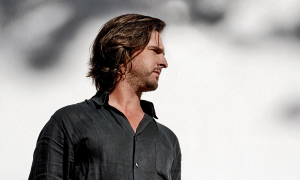
Home » Jazz Articles » Interview » A Fireside Chat with Evan Parker
A Fireside Chat with Evan Parker

I am very interested in finding out where those lines are and sometimes moving them. Too much is never a thing that worries me. I am not really a minimalist.
All About Jazz: Tell me about your involvement with the Spontaneous Music Ensemble.
Evan Parker: The core members of that group were John Stevens, Trevor Watts, and Paul Rutherford. They had met when they were in the Royal Air Force, stationed in Germany. Each of them joined the RAF as a way of studying music. It was one of the options that people used in those days. Also, conscription was still enforced. I'm just slightly younger than they are and so I missed that, but they were all old enough to be included, so I think their logic was that if they were going to have to be soldiers, they would be soldiers playing an instrument. That was how they met and then when they came back to London from Germany, they stayed in touch and formed the SME, the earliest version. I came onboard something like '67. It was a strange transition then because they had been working with notated materials, the usual forms of theme and variations on the theme. Some were cast in the mold of Ornette Coleman type material and some things sounded like George Russell's work and some things sounded a little bit more like Eric Dolphy perhaps. But in a way, you could hear clear models, well stylistic traditions for the notated material that they were working with. I came into that and it gradually changed into a thing with no fixed material. In a way, that fitted the idea of Spontaneous Music Ensemble better than the original material. In fact, the earliest form of the Spontaneous Music Ensemble was not really playing what we now think of as classic SME music, which was then derived from that second phase of working without themes.
AAJ: The perceived school of thought in the States is that European improvisers are coming from European classical music like Stockhausen and Berg rather than "traditional" jazz models, which is clearly not the case.
EP: That is absolutely the case for almost everyone of the players that I can think of from that so called first generation, apart from Cornelius Cardew, who was a member of AMM from around that same time and Cornelius' background was in classical music and in composition studies from a conservatory background. Later, I suppose it could also be said that Gavin Bryars had a foot in both camps. As far as I know, what made Gavin Bryars interested in playing the bass was Scott LaFaro. There were probably clear hero figures from that generation of American jazz players for everyone. The fact that we were also listening to Boulez and Stockhausen and Webern is almost incidental.
AAJ: That being said, how influential were records coming out of the States on new music labels like ESP?
EP: Well, yeah, the ESP records that I remember were obviously the Albert Aylers, but also a little mentioned record is the Giuseppi Logan, which may be more important for me for the interplay between Milford Graves and Don Pullen. Then the duo records that Don Pullen and Milford had made. Yeah, there was a bunch of stuff from musicians that we first heard of in association with ESP. Not everything that was on ESP was relevant, but I think some of those musicians were very, very pertinent.
AAJ: Certainly, there must have been something in the water for that many musicians from the SME to have gone on to become the vanguards of the music.
EP: Yeah, I think that is a reasonable thing to say when you look at the second record that the SME made. The first record with the open improvising that is characteristic of that group, well, Dave Holland, Kenny Wheeler, Derek Bailey, myself, and John Stevens. If John were still alive, he would still be playing. Everybody else is still alive and still playing and somehow made a life for ourselves in the music. That speaks of the commitment I suppose and the attention behind those early statements.
AAJ: Through the years, you have had a close association with Paul Lytton.
EP: I met Paul under very strange circumstances at the Open Air Festival in Birmingham. I was playing with John Stevens in a duo. At that point, the SME in live situations was a duo. In fact, the band on Karyobin (Kenny Wheeler, Evan Parker, Derek Bailey, Dave Holland, John Stevens), I don't think ever did a live gig. It was conceived for the record between John and myself. At that point, the SME in a live situation was a duo between John and myself. We played opposite a big band, which still exists, called the National Youth's Jazz Orchestra, which represents the conventional route for aspiring young jazz musicians. That is the pinnacle of their aspirations, in the sense that it is very rigorous. You have to read very well and you have to improvise very well to get into that band as a young player. Paul Lytton, I think, was the second drummer. As a young man, he was the second drummer in that band. Obviously, he had reading chops and the conventional jazz chops to be playing in that band, but at the same time, he was interested in what John and I were doing. So he came over and talked to John and to me and we stayed in touch. We started to make rehearsals. I think we rehearsed for about a year before we gave our first performance together. Yeah, we have collaborated on different things ever since.
AAJ: And many of those recordings are being released on your Psi label in conjunction with Emanem, Martin Davidson's label.
EP: Yeah, the thing I call Psi is my label. Martin is responsible for all the administrative side of the label. The musical content and the decision about the releases is entirely my province and Martin is very supportive of that.
AAJ: You have released eight titles.
EP: It is eight. One has come out since I have been away. Martin sent an email to say that the eighth one is out now and there will be several more this year. I can't say exactly how many, but it could be as many as four or five.
AAJ: How extensive do you plan on making the Psi catalog?
EP: The old historic stuff, there are piles of them. That is not what the label is about. It is at least as important to me to do new things as to put the old stuff out. But we are trying to do both things in a balanced way.
AAJ: Lines Burnt in Light, one of the initial Psi releases is a testament to that.
EP: I was very pleased with that one. I think it took less than a month to get it out, from the time it was recorded to the time it was released. Then I became very excited about working with Martin because he can be incredibly efficient. I am not always fast enough to keep up with him. He is an amazing character and the way that he can work on projects and his own label, Emanem, is great evidence of what I am saying.
AAJ: What is the Psi release schedule for the remainder of this year?
EP: There is a double CD from a festival that I play every year in England. It's in the north of England in a place called Appleby. Certainly, in time for this year's festival, the double CD from last year's festival will be out and that is combinations of eight musicians, myself plus Sylvia Hallett, violinist and she also sings on that, Phillipp Wachsmann, violin, John Edwards, bass, Mark Sanders, percussion, Marcio Mattos, cello, John Rangecroft on clarinet, and Neil Metcalfe on flute. There is an octet piece, a string quartet piece, a quartet by the other players, and a sequence of duos, trios, and solos. I think Sylvia Hallett has a solo. It is very representative of the concert that I was very happy with. That will be one thing. Then I am working on a Ray Warleigh record with Ray. Ray is a fantastic alto player that is totally under-recorded, something equivalent to the Gerd Dudek record stylistically and the motivation behind it was coming from the same place in my mind. There are certain people that have been horribly under-recorded over the years and however, symbolic my efforts are, they do, at least something, to rectify that situation. We just finished up a Kenny Wheeler project. It has taken about nine visits to the studio and Kenny is very critical of his own work. I think we've got something now that he won't admit to being happy with, but at least he is not unhappy with it. I think it is one of the best things he has ever done. There might be a reissue, also some Kenny Wheeler material from the past. We're talking about that. I've got different projects from visits to Japan. There's an electro-acoustic quartet with Paul Lytton, Joel Ryan, and Lawrence Casserley. There's a big pile of material there that I am very happy with. And then there is concert from another visit to Japan where Otomo and Sachiko M. played at the Pitt-Inn in Tokyo. I would like to see that come out. There is really plenty of stuff there.
AAJ: Is there a line that improvised music can cross where too much electronics is employed?
EP: I am very interested in finding out where those lines are and sometimes moving them. Too much is never a thing that worries me. I am not really a minimalist. In fact, the full scale Electro-Acoustic Ensemble has a third release finished for ECM. I am hoping it will be released in the fall. It has been finished since sometime earlier this year. We have to wait and see how ECM times the release of that. The best indications are they are thinking of possibly before the end of the year.
AAJ: Manfred Eicher's label has become the standard for independent labels of my time.
EP: That is true. They are still independent in the sense that Manfred Eicher retains complete control over the output and over all the decisions that affect the company. He has not last any independence at all. He has been incredibly successful and very determined to hold onto everything and he has protected it very skillfully. I've known Manfred since before ECM even started. He was a freelance producer before he started his own company and I met him then. We stayed in touch and on good terms ever since. The fact that Steve Lake also works there are the producer responsible for the Electro-Acoustic Ensemble, the relationship with Steve goes back very many years. When there is an understanding between people, it just becomes more rewarding to stay in touch and to stay working at things. Maybe this brings us back to that first question or one of the early questions you asked, Fred. When you sense that other people are in it for life, you can work with them. You know the degree of commitment is there.
AAJ: Having been a member of Chris McGregor's Brotherhood of Breath, you played alongside Louis Moholo, but even the Brotherhood of Breath's eventual conclusion, you have collaborated with him on numerous occasions.
EP: We do projects together and we play pretty much, not every month, but we do six or seven concerts a year with a small group in a particular club in London. I know we both value very much the opportunity to get together. We're different people, but we are also very similar people. Louis is fantastically committed to free playing. He has a brilliant spirit and a brilliant personal approach to it. I didn't met him before he went to South America with Steve Lacy, Enrico (Rava), and Johnny Dyani, that famous trip where they all got stranded somewhere in Argentina or somewhere (Forest and the Zoo), but I met him when he came back and we've stayed in touch since then. We've played together, obviously, in the Brotherhood of Breath and subsequent to the death of all the other guys in that band, we've stayed together to make the Dedication Orchestra projects and even the reunion of that, which we've just done a tour in England. The last word I had of him was by email from Steve Beresford to say that Louis wants us to go to South Africa with the Foxes Fox project. Yeah, that is another friendship which is alive and working.
AAJ: Friendship brings to mind Alex von Schlippenbach, who you feature in the trio along with Paul Lytton for this extensive North American tour. Does it ever get old?
EP: That's right. Well, there are those two schools of thought. One, which is that somehow you need constant new relationships with new musicians, unknown factors in the music, in order to keep the improvisations fresh. But I think, although I value that kind of meeting, new people, obviously, there is a lot of excitement in that, but there is also great benefits in working with the same people. We have now come to the end of this five week period with Alex and Paul, but when we go home, we may not see one another again until the end of the year. So it is not like you are playing every week with the same people. It is just that when you stay in touch with certain people and you play every year, concerts after concerts, then, of course, the understanding gets tighter and the communication gets more rapid and more intuitive. The level of understanding grows. I think that is a natural development and for me, it is an interesting part of the mechanisms of free improvisation.
AAJ: Critics always pine for the "golden age." In free improvisation, such a "golden age" is perceived to have passed with Albert Ayler and the extinction of the loft scene.
EP: I think we are starting to see a kind of maturity coming into the music, which was there with rough edges at the beginning, but whether you analyze the playing of individuals. The proliferation of solo recordings makes it possible to look at the way each individual has developed in their relationship with their own vision and also the way the approach to group music has evolved. I think what we are seeing now is a more mature music that comes out of those processes of evolution and refinement and it will continue in that way. If you take the golden age to be that point in time where the basic assumptions were made or the fundamental connections between the key people were made, then of course, there was a golden age. But by defining it in those terms, you've automatically ruled out the possibility of now being considered in those terms. What was missing then was that refinement and that evolution, which was inherent in that nexus of time and place and people.
AAJ: The confounding thing about being an Evan Parker aficionado is one could very well be out of house and home attempting to purchase all your recorded documents. And my head would explode thinking just how many bootleg recording of live concerts could be released as well, much like that of your recent North American tour.
EP: (Laughing) Well, the background to the rather serious multi-track recording, comprehensive recording that we've been doing was actually with the idea that Barry Guy should have made this tour. That was the original plan. It was Parker/Guy/Lytton that was to do this tour and for personal reasons, Barry was unable to make it. The plan to record was in association with Maya Recordings, Barry's own label, and some sort of hook up between Maya and Intakt. They wanted to make a very extensive document to mark the whole tour in some rather extravagant way. So we stayed with that plan, but I don't think we can stay with such an extravagant idea. I'm not sure quite what the situation is as far as those recordings. Certainly, we will make one program for the BBC and I am sure there will be one CD from it. It might be a double CD. It really depends on how the material we've got strikes us. Of course, in some places, the pianos were not of the highest quality because very short notice and people that were expecting a group with a bassist had to find a piano. That may be also a factor which limits the appropriateness of using some of the recordings, but we were fortunate in several places there were perfectly good pianos and we have some very good recordings.
AAJ: You are forever young.
EP: (Laughing) I look at the generation of players, is Cecil Taylor old? Technically, maybe his birth certificate says a number, but when he jumps on that piano, what are you hearing? Are you hearing age or are you hearing a vision that is sharper and sharper and more refined? I am looking at that. To me, Fred, it is getting better. Of course, I am getting older, but the music is getting better.
< Previous
Four For February
Comments

About Evan Parker
Instrument: Saxophone, soprano
Related Articles | Concerts | Albums | Photos | Similar ToTags
For the Love of Jazz
 All About Jazz has been a pillar of jazz since 1995, championing it as an art form and, more importantly, supporting the musicians who create it. Our enduring commitment has made "AAJ" one of the most culturally important websites of its kind, read by hundreds of thousands of fans, musicians and industry figures every month.
You Can Help
To expand our coverage even further and develop new means to foster jazz discovery and connectivity we need your help. You can become a sustaining member for a modest $20 and in return, we'll immediately hide those pesky ads plus provide access to future articles for a full year. This winning combination will vastly improve your AAJ experience and allow us to vigorously build on the pioneering work we first started in 1995. So enjoy an ad-free AAJ experience and help us remain a positive beacon for jazz by making a donation today.

Giveaway

Days remaining: 3