Home » Jazz Articles » Profile » Evan Parker: Solo
Evan Parker: Solo

It's an absolutely untheoretical music but there are a lot of theories about the lack of theories.

As jazz has developed since its inception, it has always centered on individuals working with each other. Over time, the music unit has gotten smaller, from the big band era to the time of small combos and the modern era where solo performance has flourished. What was first only the province of the piano has come to include innovators on virtually every instrument. The saxophone, be it in the hands of Steve Lacy, Anthony Braxton or Roscoe Mitchell has proven itself a worthy contender. During an interview with English reedman Evan Parker, he makes the bold claim that "The limits seem only to come from the player, the player's imagination and the player's technique."
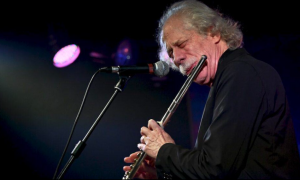
This month, the Metropolitan Museum of Art (as part of an annual concert series of over 50 events of classical, jazz and world music), will present Parker, one of the modern pioneers of the soprano saxophone, in solo performance. This will be in conjunction with the final stop of an exhibit tour of German photographer Thomas Struth. Parker's appearances in the US are special events, particularly in the context of a genre he helped create.
Evan Parker's career began in the fertile period of mid ‘60s London. Drummer, bandleader and free jazz übermensch John Stevens' Little Theatre Club played host to most of England's first free improvisation generation. Parker met Stevens, played in duo with him and later became a part of the legendary Spontaneous Music Ensemble group that at one time or another featured bassist Dave Holland, trumpeter/flugelhornist Kenny Wheeler and reedman Trevor Watts. Numerous associations developed over the period of 1966-1967, including groups with trombonist Paul Rutherford, guitarist Derek Bailey and bassist Barry Guy.
It would be a few years later that Parker began his work in a solo context. "You know I was very keen on the distinction between improvisation and composition at that time, consequently I've come to realize it was a false kind of distinction, but for me the special problem was to distinguish between solo improvising and composing, precisely because it was one mind at work and none of those qualities of group improvisation. But subsequently I've come to think rather differently about the whole thing. I don't think it’s accurate to speak about an improvisation as something different from composition...it’s more accurate to speak of it as opposed to notated music.”
The groundwork for solo improvisation had already been laid and it was from previous examples that Parker would forge ahead. "You have to relate, make a coherent line for yourself. You can't just be bouncing ideas around with somebody else - you have to generate something which starts, develops and ends and there is specific challenge to that...the big attraction is you have all the space. Not only do you have all the responsibility but you have all the space, the acoustic space. And some things really come out of doing, certainly in my approach to solo playing from very specific response to the specific acoustics and specific resonances of a given space."
For all its history, most listeners have probably had little exposure to solo playing which, it must be stressed, is vastly different from playing solos. The musician is responsible for the structure that is already in place when a person plays a solo over a set of changes with a band accompaniment. Parker's solo work is dense and hard to fathom the first time one hears it. There seems to be so much going on. Parker explains: "I try to give them a sense of dialogue with myself anyway, you know the way I move lines around in the overtone structure against lines in the lower register of the instrument. There is still some sense of a dialogue in the music but it’s just one person speaking to himself. Solo improvising should be a good introduction for listeners who are not so familiar with players. It's a way to understand the approach of a given player that might feed through to the way they approach group playing."
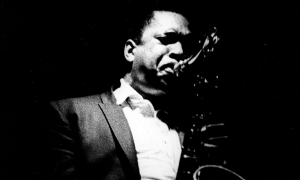
It seems so logical that a person must adapt to playing in a group but, since most musicians play solo infrequently, the listener can only imagine the internal process. Though the average person can easily identify a Coltrane solo, to gain insight into what his own personality brought outside of the contributions of the rest of the group is near impossible.
Parker quantifies this concept as such: "For me the art of collective improvisation involves finding the appropriate elements from your approach for that given situation and being ready to involve new elements for that approach in response to people that you've never played with before. So, it's not a matter of simply going in there and being myself regardless of context. There should be a sense of self or a sense of self as musician, which is flexible enough to generate slightly different - or very different depending on the context - music, according to whom I'm playing with. That was brought on to me very early. I was playing this very delicate, atomistic music with John Stevens in duo when I was invited to play with [saxophonist] Peter Brötzmann for the [1968] Machine Gun thing, which was absolutely the opposite: very robust and loud, energetic, and not so delicate. It was like a baptism of fire in that sense for me that I'd go ‘okay this is a whole other approach to improvising, I'd better think of something different to do in this context.’ Having dealt with those two extremes was a good early training or early experience for me to know that an essential part of an improviser's arsenal is flexibility.”
Part of Parker’s flexibility is his work, not only with the creative side of music, but with the business side. He, Derek Bailey, and drummer Tony Oxley founded the record label Incus in the ‘70s, releasing much of the music created in the vibrant European scene. He has now reembraced this idea with his new label Psi, a collaboration with Emanem Records. He releases his own solo work, partnerships with percussionist Paul Lytton, trombonist George Lewis and drummer Han Bennink, as well as a rarity: an album led by saxophonist Gerd Dudek. Parker cannot understate the importance of recording: “I've always encouraged other musicians to document what they do as soon as they can because this is the only way you exist in a bigger community. Of course in the town where you live and play, okay, you can function without a record maybe, but in order to make contacts and travel further afield, which is essential if you want to survive as a musician doing this kind of music exclusively, then you really must have documentation...It seemed that the only way that we could be sure of maintaining a process of ongoing documentation was to take control of it ourselves.”
Though the arguments about the validity of free improvisation continue, despite its rich history over the past 40 or more years, mainly by proponents of the retro-mainstream style that accumulates most of the listeners, funding and critical praise, Parker is not discouraged. "We're actually on a cusp or a watershed in that respect. If the more instrumental approach, the more expressive approach is gradually succeeded by the PowerBook players and the very quiet players, you'd have to say it has evolved into something else or it simply died out depending on the way those successors choose to represent their activities. I think there are enough people playing in what you might call a ‘straight ahead free way’, that's a very clumsy term, to guarantee the life of the music for a good while yet...I think the rewards of playing the music are such that people will always come into it. Whether the style of the music or the way of talking about the music or the way of theorizing about the music stays the same I don't know. It's an absolutely untheoretical music but there are a lot of theories about the lack of theories.”
Tags
PREVIOUS / NEXT

Become a Sustaining Member

Since 1995, All About Jazz has championed jazz as an art form and supported the musicians who create it. Over three decades, it has grown into one of the world's leading jazz resources, serving hundreds of thousands of readers, musicians, presenters and industry professionals each month.
Help Build the Future of All About Jazz
Your support helps us continue building All About Jazz for the next generation—expanding our editorial coverage, preserving jazz history, developing new community features and creating better ways to discover the music and the people behind it.
Become a sustaining member for as little as $20 per year and you'll immediately enjoy an ad-free experience along with access to subscriber features and future articles for a full year.
Together, we're not simply sustaining All About Jazz—we're building its future. Thank you for being part of the journey.