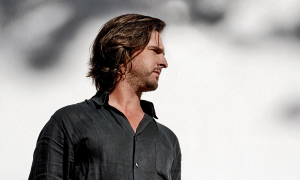
Home » Jazz Articles » Interview » Dom Minasi: A Matter of Time
Dom Minasi: A Matter of Time

When I play live, it's like a bomb went off: people with their mouths open and their hair up in the air. I had to learn how to cool it a little.
—Dom Minasi
 When Dom Minasi steps away from his intense schedule of composing, writing, teaching, recording and performing and pauses long enough to talk — and even then the pace doesn't slow: the guitarist's sentences arrive in a relentless, stream-of-conscious barrage, full of names, anecdotes and ideas — he seems to dwell on two words above all others: 'in' and 'out.' To Minasi, however, they're not just prepositions. They also double as adjectives.
 In jazzspeak, being 'in' or 'out' has nothing to do with the right social clique; it has everything to do with musical time. To be able to play 'out' is a skill that is no less than admirable, because it means a jazz musician is able to maintain the rhythm of the piece while playing across the beat and barlines. Dave Brubeck is likely the most familiar example of one who has found something worth pursuing when it comes to quirky time signatures and being in, out and even further out. Less well known himself (for reasons that should soon be evident), Minasi has made little secret of his own fascination with musical time and the ways he can follow, defy or reinvent it. In 2001, he gave several Ellington charts a highly unconventional treatment on Takin' the Duke Out , transforming "Satin Doll," for example, into a distant harmonic cousin of the original (and a rather skittish one at that). A year later, he brought a new interpretation to four other standards - Monk's "Well, You Needn't" and Johnny Mercer's "Autumn Leaves" among them - alongside several self-penned compositions on Goin' Out Again. As their titles suggest, these albums were 'out' in terms of both spirit and execution.
They were also the confirmation that Minasi, who had returned to the studio after nearly two decades of what his promoter calls "self-imposed exile" for 1999's Finishing Touches , was back for good. Listeners and critics alike greeted the all three of these albums as bold, adventurous, controversial. Minasi was likewise flattered with frequent comparisons to Trane, Cecil Taylor and Eric Dolphy.
"When they talk about guitar players, they don't compare you to [non-guitarists]," says the native New Yorker in his telltale accent. "They were the biggest influences in my life, including Cecil Taylor. My early albums reflect the Cecil thing, but when I was younger, I was fortunate enough to hang out at the original Birdland on 52nd and Broadway. They had a peanut gallery for kids. You could go in and have a Coke and watch the greatest jazz players in the world." While he took in these triple-header all-star sets, carefully amassing the variegated influences that would shape his playing, his parents thought he was at the movies.
Minasi shrugs off any implication that his intent on Finishing Touches was to shock: "I just did what I did and all these reviewers were calling me controversial and daring." Far from being a jaw-dropping comeback, the album was just supposed to be just a one-off, a means of proving to himself that he could do it and to stop friends from nagging him to record. But the response was too positive to ignore. It was so good, in fact, that he thought Finishing Touches merited a follow-up: Takin' the Duke Out.
"I expected The Duke to get killed," he says. "And it didn't." This confession leads (or rockets, considering Minasi's auctioneer's speech) into a historical anecdote about Roman chariot drivers. Upon returning victorious from battle, parading through streets packed with cheering crowds, they invariably had someone stood beside them to keep their egos in check. "Remember, you're just a man," whispered the individuals appointed with the task of humbling into the chariot driver's ear. Minasi says he was never allowed to forget his humility, no matter how favorable the reviews were. "My wife would say, 'Remember, you're just a player,'" he laughs, adding, "Of course, when you read a bad [review], you can really get sucked into it."
The negative press, on the rare occasions when it did appear, could hardly discourage him from pushing ahead. As we settle into a new year, Minasi is preparing to release Time Will Tell , his fourth full-length since his return to the recording scene in the late 1990s. Much more accessible and overtly melodic than its immediate predecessors, the record is arguably the guitarist's best to date. It brings together old and new partners in a collaborative effort dubbed DDT+2: Dom, bassist Dominic Duval (who, oddly, does not appear on the album: "DDT played a lot of in and out music," explains Minasi, "but Dominic wanted to play freeform. He moved on, plays with Cecil [Taylor] now and is very happy") and cellist Tomas Ulrich, as well as bassist Ken Filiano and drummer John Bollinger (the last being the +2). There is also a third, 'un-acronymed' collaborator, Dom's wife Carol Mennie, an actress and singer who lends her vocals to the ubiquitous Monk standard ''Round Midnight.' Incidentally, but worth noting for the sake of clarity, the first-name acronym is a habit of Minasi's that crops up as much as the words 'in' and 'out' - viz. his own independent record label CDM (Carol Mennie, Dom Minasi), or the Time Will Tell track "DMP" (Dom, Marco Katz, Peter Weiss, an incarnation of an earlier trio).
Despite its more commercial, non-specialist appeal, the latest album continues in the free and avant-jazz mold. "People around me have told me it's not that in," says Minasi, quickly noting that 'in' and 'out' are not necessarily interchangeable with 'harmony' and 'cacophony.' "I have a lot of friends who are making albums we would call non-accessible. This is a very out album, but it's very accessible even though it's out. It's all free form. Out music can be very accessible." Hinting that the stigma attached to free jazz might derive from something else, he continues, "Some of these guys are making noise. They're not listening to each other. It's not coherent. Everything I play, whether it's atonal or freeform, is coming from a harmonic point of view. I'm always thinking in chord changes. If you're making music, you have to come from that place."
 Making music — that is to say, collaborative, passionate, enduring music — was the overarching concern during the Time Will Tell sessions. Minasi would appear to be the bandleader in name only. As the part-militaristic, part-swinging rendition of the Wayne Shorter chart "Witch Hunt" goes to show, he is content to let Ulrich spend a considerable amount of time in the spotlight. Likewise, the title track, a composition Minasi wrote in the '80s and just receiving its first recorded treatment, highlights Ulrich's skill and delicate, compelling bowing instead of acting as a vehicle for its composer. "These guys, when they play together, they're like an orchestra," says Minasi. "And I'm not gonna use them? It's not about me. It's about the music. This record is about my writing, my arranging. It's about a group sound. And I wanted to do something really different."
For Minasi, doing things differently doesn't just mean doing things differently from everyone else. It also means upping his personal ante. Since distancing himself from Blue Note in the mid-'70s, he has been going about his life and career altogether differently. Those in need of proof can simply examine the flipside or spine of Time Will Tell and take note of the record label.
CDM Records represents an entrepreneurial approach to making jazz albums that proves the support of a rich, powerful benefactor isn't essential to distributing quality music in an attractive package and getting it heard. And it's an approach that developed in direct reaction to the terrible major label experience with Blue Note that drove the young guitarist away from the studio for seventeen years. Of course, one might point out that Blue Note by that time was no longer really Blue Note. The death of the label's founder, Alfred Lion, enabled it to be subsumed by the much larger United Artists. This series of events ultimately led to a company with a resource it didn't know how to correctly appraise. Thus Minasi's two early albums from this period, When Joanna Loved Me (1974) and I Have the Feeling I've Been Here Before (1975), have become a source of amusement, anger and embarrassment for him. He describes the aftermath with typical New York City bluntness: "I had a very sour taste in my mouth. It was the whole experience of the second album - and, actually, the first album too. The first I wasn't happy with, but that was my fault. I used friends."
I Have the Feeling I've Been Here Before was by all accounts an egregious, stereotype-substantiating instance of an ignorant corporate label meddling with its artists. "They gave me this Hollywood studio orchestra and these lavish arrangements. When I soloed, I tended to go out, and they took it out in the mix." They wanted jazz music, but commercial, watered-down jazz music. It was indeed a case of déjà vu. Minasi had had this same experience just a few years earlier: "After high school, I became a full time musician, and the first group I played with, the guy said, 'You play too far out.' You gotta remember, I was hanging out at Birdland. This is how I thought everybody played. I had to relearn how to play tonally, or inside."
Surprisingly (or not, considering how much effort had gone into making I Have the Feeling... docile and anodyne), the radio stations adored it. "Oh, I got tons of radio play. The record was the top played record in college radio stations throughout the country. But you couldn't find an album anywhere, not even in New York." Airplay but no availability. Red carpet treatment but no creative license. He'd had enough.
"I was not interested in the business of jazz," says Minasi. Though that didn't prevent him from giving it one last shot before retreating. "I did meet a couple people in the record business, and I was all ready to go with Mercury. And then they started to tell me how to play..." Frustrated, he ran through the door and tried bolting it from the outside. The suits could keep their cash and their fancy studios. He'd never set foot in that space again, not if it meant becoming a part of that manipulative, greedy, awful machine. And with that decisive action, he traded a life of potential fame under someone else's thumb for a life of complete independence and total anonymity. Hence his protracted disappearance from the public eye.
On the bright side, however, Minasi's long hiatus gave him plenty of time to compose. "The time wasn't wasted. I didn't do a lot of jazz gigs in the '80s. I got my chops together and I wrote a lot of music. You wouldn't believe how much music I've written. My drawers are filled with music, and I'm always writing more. I love to write and I love to compose. The reason why I'm like that is... The guy who did it all for me was Roger Kellaway," a pianist whose résumé features stints with Zoot Sims, Bob Brookmeyer and Kai Winding, not to mention the theme music to the popular TV sitcom All in the Family. During one meeting, Minasi watched in disbelief as Kellaway sat down at the piano and produced a complex new composition in a few minutes. "I just stood there with my mouth open. I went home from that and started writing and writing and writing."
Some time later Dom went with his wife to see a Broadway production entitled Red Shoes. "One of the lines in there, the producer says to the composer, 'Why are you composing on the piano? If you get away from it, it opens it all up.' It was one of those moments where the light goes on. I said, 'I'm not composing with the guitar and the piano anymore. All my music I'm going to write in my head.'" This might partly explain why Minasi's guitar playing doesn't evoke comparisons to other guitar players, in contrast to the way, say, Biréli Lagrène can be likened to Django. Minasi himself admits to making an earlier conscious effort to steer further away from fellow guitarists. "I had all these major influences. I was influenced by Chuck Wayne, Jimmy Raney, Wes Montgomery. One night my friend would say to me, 'You sounded like Jimmy.' The next night he would say to me, 'You sounded like Wes.' I said, 'That's it, no more guitar players.' I just stopped and I started getting into horn players." As if to bear this assertion out, Trane and Dolphy get due credit on Time Will Tell with the homages 'John' and 'Waltz for Eric.' Minasi even took advice from a vibraphonist, Harry Shepherd. "Harry could play in, out, anything, and it was always amazing. I said, 'Harry, how do you do this?' He said, 'Every night is Carnegie Hall.' I haven't had a bad night since."
Contrary to easy assumptions, the post-Blue Note years were not lean ones. "I made a good living," says the guitarist with a hint of pride. He taught. He performed now and again. He developed workshops for children. After dropping out of school when he was younger, he returned to get his degree. "But my friends kept saying, 'Oh, you gotta do this. You gotta record.'"
So he did, marking the first step toward where he is now. "I started to get some really nice reviews. It put me back on the map. I started to get a very funny feeling, so I said, 'Let's bring in our own people and start our own record company and let's do it." Six months later he was booked for a gig at NYC's Knitting Factory. He decided to record and release the material from the performance. "Whatever was there was there. We didn't edit anything. And I said this would be it. This would be the end of my recording career forever."
"You have to give it up in order to get it," he says with an air of sententiousness. "I wrote, played practiced and taught, and the minute I said I'm not interested in being a star ... that's when these things started to happen."
Now that CDM Records has more or less established itself on its founder's strength, Miansi has mental flip chart diagramming where intends to go from here. Foremost, he means for the label to form a sort of jazz collective, rotating musicians on and off one another's albums, sometimes leading, sometimes supporting, but always under the CDM umbrella. He also anticipates that the freedom from dependency on a major label will enable him to genre-hop, moving from 'in' and 'out' jazz music to traditional vocals, and perhaps even neo-classical. "I do everything. And I've got a plan. I'm 60 years old and I've got to get this plan going."
This is why such high hopes have been pinned to Time Will Tel l. It has the potential to be an extraordinary landmark in CDM's history and Minasi's ambitious scheme. Because of the album's greater accessibility — especially in comparison to Takin' the Duke Out and Goin' Out Again — it could draw more traditional, "tonal" (or "in," as Minasi might say) listeners to the CDM catalogue and the ideas behind it. "It might lead them down the path to the other stuff," he says. "My wife is a very tonal person. It took her years to start to get it."
Nevertheless it may also have its drawbacks. "All the out guys are gonna put me down. And all the in guys are gonna put me down. I can't win," Minasi grumbles in mock exasperation. "The thing with New York is, you get kinda like boxed in. You play out, and you're an out player." When he shopped some earlier DDT material around to record companies, he ran headfirst into the apprehension caused by deviating from his assigned category. "They just would always say, 'Where's the drums? What is this? This is, like, chamber music.'" He cites saxophonist Joe Lovano as someone who's managed to skirt pigeonholes, jumping as nimbly as he does from Sinatra to opera interpretations and then on to Latin jazz with bassist Charlie Haden. What matters to Minasi is tapping into every compositional urge. If it happens to be commercially successful, he considers it a pleasant bonus.
"I needed to reinforce that I can do that. They were putting down Jimmy Bruno. He said, 'It's my speed that got me signed to Concord. It's just that I have to play fast to play what I want to play.' People were taken aback by the speed I have. When I play live, it's like a bomb went off: people with their mouths open and their hair up in the air. It made them take notice. So now I can slow down. I had to learn how to cool it a little."
"I'm just trying to expand on everything I do," he continues. "I have charts on an organ trio. I have charts on a quartet and quintet that I haven't done yet. I have, like, 50 arrangements with guitar, bass, cello, drums. Now that I have my own label, I'm going to be putting out an album every year - or two, one for my wife and one for me. The next thing will be my wife. That's why I wanted to put her on this record and introduce her voice to the audience. We've been working together for 12, 13 years. I have more music for her than I have for the group."
His voice swells with a rush of excitement. "I already wrote the music for the next one, which is going to be further out than anything I've done. Around September we're going to release an all-vocal album with four or five original tunes" on top of "a trio thing which is out there, but then I'm going back with Carol and putting out something really accessible." All this preparation for future projects is taking place as Minasi launches Time Will Tell , lays the groundwork for U.S. and European tours in support of the album, and finishes an essay entitled Rules of Engagement? No. Why Not Rules of Harmony? .
"The American people have accepted rock 'n' roll, but they really haven't accepted jazz," he reflects toward the close of the interview. If Minasi has his way, he'll write, perform, record and distribute the music that will realize that acceptance. It's only a matter of time.
Click here to visit Dom Minasi's official website.
< Previous
Best of 2003
Comments

Tags
For the Love of Jazz
 All About Jazz has been a pillar of jazz since 1995, championing it as an art form and, more importantly, supporting the musicians who create it. Our enduring commitment has made "AAJ" one of the most culturally important websites of its kind, read by hundreds of thousands of fans, musicians and industry figures every month.
You Can Help
To expand our coverage even further and develop new means to foster jazz discovery and connectivity we need your help. You can become a sustaining member for a modest $20 and in return, we'll immediately hide those pesky ads plus provide access to future articles for a full year. This winning combination will vastly improve your AAJ experience and allow us to vigorously build on the pioneering work we first started in 1995. So enjoy an ad-free AAJ experience and help us remain a positive beacon for jazz by making a donation today.

Giveaway

Days remaining: 3