Home » Jazz Articles » Album Review » Peter Parcek: Most Of The Time
Peter Parcek: Most Of The Time

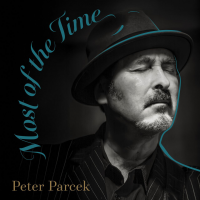
In fact, as demonstrated on Most Of The Time, this native of Connecticut—who moved to England in the Sixties just in time for the blues boom to echo throughout the British Isles—may very well suffer for an embarrassment of riches; the surfeit of considerable talent at his disposal renders moot the blemishes pockmarking this 78-minute-plus album.
Accordingly, it is really not so execrable a sign of misappropriation that Parcek would claim "Twistified" as his own song. While it is true Blind Joe a/k/a Arthur Reynolds wrote its apparent source material, "Outside Woman Blues," but the same number was also commandeered by Eric Clapton as the basis for a cut of the same name as well as "Lawdy Mama" (credited as a traditional)on Cream's sophomore studio outing Disraeli Gears (Atco, 1967). The history of this number's lineage then only adds to its durability, not to mention its fitting familiarity as this LP's opener.
Quite apart from antecedents including Howlin' Wolf and John Lee Hooker, "How Many Times" ripples with echoes of blues standards aplenty too. Nevertheless, the premium sound here, produced by the front man and Patric DiCenso, not only distracts from any suspect precedent, but also supplies ready immersion in a rare depth and presence of audio (for which Doug Krebs deserves great kudos in preserving with his mixing).
More effective, more direct and far more poetic than the both of those selections is this supremely nuanced take on Bob Dylan's "Most of the Time." Little wonder it was designated the title of this LP: Parcek channels the emotional and intellectual shading of the tune with his finely-etched guitar work, while his singing carries the quietly wry self- awareness at the heart of the Nobel Laureate's composition.
Likewise, the take of "I Don't Worry 'Bout A Thing." Mose Allison's statement of personal policy continues the deceptively confessional theme in such a knowing way, it sets up the catharsis that comes through the rollicking, horn-accented instrumental "Just Play Rhythm, Baby." It is at this point that the album begins to develop tangible momentum. The insertion of John Hiatt's "Mississippi Phone Booth" suggests a Parcek album comprised exclusively of material from contemporary sources.
As this astute cover further evolves into a graphic point of reference, it is immediately followed by an Elmore James co-write, "Stranger Blues." The deeply haunting nature of that piece permeates the performance and spreads into its surroundings.
Thus, in a tangible sign of the continuity emerging from the baker's dozen cuts of Most Of The Time, the words of "Poor Boy" carry a similarly ghostly air, a foreboding atmosphere that also (more obviously) pervades "When I'm Dead & Gone." Accordingly, so joyously rendered as is yet another instrumental track, "Cold In Hand" seems out of place, the thought arises that Parcek should consider assembling an entire LP of such numbers (or should have reconfigured this effort into a double album) .
The esteemed guests that contribute to the former—North Mississippi Allstars co-founder Luther Dickinson on guitar and long-time Willie Nelson harmonica player Mickey Raphael—would surely relish participating in such a project. And it is further notable that the two bonus tracks on this Lightnin' Record, "Lord Help The Poor & Needy" and Freddie King and Sonny Thompson's "Swooshy," also arrive sans singing, consequently resounding of their own accord.
The core ensemble present on this record would likely acquit themselves equally stylishly on any Parcek project. Keyboardist Tom West, bassist Marc HIckox: and drummer Tim Carman present themselves as a most formidable unit throughout and never more so than when they, alone with the bandleader, tear through a smoldering rendition of Mississippi Fred McDowell's "61 Highway."
Shimmering electric piano decorating this subdued interpretation of Bill Withers' touching tribute to "Grandma's Hands" makes for a quietly dramatic punctuation as the last formal cut track of the album. Its placement, not to mention the delicacy of its musicianship, embellishes the virtues of Most Of The Time.
Personnel

Peter Parcek
guitar
Duke Robillard
guitar, steel
Luther Dickinson
guitar, electricKevin Barry
guitar
Mickey Raphael
harmonicaMarcos Anthero Silva
harmonica
Mark Earley
saxophone, tenorDaniel Kellar
violinMarc HIckox:
bass, electricDominic John Davis
bass, acoustic
Tim Carman
drumsSteve Scully
drumsMarco Giovino
drumsDanielle Miraglia
vocalsAdditional Instrumentation
Peter Parcek: vocals; Kevin Barry: lap steel; Tom West: Hammond B3, Fender Rhodes; Mark Earley: horn arrangements; Dominic John Davis: acoustic bass; percussion; Steve Scully: loops; Marco Giovino: percussion.
Album information
Title: Most Of The Time | Year Released: 2026 | Record Label: Lightnin' Records
About Peter Parcek
Tags
PREVIOUS / NEXT

Become a Sustaining Member

Since 1995, All About Jazz has championed jazz as an art form and supported the musicians who create it. Over three decades, it has grown into one of the world's leading jazz resources, serving hundreds of thousands of readers, musicians, presenters and industry professionals each month.
Help Build the Future of All About Jazz
Your support helps us continue building All About Jazz for the next generation—expanding our editorial coverage, preserving jazz history, developing new community features and creating better ways to discover the music and the people behind it.
Become a sustaining member for as little as $20 per year and you'll immediately enjoy an ad-free experience along with access to subscriber features and future articles for a full year.
Together, we're not simply sustaining All About Jazz—we're building its future. Thank you for being part of the journey.