Home » Jazz Articles » Interview » Interview with Tom Varner
Interview with Tom Varner
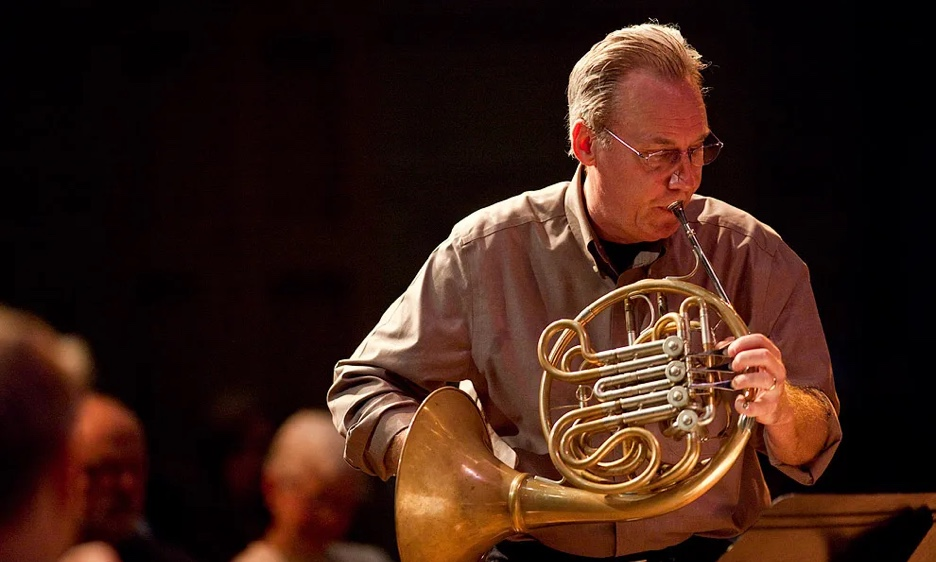
Courtesy EyeShotJazz
...the Alphorn is a little like a long wooden straightened-out French horn, from the Swiss mountains, with a very haunting sound. Imagine four improvisers on them!
When I mentioned to a friend and fellow jazz fan that I had an upcoming opportunity to interview Tom Varner, I was met by his momentarily puzzled expression which suddenly gave way to a pleased recognition and an enthusiastic... Oh yeah! That French horny guy! Well... not exactly.
Despite the slip of his tongue, I probably shouldn't have been too surprised by his reaction. Although French hornist Tom Varner has released seven recordings of his own compositions (from 1981—Tom Varner Quartet—to 1997—Martian Heartache—(both on Soul Note)), and while his evocative, warm playing has enhanced the recordings of Steve Lacy, Bobby Previte, and John Zorn (and that of many others), and despite (or maybe because of ?) winning polls in both DownBeat and JazzTimes, he's probably best known as a jazz musician who plays an 'oddball instrument.
Not that Tom Varner would have a problem with that. It's simply the price of perseverance, the payment for striving with, sticking to, and succeeding at, the establishment of a distinctive musical personality as both an instrumentalist and as a composer for that instrument. Or as Varner told interviewer Frank Tafuri: It's a little perverse. It's like 'Okay, what am I gonna do? I'll pick the hardest instrument you can possibly play. Then I'm gonna play jazz on it. Then I'm gonna play my own music that some people call avant-garde jazz on it.' How else could I have set myself up for hardship ... and still done okay?'
Tom Varner's eighth recording as a leader, The Window Up Above: American Songs 1770-1998 (released by New World), does quite a bit more than okay. The Window Up Above is no less distinctive than his previous recordings but does represent a significant departure in that he composes only one track. As the title suggests, the project presents a unique survey of the American songbook. The tunes selected include both well-known ones and obscurities and are selected from a diverse origins: the Revolutionary War, the Civil War, church hymnals, and compositions from George Gershwin, Duke Ellington, Hank Williams, Tammy Wynette, and Bruce Springsteen. The results are truly memorable and inspirational. Whether tunes are presented in a straight fashion, or are reworked, they are consistently treated with respect, sensitivity, and honesty. Jazz, rock, folk, bluegrass, country and western fans should all find something to deeply enjoy on this disc.
To encapsulate, AAJ reviewer Joel Roberts writes: "One of the best and most ambitious albums to appear last year was Tom Varner's The Window Up Above, a wildly eclectic overview of the entire history of American music." While AAJ modern jazz editor Glenn Astarita writes: "The Window Up Above is classy and uplifting yet at times, sentimental. Tom Varner's approach is steadfast and unique as opposed to being derivative or corny. A simply beautiful recording which should appeal to jazz aficionados, children, or anyone who is willing to check out America's vast musical heritage. Highly Recommended."
All About Jazz eagerly seized the opportunity to speak with Tom Varner about The Window Up Above when he graciously consented to an interview. The interview was conducted via e-mail correspondence in late May 1999.
On The Window Up Above: American Songs 1770-1998
ALL ABOUT JAZZ: In describing this recording, you state: 'I wanted to do something different for this record. Instead of playing my own compositions, I wanted to simply explore a variety of songs that have an inner resonance, whether from family, religion, nation or culture. Would you please elaborate on the term 'inner resonance'? Is this intended to encompass both your own personal emotional and intellectual perspectives on these songs in addition to the potential emotional and intellectual reactions of the collective listening audience?TOM VARNER: Uh, yes. I simply wanted to get away, for this particular project, from my own writing and explore series of songs that have a deeper meaning for people—songs that might affect people in different ways, but still tap into a deeper "emotional memory pool," if you will. Each one had affected me in a profound way as well.
AAJ: In your interview with Frank Tafuri, you describe MARTIAN HEARTACHE as there was that feeling like no matter what you do, no matter what you say either you or everyone else is on a another planet. In this light, could The Window Up Above be understood as a deliberate attempt to establish a sense of normalcy or commonality? (i.e., an effort to put yourself and everyone else on the same planet?)
TV: Perhaps. "Martian" was definitely about alienation, and "Window" is definitely more about songs that link our various American cultures and traditions together—even songs ABOUT alienation!
AAJ: What would you hope that European, Asian, or African listeners would come away with after hearing this recording?
TV: Hopefully that they have heard some good music, whatever the source! Soulful, deep, passionate music, period.
AAJ: When preparing this project, how many songs did you consider for this recording?
TV: Let's see—about 25, and the final project ended up being 19 songs.
AAJ: Were there any songs that you knew simply had to be included? If so, which ones?
TV: Almost every one—each one had some special meaning to me. My Mom, who died in 1984, loved Mahalia Jackson, as I do today ('My God Is Real'). My entire family saw Eubie Blake around 1971 ('Memories of You'). Some of the music I found in my piano bench, music that had been my grandmother's ('Abide With Me,' 'Battle Cry of Freedom'). I saw Duke Ellington with my Mom and my piano teacher, Ms. Capitola Dickerson, in 1970 ('I Got It Bad'). Later, at my Mom's funeral, Ms. Dickerson sang "There Is A Balm In Gilead." My great-grandfather was a 17-year-old kid in the Civil War ('Lorena,' 'All Quiet on the Potomac'). The Springsteen tune, "With Every Wish," had meant a lot to me when I was dating the woman who became my wife.
AAJ: Were there any songs chosen in mind of particular individuals in your life? If so, would you please tell us who they are and what songs were chosen?
TV: I guess I answered that one too above.
AAJ: Are there any songs that you wish you could have included, but regrettably had to omit? If so, what songs weren't included?
TV: No—I was very happy with the final selection.
AAJ: Are any of these songs included as a result of your having heard them or learned how to play them at an early age? If so, which songs are these?
TV: I guess not—my Mom sang hymns (she grew up in rural Missouri) when I was little, but not the ones on the CD—maybe that will be for another project!
AAJ: What special qualities or exclusive characteristics did each musician bring to the project? (i.e., how and why did you select these particular musicians?)
TV: I knew Pete McCann would do a great job as guitarist—his mix of jazz, country, and free playing was perfect.
Mark Feldman has country experience as well as EVERY other kind—he's incredible. Steve Alcott has played with Jo Jones and Vic Dickensen at Jimmy Ryan's as well as country gigs. Dave Ballou, George Schuller, Lindsey Horner—all great jazz players, but sensitive and can play free too. And Thirsty Dave Hansen had exactly the voice that I wanted for this project.
AAJ: 'The Best Thing—is the only composition of yours to be included. Would you please tell us more about this track?
TV: It felt right to include it with the others, a single original with the rest of the American songs. I wrote it for my wife Terri—pretty mushy, eh? Only time I've ever done that.
On work as a sideman
AAJ: Which performances or recordings have been the most fun, most enjoyable, or most memorable? Which have been the most demanding? From which have you learned the most as a musician or composer? What is it you've learned from the above?TV: Bobby Previte's quintet in the mid-late-80's was fun and I learned a lot. Steve Lacy's octet project "Vespers." The George Gruntz Big Band. John Zorn's Cobra in the early 80's. The East Down Septet. Urs Blochlinger. Franz Koglmann. And currently, the Neal Kirkwood Octet, The Mingus Orchestra (Tuesdays at Birdland) and Swiss trumpeter Peter Scharli's Special Sextet with Glen Ferris. Learned to respect others, give it your absolute best, let it go when it's over, and still be open to anything new (I know, all dumb cliches, but still true).
AAJ: how did you become involved with the recent Orange Then Blue recording, HOLD THE ELEVATOR?
TV: I've known leader George Schuller since 1977, and I've played in OTB since around 1993. A wonderful, fun band.
On live performance
AAJ: What is your favorite venue to play in? What is the worst place you've ever performed in?TV: Hard to say—if one feels respected and the music is good, the place is good. Depends on attitude—of self and of the place.
On recognition
AAJ: What significance or meaning is there for you in receiving awards or in winning readers polls?
TV: Makes me feel great—for about one day. Then it's back to work.
Miscellaneous
AAJ: Are there any plans to release the soundtrack to Saints and Sinners?TV: Not at the moment—but the film is sometimes played on cable. Maybe someday a re-working of the music would be a special project.
AAJ: Would you please elaborate on the following recent and upcoming projects: a) Hornithology (with Vincent Chancey and John Clark)
TV: A three-French horn and bass and drums project—we'd like to pursue it further—it's very different to play with other French horns—very rich and dark sound.
AAJ: b) IHS Workshop
TV: International Horn Society—I was just down in Athens, Georgia, playing for 200 classical hornists!
AAJ: c) Improvising Alphorn Ensemble (with Hans Kennel, Arkady Shilkloper, and Ray Anderson)
TV: This August I play with Swiss trumpeter Hans Kennel in a special project—the Alphorn is a little like a long wooden straightened-out French horn, from the Swiss mountains, with a very haunting sound. Imagine four improvisers on them!
AAJ: what other projects or recordings can AAJ listeners hope for from you in 1999-2000?
TV: I'm recording for my next CD of original music in two weeks—a new band with Steve Wilson, alto sax, Tony Malaby, tenor sax, Cameron Brown, bass, and Tom Rainey, drums. Special guests will be Mark Feldman, violin, Dave Ballou, trumpet, and Pete McCann, guitar. A whole new batch of passionate, crazy, swinging, brainy, quirky, soulful, beautiful Tom Varner music. All the best to my friends out there in cyber-land, and please visit my web site at tomvarnermusic.com.
 FOLLOW AAJ Staff
and get notified whenever AAJ Staff has a new article published.
FOLLOW AAJ Staff
and get notified whenever AAJ Staff has a new article published.
Various staff members.
About Tom Varner

Tags
PREVIOUS / NEXT

Become a Sustaining Member

Since 1995, All About Jazz has championed jazz as an art form and supported the musicians who create it. Over three decades, it has grown into one of the world's leading jazz resources, serving hundreds of thousands of readers, musicians, presenters and industry professionals each month.
Help Build the Future of All About Jazz
Your support helps us continue building All About Jazz for the next generation—expanding our editorial coverage, preserving jazz history, developing new community features and creating better ways to discover the music and the people behind it.
Become a sustaining member for as little as $20 per year and you'll immediately enjoy an ad-free experience along with access to subscriber features and future articles for a full year.
Together, we're not simply sustaining All About Jazz—we're building its future. Thank you for being part of the journey.